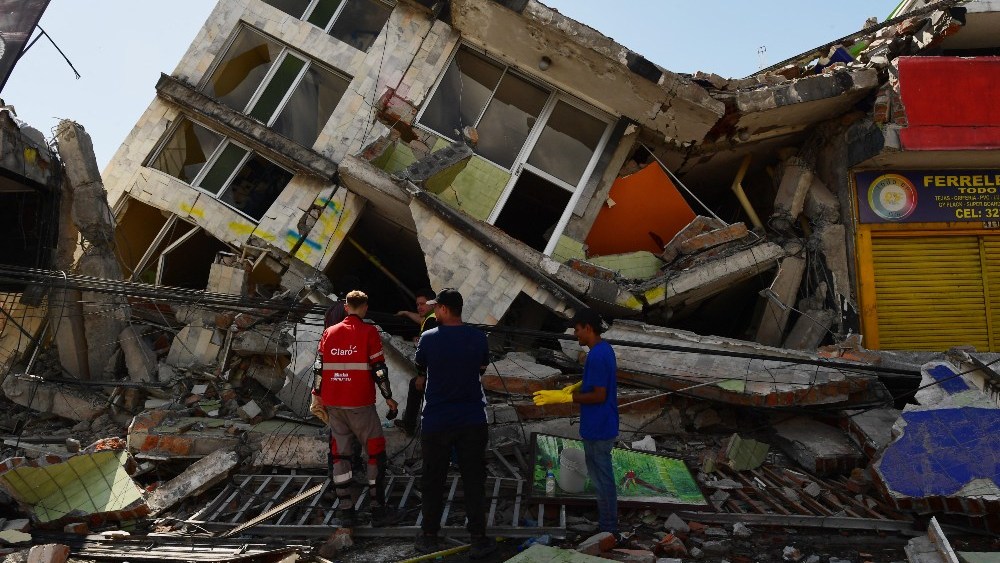
Colombian exhibitors at the Sourcing at Magic trade show in Las Vegas this week came with the intention of gaining a greater foothold in the American market. But on the first day of the trade show, a devastating 7.4-magnitude earthquake struck the country’s western region.
As reports from officials continued to come in, the death toll rose to above 200. Colombia’s government declared a national disaster, and world leaders from the United States, Mexico and across Latin America mobilized assistance.
Shaken by the news, many Colombian exhibitors appeared to be monitoring the situation, with concerns about family, friends and employees clearly top of mind.
“Three cities that are well known for having suppliers for textiles and apparel were affected. Those were Cali, Pereira and Manizales—the coffee region. Sadly, this is something that nobody could prepare for,” Sebastian Echavarria, textiles and apparel sourcing representative at ProColombia, an arm of the government’s export agency, told Sourcing Journal.
“We had a tragedy in our country. It’s very sad for us and for me, being so far away, seeing all the images of my place, the airport, the buildings all over my zone destroyed,” said Jose Fernando Giraldo Ospina, general manager for Ferditex, a family-owned, full-package manufacturer of activewear, loungewear, pajamas and casual apparel.
Launched in Manzinales in 2001, the firm has been doing business in the U.S. since 2012, when the free trade agreement between the two countries was signed.
“We have been exporting to different states in the U.S. like Florida, California, New York and Atlanta [Georgia] as well. We came here to this show willing to have some new opportunities, new clients,” Ospina said. “We came here with the illusion of having new business, new projects for our community, our country. But we contrast with this reality right now.”
On Tuesday, Ferditex teams were called off work while damage was assessed, giving them a chance to check on their own loved ones. “Fortunately, everybody was okay, safe,” Ospina added. “We had a chance to evaluate the infrastructure of our warehouse,” a 6,000-square-foot space, as well as its factory which employs about 200 people, he said. They will return to work this week.
Miriam Obando Botero, senior international account manager of Medellin-based knit and seamless manufacturer Crystal, said the company’s textile mill, spinning mill and cut-and-sew operations are located throughout Colombia.
The earthquake impacted one of its sewing factories in the coastal region of Choco, “and then we have our operation in Pereira, which is the city that got hit the most,” she said. “We’re very fortunate because everyone was evacuated on time, so no injuries to the people, which is the most important.”
The building in Pereira is being checked for damage, though Botero said as of Tuesday there was “no water, no energy in the city.”
“I would guess it will be two weeks until we can start again, depending on the findings on the building. It was hit hard—something that we never expected to happen,” she said. Clients have been supportive, reaching out to offer condolences and concern. “They know and understand, so hopefully, we will get out of this together,” she added.

The natural disaster comes in the wake of a man-made conundrum for Colombian suppliers—the imposition of 12.5 percent duties by the Trump administration under Section 301 of the Trade Act of 1974. The tariffs replaced global 10 percent duties that expired on July 24.
Asked about the state of business in recent months, Botero told Sourcing Journal, “It hasn’t been good.”
“One of the competitive reasons we were competitive is because we were duty free—that was what made us attractive [against] the rest of the world, because we will never compete with Asia. Their labor is really low and they are cost driven,” she said. “This 10 percent tariff and now 12.5 percent tariff is terrible for us—it has impacted the business, the volume.”
Botero said clients remained steadfast in their devotion to Crystal and Colombia when the 10 percent duties, levied under Section 122 of the same trade statute, were imposed in February to replace Trump’s “reciprocal” duties.
“The clients were supportive as the tariff was given to everyone,” she said. But the Section 301 investigation targeted 60 countries with double-digit duties, placing them at a particular disadvantage to their global peers, she believes.
About 70 percent of Crystal’s business services its own private label brands, which are sold domestically, while 30 percent of volume is exported to the U.S. and Canada, with the lion’s share going to the U.S. The vertical manufacturer has been looking to up its sales to American brands (and those that sell heavily into the U.S. market), with current clients including Alo Yoga and Lululemon.
“One offering right now that really helps us is, for example, is with cotton—we are fully traceable back to the farm. That is really attractive for the brands, and that’s something that we can offer that not everyone can offer. We can work on [digital product] passports, being fully transparent,” she said.
While Crystal’s booth was buzzing with buyers asking questions about order minimums, Botero said the current trade policy challenges have made it hard to secure new contracts—and the terms aren’t always favorable to suppliers.
“If you want the business, we have to share [the tariffs], or some will say, ‘You absorb it,’” she said. A fresh wound, the Section 301 duties are still under discussion with current clients, too. “Customers won’t leave because of this, but it hits new opportunities. It hits the volume and the ability to grow the business.”
Asked whether clients have raised prices to offset tariff costs, Botero said, “There are brands that can do it. It’s not the ideal, but I do know that with the tariffs, at the end, who paid was the consumer, because some price was reflected at retail.”
Brands like Alo and Lululemon have also leaned into expansion into the European market as a means of avoiding the fray entirely, she said. Crystal has been shipping more goods to the companies’ stores overseas.
Then, there’s the looming issue of another round of Section 301 duties due to be announced any day now. If the Trump administration raises tariffs again upon the conclusion of that investigation, “We are out” of the American market, Botero said. “For the hemisphere, for us, where our labor is more expensive than Asia, it’s a killer.”
Ospina expressed similar concerns about the imposition of even more duties and the dimming of prospects for Colombian suppliers. Nonetheless, he flew to Las Vegas with conviction about securing new leads.
“We decided to go [to Sourcing at Magic] because I believe the U.S. market is the biggest market in the world, and we are very close,” he said. “Potentially, someday, these tariffs will be taken out, so at this time, we are trying to save our business and make relationships for the long term.”
He still sees potential, he said, because of sourcing shifts that started to take place post-pandemic. “Some brands are coming from Asia to manufacture in the Americas. Me personally, I had to open a new business in the U.S. so it would be easier for me and for my clients to have negotiations with local companies,” he said. “There has been more interest for American brands to manufacture on this side, in this part of the world.”
It’s true, Echavarria said, as the U.S. market has come to represent the largest single market for Colombian textiles and apparel, taking in 41 percent of the industry’s exports. Last year, $265 million in fashion products made their way from Colombia to the U.S. Mexico and Ecuador are the next biggest trading partners, with 3 percent growth in collective exports in 2025.
With more than 10,000 mostly small businesses making up the sector, the ProColombia rep said, “It’s industry that creates a lot of jobs that impact small communities, including indigenous communities with women heads of households.”
Echavarria is more optimistic about the sector’s future now that a new political regime has taken over. On Aug. 7, Abelardo De La Espriella, a conservative, was sworn in as Colombia’s president, replacing left-leaning former President Gustavo Petro.
“Compared to the past government, this one is very aligned with U.S. policy,” he said. In recent weeks, Colombian trade officials have had bilateral meetings with Secretary of State Marco Rubio, and talks are expected to continue this month. “We know that in a few days, [the Ministry of Commerce] of Colombia will have a meeting with the U.S. government, and we’re aiming and hoping that we can go back to zero tariffs again due to the good relationship,” he added.
Colombia has also been challenged by some depreciation in currency value relative to the U.S. dollar.
“Our strategy now is being more competitive in niche products and categories with added value; we’re definitely not for basics,” Echavarria said.
The country’s apparel sector is largely known for its prowess in three categories: activewear featuring high-performance fabrics, swimwear with premium trims and finishes, and shapewear and lingerie. “Shapewear is a very niche product in Colombia and is world known because of the high compression,” he added. “We’re offering more flexible units for clients looking for prints, for high performance fabrics, for embroideries.”
Deepening its expertise in these areas while also providing faster turn times than offshore players may be Colombia’s strategic advantage.
“In the past, we used to benchmark ourselves with Asia. But nowadays, it’s been a while since nearshoring became more popular, and we compare ourselves with Peru, Mexico and Central America,” Echavarria said. Notably, however, those countries have duty-free access to the U.S. market under free trade agreements, “So there’s other countries in this hemisphere that have a better situation compared to us.”
Nonetheless, he’s hopeful that the continued appetite for nearshoring and “friendshoring” will lead to better trade terms for Colombia’s suppliers, especially now that there’s greater political alignment with the U.S.
“Of course there’s challenges, but I think that every time that there’s challenges, we are a very resilient country,” he said. “Our people have to look forward to the future and focus our efforts on what we can do.”