
Is compromise underrated in the fashion business?
Andrea Guerra, chief executive officer of Prada Group, certainly thinks so, even if he works in an environment of frequent confrontation, not the least with Patrizio Bertelli and Miuccia Prada, the famously strong-willed husband-and-wife leaders of the Italian fashion company.
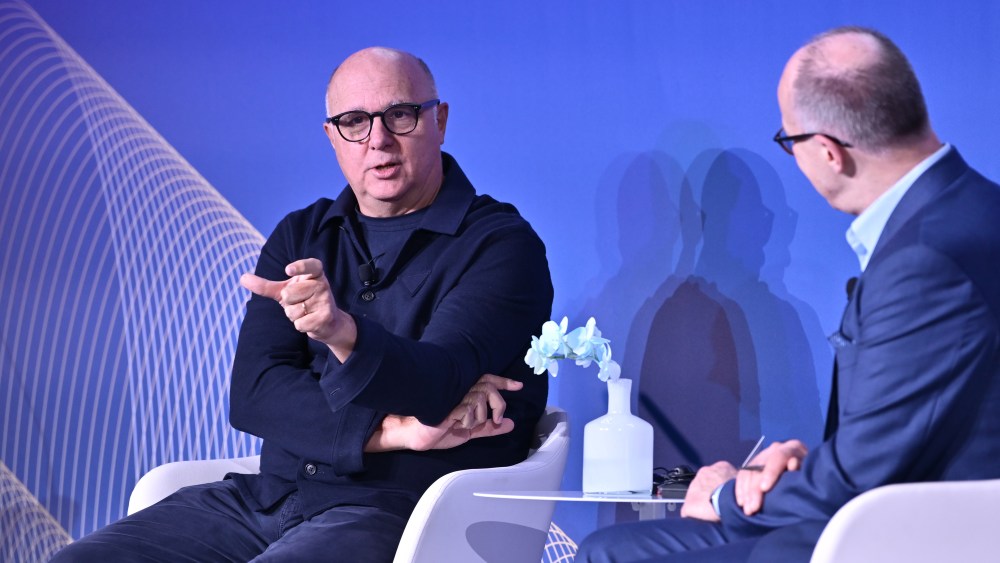
“Compromise to me is one of the most neglected words of the cultural vocabulary,” Guerra related during a fireside chat with James Fallon, chief content officer at Fairchild Media Group, parent of WWD. “Compromise is generosity. Compromise allows everyone to have a positive contribution to something, and at the end, you are able to find a common ground. It’s a positive word. It’s not a negative word.”
Guerra, who worked at LVMH Moët Hennessy Louis Vuitton, Eataly, Luxottica Group, Marriott International and Merloni Elettrodomestici before joining Prada in 2023, said he thrives on working with first-generation founders.
“I love the idea to have this personal commitment by people who have the courage, the ideas, the fantasy to create it,” he said, speaking at the WWD x SKP Global Fashion & Beauty Summit in Wuhan, China. “And then on the other side, the question of moving on, and it’s never revolution. Don’t think that there can be revolutions in this kind of organization, but it’s a constant evolution.”
Indeed, he stressed that brand DNA evolves slowly, and “if you punch it,” results are unlikely to be lasting.
The executive said he feels at home in China, and is sanguine about its long-term prospects.
He related that he came to Beijing for a summer at age 16, since his best friend’s father was opening a branch of an Italian bank there. And he marveled at nearly two decades of uninterrupted growth for European luxury firms who had the foresight to arrive early.
“Now there’s a little bit of a consolidation, a little bit of a digestion, but the clients are still always there,” he said. “So it’s a question of linking to clients properly, to younger, to older, to more affluent, to less affluent.…Change is normal.”
Echoing other speakers at the one-day forum, Guerra called for a reset in the sector.
“We have to go back to what old luxury was. You need to be authentic. You need to be credible. You need to tell a story that allows people to dream. If we’re not able to do this, let’s go do something else,” he said. “And if you don’t have a background, if you don’t have a skill, if you don’t have roots, there is nothing you can tell to your clients.”
He noted that some objects created by Miuccia Prada’s grandfather Mario Prada, who founded his company in 2013 specializing in travel bags and trunks, oozed what is today characterized as Prada-ness.
“From Day One you understand that there is a constant debate, that there is a constant conversation. Sometimes in the same object you could feel that there is a kind of contrast,” Guerra said.
He predicted that the luxury goods market, aided by technology and especially AI, will become hyper-personalized, allowing brands to conduct one-to-one conversations with clients rather than targeting a category, a cluster or everybody.
For example, if Prada knows a specific client is an “unbelievable lover” of a specific kind of shoes, it can reach out when a style in a similar vein comes on the market.
But keeping a brand vibrant and relevant, IRL storytelling and experiences have become more and more elaborate, reaching a zenith with the Prada Galleria complex the brand unveiled during Milan Fashion Week last September. It fuses retail, hospitality, art, heritage and innovation across eight floors set in the historic shopping arcade Galleria Vittorio Emanuele II.
“Normally, I’m a very humble guy, but I’m so proud of this project. This project represents our skill, our heart, our roots. This project is allowing Prada lovers, and Prada newcomers, to understand who we are. We’re not a logo. We’re not a sign. We are a DNA. We are a living DNA that has grown from day number one in culture, art, architecture,” he said. “I would love all of you to go because I think it’s a cultural journey in fashion.”
He also trumpeted the Prada Rong Zhai epicenter in Shanghai set within a restored 17th-century palace that contains a restaurant created by Miuccia Prada and filmmaker Wong Kar Wei, gallery spaces, a garden, and private salons where VICs can hang out, and buy “exceptional and unique things.”
“If you ask me, ‘Andrea, do you prefer to sell or so you prefer people to come back?’ I prefer people to come back,” he said. “These are places where you can spend your time. These are places where you really understand, and we will have 10 or 15 of these places around the world, while Milan will always remain the epicenter of the epicenters.”
Guerra noted that Prada’s vast cultural tentacles are never achieved via sponsorship.
“Either we do things or we don’t do things. So if you think of Linea Rossa in the America’s Cup (sailing race), that’s not sponsorship. It’s part of our group, so that is a huge connection through sports,” he said. “On the other side, [there is] the fact that we created 26 years ago an art foundation where we are doing our own exhibitions with artists.”
Prada Group’s latest big move was acquiring Versace and poaching Alaïa’s star designer Pieter Mulier as chief creative officer, setting the stage for one of the hottest debuts in early 2027.
“Versace is one of the greatest brands. If we think about fashion as it is today, Versace was at the base of the glamour, the music, the supermodels,” he said. “How to make it sexy in 2027? This is the challenge we have, and it’s hard. It’s in a different world from us.”
That being said, “we don’t want to become a group of brands. We were not looking for a Versace.”


