When the Business and Human Rights Centre queried 25 of the U.S. market’s biggest fashion companies—including Gap Inc., H&M Group, Nike and Zara owner Inditex—about labor impacts from President Donald Trump’s erratic tariff rollout, not a single brand responded, not even to decline.
This was a first for the organization, said Mayisha Begum, BHRC’s labor program officer.
A year after “Liberation Day” hit partner nations with 10-50 percent additional levies, driving brands to decamp to cheaper locales or demand price cuts so steep that suppliers could only meet them by slashing wages, a black hole of information has made it difficult to assess the extent of the damage to garment workers‘ livelihoods.
While brands wielded similar contractual clout during Covid-19 to axe mid-production orders and impose discounts on shipments already en route, today’s lack of transparency is harder to penetrate, Begum said.
“During Covid, there was more visibility into where orders were being canceled and shifted, which allowed organizations to go to brands and demand better practices,” she said. “Now, campaigners and organizations don’t have that data. We don’t know how bad things are because we’re working with what we can find through the media and unions.”
Washington’s legal scramble has only added to the fog. After the Supreme Court struck down Trump’s use of emergency economic powers in February, the administration moved swiftly to impose a 10 percent “stopgap” tariff under Section 122 of the 1974 Trade Act. But with those levies set to expire before the end of July, the White House has doubled down, launching sweeping Section 301 investigations into manufacturing overcapacity and forced labor—the public hearings for which begin this week—that would rebuild the previous regime.
All of this has only deepened the ambiguity as brands remain loath to commit to long-term contracts, creating an “ongoing trend not so much of cancellations, but of reduced orders, paused orders and no guarantee for the future,” Begum said.
This wait-and-see approach has led to a drumbeat of bad news: In Sri Lanka, worker groups reported factories scrapping night shifts and overtime as orders dried up. In India, workers described being forced into excessive overtime to rush final orders before additional tariffs kicked in, then getting laid off anyway. In Bangladesh, suppliers said brands ordered them to bear tariff-related costs or risk losing their business altogether. In Cambodia, worker groups spoke of furloughs, cut shifts and job losses.
“Brands need to be transparent in terms of what they’re planning and their commitment to purchasing practices,” said Tharo Khun, program manager for the Center of Alliance of Labor and Human Rights in Cambodia. “So far, we have not seen that in place. We need transparency and we need engagement with unions and stakeholders in discussions.”
Compounding the crisis, key trade preferences—the African Growth and Opportunity Act and Haiti’s HELP/HOPE Acts—expired in September 2025.
For the tiny southern African nation of Lesotho, which received an initial 50 percent tariff rate—the highest on any country—this delivered a double blow that prompted U.S. buyers to slam the brakes on orders almost instantly. Within three months, an estimated 5,000 workers at various factories were placed on furlough. When the rate dropped to 15 percent last August, the damage was already done. Even AGOA’s retroactive one-year extension this February made little difference.
“By the time buyers place orders and they’re ready to ship, the year will already have ended,” said Lieketseng Leteka, an advocate and legal representative from the Independent Democratic Union of Lesotho, an affiliate of IndustriALL Global Union. “There’s no guarantee AGOA will be renewed again. So we are still facing a crisis of workers being retrenched and companies closing down because of a lack of commitment from the U.S. administration.”
She rattled off the numbers: Quantum Apparel, which sells to Walmart, has shed more than 50 percent of its workforce. Hippo Knitting, which produces for Fabletics, laid off 1,200 to 1,400 workers. Maseru E-Textiles, which manufactures for Perry Ellis, placed 1,000 workers on unpaid leave before permanently parting with 200 employees. Precious Garments, which supplies to Reebok, let go all 4,000 of its workers. Costco and JCPenney supplier TZICC Clothing Manufacturers closed, eliminating 700 jobs. Tai Yuan Garments, a Levi Strauss & Co. manufacturer, also shuttered, cutting 1,500 more.
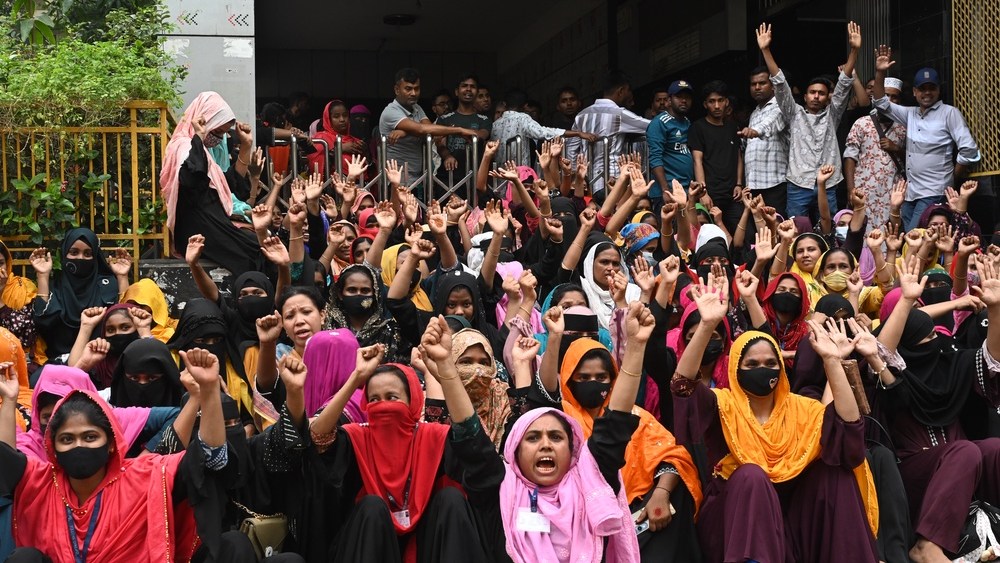
Every morning, growing crowds press up against the gates of surviving factories, hoping to be called in for a shift.
Without urgent intervention, up to 40,000 jobs could be on the chopping block, Leteka said. In a country where the textile sector is its largest private employer, especially of women, few employment alternatives exist. Some workers may turn to informal jobs like laundry or street vending; others might take their chances in the mines in South Africa or resort to sex work to survive.
“Some of these factories, when they disappear, they just disappear with their money,” she said. “They don’t even give workers severance payments, because they don’t have them.”
Brands have claimed in the past, as they likely would now, that they have no choice but to protect their bottom lines, yet it’s clear that human rights remain an “afterthought” to commercial decisions, said Anithra Varia, interim project manager of labor rights at the BHRC.
“We’ve seen this happen with every single crisis, from economic to climate,” she said. “It’s almost being positioned as something that they have no control over. But we can very clearly see that there’s a fair bit of control that does go into how they manage their purchasing practices.”
H&M Group, the only brand that spoke to Sourcing Journal on record, described pragmatic constraints.
“For us, it is important that we make the best decisions for our customers and our business by following our business concept of always offering customers the best combination of fashion, quality, price and sustainability in all markets, while ensuring that we are profitable,” a spokesperson said.
Even so, how brands respond to disruption matters, Varia said. In a system of massive power imbalances, responsible companies must bridge the gap by maintaining agreed prices and terms, honoring existing orders, and working with suppliers and workers to safeguard wages, benefits and severance payments. In short, sourcing decisions and their labor impacts must be monitored as a unit, not managed in isolation.
The BHRC is also tracking the Iran-Israel-U.S. conflict, where Varia’s prescription could face its ultimate stress test as the Strait of Hormuz’s continued closure has sent oil prices breaching $115 per barrel, driving up transport and food prices for workers who cannot absorb any further squeeze.
As it stands, 78 percent of Bangladesh’s 4.1 million garment workers cannot provide enough food for their families, and 32 percent earn below the minimum wage, according to a joint study that the Bangladesh Labour Foundation and the Rights Lab at the University of Nottingham published last October.
Mounting raw material and transport costs aside, load shedding due to gas and electricity shortages has driven a 25-30 percent decline in garment manufacturing, per the Bangladesh Garment Manufacturers and Exporters Association. Coupled with political turmoil and allegations of systemic corruption in the power sector following the 2024 ouster of Bangladesh’s prime minister, nearly 400 garment factories have shuttered over the past three years, with “many more at risk” as business costs outstrip shrinking margins, the trade group warned this week.
“Bangladesh is the least developed in terms of renewable energy,” said Mohiuddin Rubel, a former BGMEA director. “To overcome this situation and meet future compliance standards, such as those in the European Union, we must secure funding for a strong renewable energy foundation immediately.”
The International Apparel Federation, whose membership includes national clothing associations, echoed this alarm in a March statement, cautioning that while the “first reflex for many buyers is to push costs and risks upstream into the supply chain,” the “ability of manufacturers to absorb rising costs is not limitless.”
“Set, as it is, in the world’s biggest oil- and gas-producing region, this particular crisis starkly illustrates the industry’s continued dependence on fossil fuels,” it said. “The days that a shift to an energy mix with more renewable energy sources was viewed only as an environmental concern are now behind us. Investments in renewable energy are a shared strategic priority for apparel brands, retailers, apparel and textile manufacturers and governments alike.”
While there are pockets of progress, such as the Future Supplier Initiative, a collective finance model launched with H&M Group, Bestseller, Gap Inc., and Mango to try and de-risk the green transition, those efforts currently reach only a fraction of the Tier 1 supply chain, leaving the majority of the industry exposed to the immediate volatility.
Any so-called “future proofing” feels distant in countries like Cambodia, where increasing logistics costs have hiked the price of raw materials and garment workers have gone on strike to demand bigger transportation and meal allowances, winning a temporary monthly fuel subsidy of $2.50 beginning April.
More outward ripples are forming: Sri Lanka has declared every Wednesday a holiday for public institutions, schools and universities to manage fuel shortages and cut energy consumption. Thai workers have demanded that their government address the impact of fuel price increases on their cost-of-living crisis. Workers in India’s textile hub of Surat are returning home after an LPG crisis linked to the Iran blockade left households without cooking gas for days, potentially hollowing out production capacity as peak season approaches.
Sri Lanka’s fuel crunch is the “single biggest issue” that couldn’t have come at a worse time, said Yohan Lawrence, secretary general of the Joint Apparel Association Forum.
“There’s been some issues with the quality of coal that we imported, which means that we’re burning more fuel to compensate for the loss,” he said. “It’s also literally the hottest time of the year, so energy consumption is really high. And also the driest time of the year, so we’re having potential issues with water.”
The vulnerability is especially acute for people living on the margin, said Anna Bryher, policy lead at Labour Behind the Label, a U.K.-based workers’ rights group. It’s why a living wage is “so crucial” for supply chain resilience, “especially where the intersection of the climate crisis, global conflict and resource wars meet,” she said.
“These supply chain shocks keep revealing the vulnerability of the system,” Bryher added. “While brands and suppliers weather the shocks, their impact on the workers is long-lasting and severe.”
The name of BHRC’s data portal, “Who Pays for the Crisis,” is almost rhetorical. Garment workers have faced “crisis after crisis after crisis,” yet few are willing to step up, Begum said.
“We heard from a supplier who said, ‘We understand that the brands haven’t caused this, but we haven’t caused this either. Why are we the ones having to pay for this?’” she said. “In this power hierarchy where brands have obviously significantly more power, significantly more wealth, and can help to absorb the cost, the element of uncertainty around orders is just exacerbated by the lack of communication.”
She paused, before adding: “There needs to be communication.”