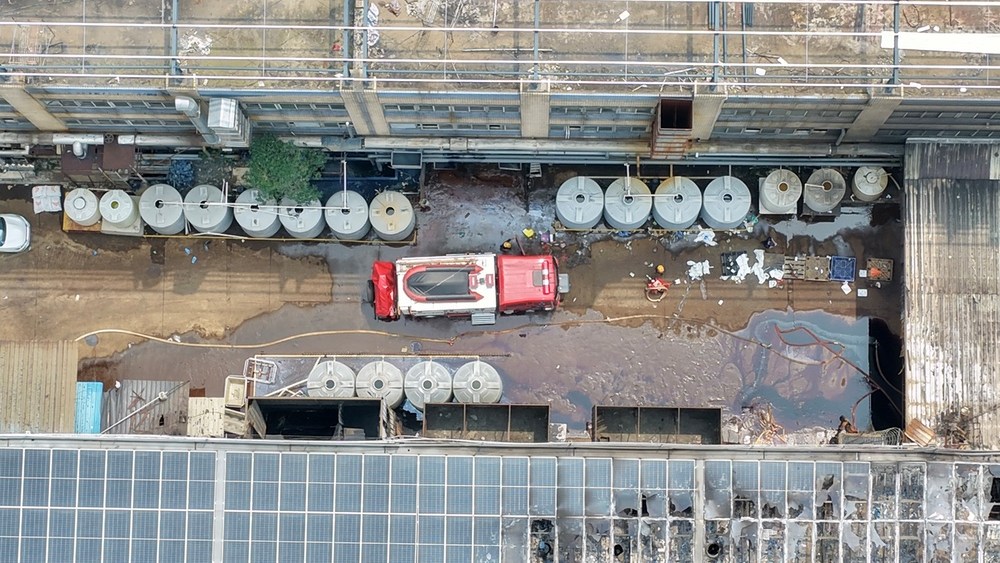
A fire that broke out at an unnamed textile factory in southern China on Sunday killed eight people and injured one, state media reported this week. The two-story building in the city of Foshan, in Guangdong Province’s Shunde District, was used for denim washing and related production, according to reports.
The cause of the fire, which firefighters extinguished in just over an hour, is still under investigation, Xinhua News Agency said. A total of 63 people at the scene and in surrounding areas were rescued or evacuated, according to China Central Television, which identified the site as the Changxing Industrial Park in Jun’an Township. The flames did not spread beyond the site, it said.
The Foshan blaze came amid two separate Sept. 20 incidents at garment factories in Ashulia in Bangladesh: a deadly gas-cylinder explosion and fire at the compound of Pretty Composite Textile Limited that killed at least nine workers and injured 35 others, and a smaller fire at Fahami Group Industry that triggered a stampede, killing one worker and injuring more than 100 others.
It also recalls a fire at Fujian Huiteng Shoes in southeastern China in July that killed 28 people, prompting President Xi Jinping to call for a swift investigation into the fire’s cause and for “those responsible” to be held accountable. In the immediate aftermath, Chinese authorities froze the company’s bank accounts and detained the factory owner and several managers pending the outcome of the safety investigation.
The three factory tragedies came two weeks after a record 300 global brands and retailers signed the legally binding International Accord for Health and Safety in the Textile and Garment Industry, the successor to the Accord for Fire and Building Safety in Bangladesh, which was formed after the Rana Plaza collapse in 2013. While the agreement’s country-specific safety programs currently operate only in Bangladesh and Pakistan under a core framework that automatically renews through 2029, it provides for expansion into other garment-producing countries.
Most of the global apparel supply chain remains unregulated and “grossly unsafe,” said Scott Nova, executive director of the Washington, D.C.-based labor watchdog Worker Rights Consortium. Even in Bangladesh, the Accord covers just 1,760 factories—about one-third of the country’s registered export-oriented garment factories—including Pretty Composite Textile Limited, where officials said an unauthorized fleet of CNG-cylinder-filled vans supplied gas for boiler operations, creating a setup that may have fallen outside ordinary factory inspections.
Fahami Industries, Nova said, was previously associated with an Accord signatory, but that buyer appears to have since stopped sourcing from the factory. As a result, Fahami Industries never underwent the Accord’s inspection and remediation program.
Its exclusion points to a systemic industry-wide problem: Despite the Accord’s progress in improving factory safety in Bangladesh and Pakistan, tens of thousands of facilities worldwide lack even basic safety coverage. Other workplace threats also need to be brought within its scope. One criticism from civil society groups, including Nova’s, is that it took years for the Accord to add boiler safety to its initial remit.
“The Accord is a safe zone in the industry because its obligations are binding on the brands and legally enforceable,” he said. “The question is why brands and retailers don’t expand the Accord across the globe and expand it to cover all safety hazards, including compressed gas.”