Textile trade shows and mill weeks are essential to the tactile nature of denim manufacturing. These events give designers the opportunity to experience fabrics firsthand, drawing inspiration from their texture, weight and hand feel, while mill representatives’ educate on new fiber innovations, fabric developments and sustainability initiatives. Together, they evaluate the best materials to meet the market’s demands.
But with so many new technologies and trends—not to mention thousands of blue fabrics—unveiled each season, the sheer volume of information can be as overwhelming as it is valuable.
“I watched every season play out the same way,” said Umer Farooq, the former head of marketing and sales EU at Neela Blue. “Buyers walked Kingpins, photographed 200 hang tags, and came back with nothing structured. Follow-ups went out three weeks late. Mills spent millions on sampling with zero visibility into what actually got selected.”
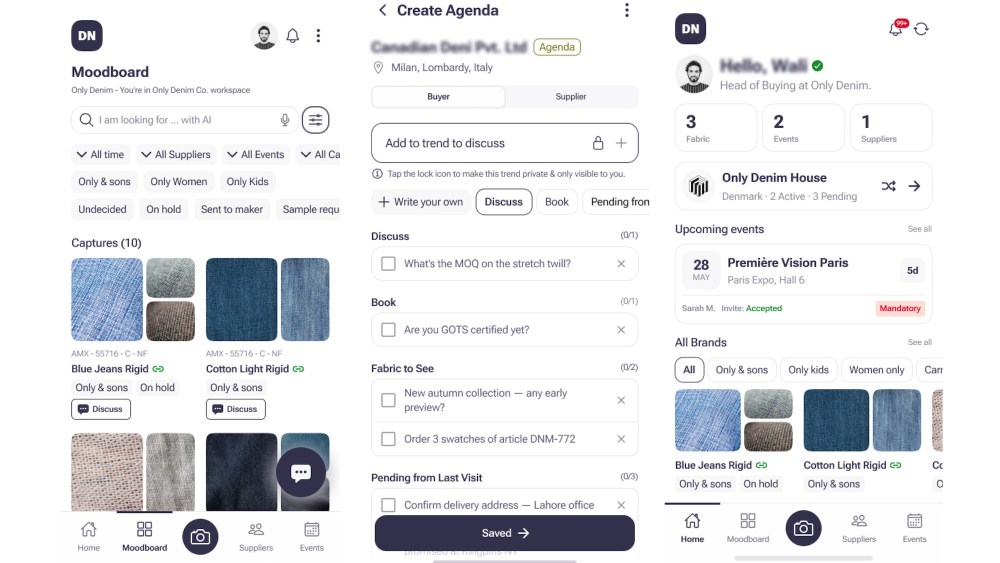
DenimNotes is Farooq’s solution for the industry-wide problem. The sales intelligence and supply chain platform eliminates the information overload in an organized way for both the buyer and the vendor. Instead of information “scattered around WhatsApp, emails, one-to-one chats and verbal conversations,” DenimNotes maintains a single thread of the communication between buyers, mills and garment makers, making it easier for each party to review and share conversations with other members of their team.
“The app is designed in such a way that if you are a salesperson for a fabric mill, you don’t have to wait for seven days to go back to your country and have a meeting with your product development or sales team to give them a brief,” Farooq said, adding that the app works offline to accommodate travel.
For buyers, key features include voice notes transcribed in real time, optical character recognition technology that reads the article number, composition, weight, and wash code from hang tag, and the ability to create mood boards and more. DenimNotes can also capture information during store visits such as trend details and fabric observations.
For mills, the platform logs article selections, price discussions and keeps track of what a client has sampled—costly investment by mills that is often overlooked by brands. “There is no accountability of how much sampling is happening for a brand, how much product is being developed for every season, for every buyer,” Farooq said. Without an organized system to know how much a mill has invested on a particular brand, there’s no way of knowing the return of their investment, he explained.
Farooq added how the platform fills a knowledge gap when long-time employees leave. “There’s often no institutional memory that exists either at the buyer or at the supplier side,” Farooq said. The new hire has no way to know what was discussed with a client six months ago, how many samples were developed for a particular buyer, or how many of those samples ultimately converted into SMS. DenimNotes makes the information accessible.
DenimNotes is resonating with the industry. In a testimonial, Lorenzo Peri, Guess denim product development manager, described it as a “tool I didn’t know I needed until I stopped using it for a week and felt the difference immediately.”
Kenneth Bennetzen, the strategic sourcing manager for Only, Bestseller’s fastest growing brand, highlighted how the platform supports transparency and traceability.
Danish Umer, the business head of Sapphire Fibers Limited’s denim garment division, said, “DenimNotes is the first tool that actually reflects how we work. I can track what we’ve selected from suppliers, monitor what customers have confirmed, and see our conversion rate from development to bulk—all in one place. For the first time, I can see exactly where we’re winning and where we’re losing.”
Farooq is in the process of onboarding brands and mills to the platform. Looking ahead, he envisions using AI to analyze fabrics based on the characteristics and parameters set by a brand, enabling the platform to instantly recommend the fits or styles best suited for a given fabric.
But he believes the DenimNotes’ greatest long-term value lies in its ability to drive efficiency across the supply chain—a benefit that extends beyond measurable cost savings. The larger goal, he said, is to give every stakeholder access to the insights they need to make better decisions. Mills can use feedback from brands to refine the fabrics that are resonating with consumers, while brands and garment makers can continuously improve product development based on real-time collaboration.
“If we are able to create a marketplace or a platform where everyone can collaborate, we can remove lot of inefficiencies in the system,” he said.