MILAN — China’s economy is slowing and as a result luxury firms are shuttering stores as consumers seek local luxury brands and the housing slowdown persists.
The latest report from Barclays said China looks less like an emerging engine of growth and more like a mature, highly selective region where those with clear positioning, disciplined execution and compelling local relevance are extending their lead. Top design and furnishing firms in Europe are happy to take that challenge.
Molteni&C, the flagship brand of the Molteni Group, one of Italy’s largest privately owned firms by revenue, recently opened a space in Hong Kong, situated between luxury shrines like Louis Vuitton and Chanel locations in the heart of the city. It also opened a 19,375-square-foot venue in Hangzhou, China, and in 2024, it opened its first Chinese flagship in Shanghai.
You May Also Like
“These spaces are so curated they rival what we achieve in Italy,” he said. The next stop in the near term for Molteni&C is Wuhan following a recently opened store in Chengdu.
“These partners are ready to invest in large, meticulously curated spaces, like the 3,500-square-meter flagship in Shanghai,” said Molteni Group’s chief executive officer Marco Piscitelli.

Versace Home, for example, currently has seven retail locations in China, comprising both monobrand stores in Shanghai, Hangzhou, Xi’an and, most recently, Shijiazhuang. Its licensee, Luxury Living Group, said that its plan is still to strengthen Versace Home’s presence, expanding with additional monobrand stores in key first-tier cities such as Beijing, Chengdu and Shenzhen, and introducing more multibrand locations in select second-tier cities.
In 2025, Cassina opened in Zhuhai, a city of 2.44 million inhabitants, and additional units are planned for 2025. Also in 2025, Minotti opened a flagship in Zhengzhou, in collaboration with local partner Xuanrong.

A New Beginning
Denmark-based design firm Gubi, which has been making contemporary furnishings and iconic re-edits since it was founded in 1967, is just getting started in China. Despite the hurdles, they are ready to play a long game.
“Having more local presence and being more accessible in the different markets — I think that’s what we have to do, not just us, but as businesses in general, to really ensure that we capture the momentum, but also that we follow the momentum,” the firm’s CEO Marie Kristine Schmidt pointed out, underscoring the need to be agile and build strategic anchors.
Gubi also established a team in China in 2021 and is slowly building its platform there.
“I think the misunderstanding is some think you can go in and out of China fast. It’s a long-term investment like any other market, honestly. And you need to establish a team, you need to build strong partnerships, you need to also see, for a brand like Gubi going in there, we had a brand awareness exercise to do as well,” she said.
Unlike Italian and French brands positioned in the luxury end of the market, Gubi also has the advantage of a more affordable price range, which is appealing to Chinese consumers.
“But we give a very good price-value offer, and I think that that has opened up an opportunity for a brand like ours in China,” she said.
The T3 chaise longe is priced at 1,900 euros and then the lounge chair is priced at 1,200 euros.
The Long Game
Another company placing big bets on China is luxury Italian linens firm Frette, which was bought by Raza Heritage Holdings in 2023 in a club deal that involved a consortium of private investors, including Chinese billionaire Ding Shizhong, chairman of Anta Sportswear, one of China’s largest sportswear-makers, and Hong Kong businesswoman Adrienne Marie Ma, the former president of Joyce Boutique Group Ltd.
Ma and Shizhong have a large network of contacts in Greater China and Hong Kong, exactly where Frette has begun to expand with directly operated stores.
Frette has continued to expand its retail presence in China over the past year, starting with a Shanghai Frette House in July 2025, followed by a pop-up store at Plaza 66 in November 2025. Most recently, the firm opened MixC store in Shenzhen in January.
Frette opened a flagship at Shanghai Plaza 66 in April 10, replacing a pop-up store at the same location, marking a transition from a temporary presence to a long-term retail destination.
“We are not just opening stores. Opening stores, it’s a given. It’s an investment that you have to make. Because it’s like a showcase, it’s like a billboard. But what we’re trying to do is to really connect the consumers in a less conventional way with cultures that we never did in the past, and really a one-to-one experience with the consumers,” Frette’s CEO Filippo Arnaboldi explained in light of the economic data.
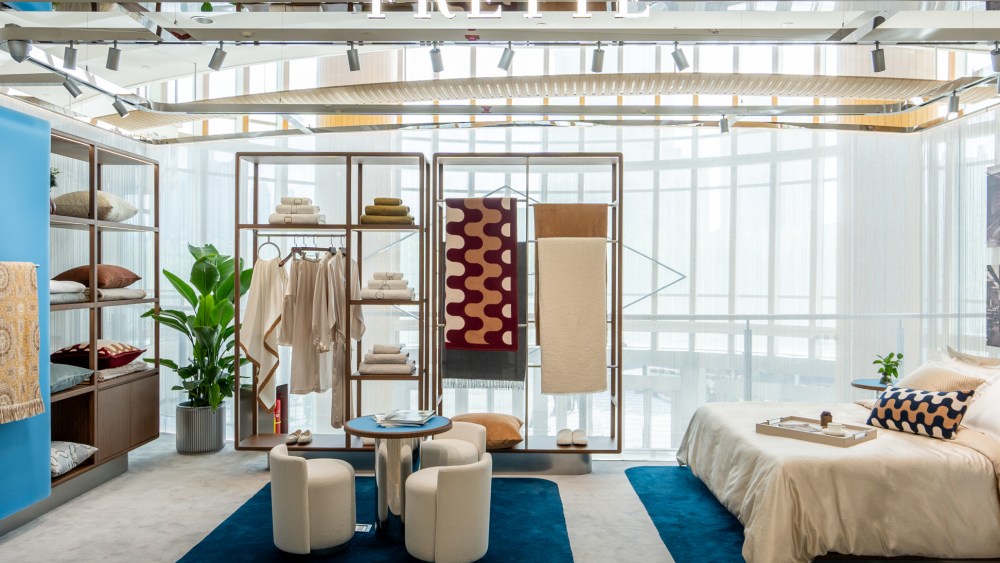
Arnaboldi added that the Frette House in Shanghai’s historic French Concession, located within Capella Shanghai, is a curated showroom designed to feel like a private home. The space, designed by Still Young, features luxurious bedding, loungewear and a textile library, emphasizing a refined, residential-style experience rather than a traditional retail store.
Barclays described China today as “structurally more selective, with growth driven less by macro expansion and more by market-share gains, execution and brand strength.”
In March, the government cut its annual economic growth target to a range of 4.5 to 5 percent, its lowest target since 1991.
In such an environment, double-digit market growth is unlikely to return in the medium term. Instead, relative winners will be those able to continuously refresh desire without overextending, the bank added.