Adidas CEO Bjørn Gulden knows what the company needs to move forward — more innovation, improved performance in the U.S. market and a tighter relationship with the consumer.
And the company is set up for success, Gulden said during the firm’s Q4 conference call. After a period of not being competitive, the new team that has been in place for about a year has been a “game changer” and they’ve “built a lot of new products. We have an innovation pipeline.”
For the fourth quarter, operating profit grew to 164 million euros, on sales that grew 11 percent to 6.08 billion euros. Shares of Adidas on Wednesday fell 4.7 percent in over-the-counter, mid-day trading to $82.50 as investors were disappointed in the brand’s 2026 outlook. The forecast for the year for operating profit was 2.3 billion euros, reflecting the impact from U.S. tariffs and negative exchange rate in the range of 400 million euros.
Addressing criticism from three years ago that Adidas didn’t have the right performance product, the CEO said the brand’s “product people, our development, design and innovation people are as good as anybody else, if not better.” And he said he’s “very happy with the pipeline of product that’s currently hitting the market.”
You May Also Like
So, what’s new?
Gulden highlighted innovations in foam, printed performance shoes, as well as heating and cooling technologies in apparel.
“We have quite some innovation when it gets to foam, when it gets to carbon, when it gets to how to treat it,” he said. “We are working a lot on additive or printed and we’re very, very close to actually launching performance shoes that are printed.”
Advancements in heating and cooling systems for apparel, as well as fit compression and “climate cool,” are also important to help Adidas athletes look good, feel good and perform well,” he noted.
He also said part of the strategic plan for growth is to strengthen the U.S. business, which grew 10 percent in 2025. Europe, another large market for the brand, also saw 10 percent growth last year. Elsewhere, Greater China was up 13 percent, and Japan and South Korea each grew 14 percent. He also said that Latin America “has been on fire for the last two years.”
Future growth will also mean fine-tuning brand positioning in the market place and one way to do that is keeping tabs with the consumer.
“We need to be closer to the consumer. And that means that the markets will have to take more responsibility in the decisions. Whatever we define a market to be, it can be a country or it can be a region,” he said.
Outside of geographic strategy, Gulden is eyeing a focus on local sports and smaller sports, “both to get credibility and visibility.” In the U.S., that could mean adding more college teams and more athletes. “I think it’s extremely cool to see that we [had] both teams in the NCAA (National Collegiate Athletic Association) final. You know, when Indiana [Hoosiers] beat Miami [Hurricanes], all the players in Adidas, that was a great feeling,” the CEO said, referring to the college football playoff on Jan. 19, 2026.
“But it wasn’t only there. You know, we also won the volleyball tournament. And we won the NCAA soccer. And again, this showcases again that our sports marketing people in the U.S. now have the freedom and the resources to do what is right for the American market,” he said.
Adidas last year added 90 net stores, opening 247 new locations and closing 158. He said the brand is also getting better at e-commerce. The current mix is 60 percent wholesale and 40 percent direct-to-consumer (DTC), with DTC reflecting 23 percent brick-and-mortar and 17 percent e-commerce. “We actually do believe that 60/40 is very healthy,” Gulden said.
Looking ahead, he said the upcoming Soccer World Cup should be a “positive” for the brand over the next few quarters in ’26, with most of the business in footwear at 58 percent. The brand opened its first U.S.-focused soccer store amid World Cup mania at the American Dream Mall in East Rutherford, N.J., last month.
Gulden also said Adidas is gaining momentum in footwear, with running at a lower base but accelerating in growth and growing 36 percent in the fourth quarter.
“I am very proud to say that Adidas is back again as a leader … We spent a lot of time establishing credibility again. Signing athletes [and] developing [the] best performance shoes that exist,” he said.
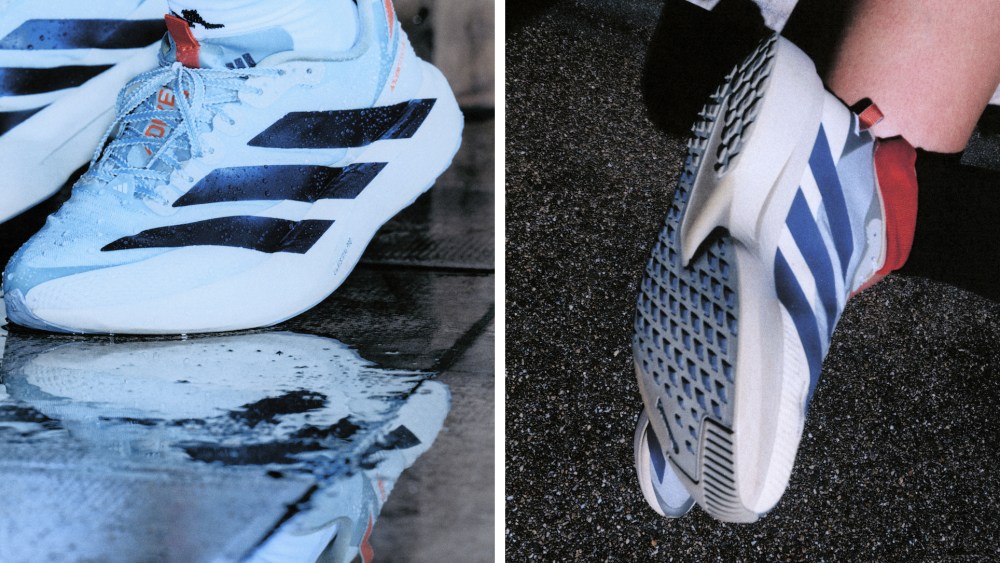
He spoke about showcasing product that’s winning in a lot of races, as well as taking running performance features and bringing it to the “normal runner,” citing the brand’s Evo SL lightweight trainer featuring the brand’s Lightstrike Pro foam midsole layer.
“The volume on the shoe is approaching 10 million pairs. So it’s been a very successful [and we have] gone further with the everyday runner,” he said, adding that Adidas also has plans to be more competitive in the comfort running category when it launches a Hyper Boost over the next “couple of weeks and months.” He described that as the “most comfortable foam” one can find in the industry.
And with more athletes participating in training across multiple disciplines that incorporate running and strength training, Gulden said Adidas has built a special product for hybrid training. In separate hybrid news, the brand is also working on dress shoe hybrids, such as the Adidas Samba Lux Freizeit, featuring thick outsole with lugs.
He cited basketball as another sport that grew for the brand in Q4, following the first three quarters of 2025 when it had a negative growth rate.
On top of those key strategies, Gulden also said the company will continue to be a good corporate citizen, not only for the planet but also for its 64,000 employees.
“We have a huge responsibility. I’m also proud of knowing that we now have 52 percent of our workforce being female to 48 percent male. Not because it’s a target, but actually it showcases the evolution of this business,” the CEO said. “And again, I think I can say that the female consumer is now more important than the male consumer.”
Gulden, who joined the company in January 2023, will continue in the CEO role through Dec. 31, 2030, via a contract extension.