
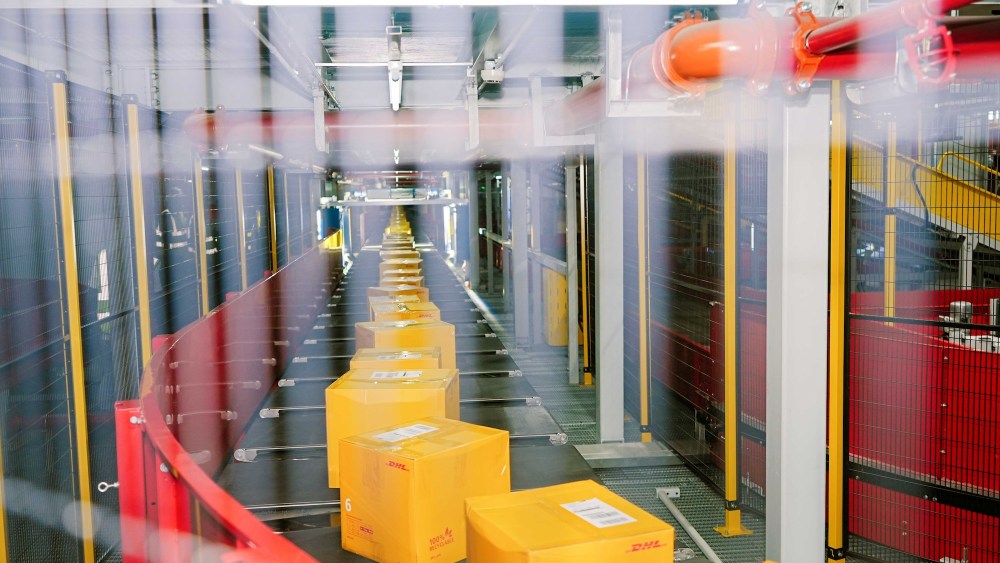
DHL Express has roughly tripled its parcel shipment processing capacity at its Shenzhen air cargo hub as part of a four-year upgrade to the facility, completing its largest investment in China to date.
The logistics giant spent nearly $205 million to expand its “super gateway” in Shenzhen Bao’an International Airport, which now hosts 237,000 square feet of operating space.
Following its launch, the gateway will open more direct cargo flights from Shenzhen to major cities in the Asia-Pacific region and globally. DHL previously operated more than 30 weekly outbound flights from Shenzhen, according to the airport.
Packages can be shipped directly from Shenzhen to other DHL air hubs, or moved by road to the company’s Central Asia Hub, where cargo can be flown out of Hong Kong International Airport to its extensive global network.
Construction of the facility began in 2022. The site is equipped with high-speed sorting systems, automated storage facilities, robotic arms and automated guided vehicles (AGVs), forming an intelligent logistics system covering unloading, storage, sorting, handling, inspection and monitoring.
Serving a vital manufacturing and export region in China, the Shenzhen facility supports growing cross-border trade, e-commerce shipments and time-definite international express services. The gateway is expected to create more than 1,000 jobs and further strengthen DHL’s network capabilities in southern China.
“Global supply chains continue to adapt to changing economic conditions, geopolitical disruption and evolving customer requirements,” said John Pearson, CEO of DHL Express, in a statement. “Our focus is on ensuring customers have the flexible, reliable and high-quality logistics networks they need to connect with suppliers, production locations and consumers around the world.”
Pearson noted that the investments help boost DHL’s role in carrying cargo for international e-commerce customers, as well as for sectors including data center and semiconductor logistics, life sciences, healthcare and new energy.
The completed expansion is timely, with air traffic from China to the U.S. is normalizing after a bumpy 2025 involving multiple dramatic shifts in American trade policy that impacted trans-Pacific volumes.
According to DHL Group CEO Tobias Meyer, the impact of last year’s end to the de minimis provision for shipments out of China has now been “cycled out.” Last year, DHL and other logistics providers experienced major drops on the China-to-U.S. trade lane when the Trump administration scrapped the trade provision, which previously allowed packages entering the U.S. to be shipped duty-free if the value of the parcel was below $800.
“We are back to normal, but not on the same level [as before the end of de minimis],” said Meyer in an earnings call earlier this month. “The growth has gone to other lanes.”
DHL Express’ total weight per day shipped internationally in the second quarter increased 9.4 percent amid last year’s soft numbers, with the metric improving on five straight quarters of declines.
Capitalizing on the shifts, DHL introduced a new dedicated air route with a widebody Boeing 767 freighter linking Shanghai, Bangkok, Bahrain and Brussels to provide additional capacity and connectivity for customers moving goods between China and key markets across Asia, the Middle East and Europe.
“This route is a direct response to how trade flows in Asia are shifting,” said Peter Bardens, senior vice president for network operations and aviation, Asia Pacific of DHL Express, in a statement. “We’re seeing increasing movement of goods between China and Southeast Asia, alongside continued demand from customers in Europe and the Middle East for products manufactured across the region. This new route boosts our network where customers need it most, providing additional capacity and more direct connections between key production and consumption markets.”
The service can move up to 50 tons of daily capacity for the air freight giant.
The additional uplift also supports the company’s growing Heavyweight Express offering, enabling customers to move shipments larger than 50 kilograms through the DHL Express international time-definite network via air.
Last month, DHL’s freight forwarding division also expanded its trans-Pacific air cargo offerings, introducing a new Bangkok-to-Cincinnati service that travels three times per week.
The service offers high-capacity widebody freighter operations with up to 100 tons per flight, complemented by road feeder connectivity across the U.S. and aims to provide shippers with more stable schedules and predictable costs.
DHL Global Forwarding’s trans-Pacific network already covers Vietnam (Hanoi) and Taiwan (Taipei), connecting shipments to key U.S. gateways including Cincinnati and Chicago O’Hare International Airport.