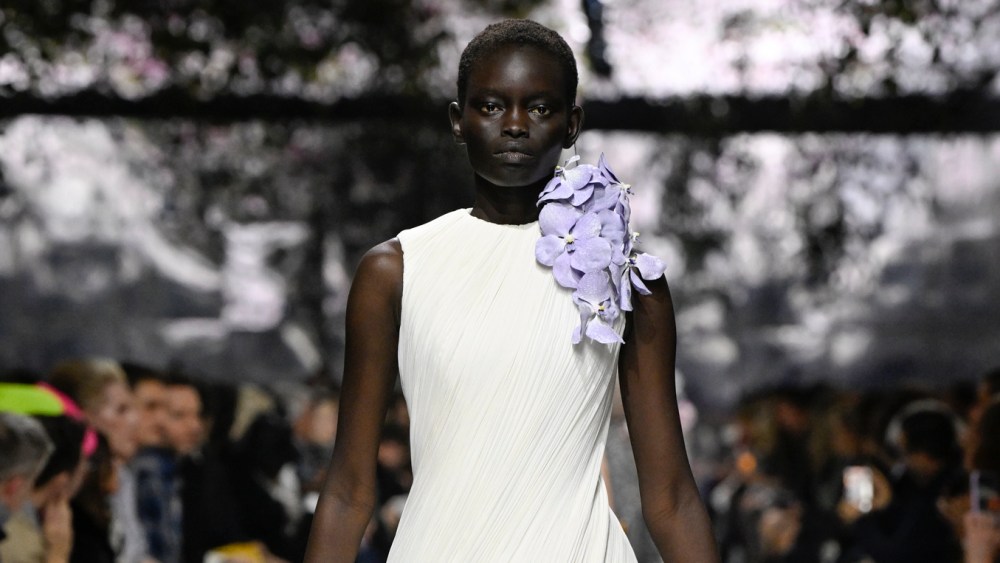
There was an air of déjà-vu as guests gathered for Jonathan Anderson’s first haute couture collection for Dior. Not only was the venue familiar — a spruced-up version of the silver tent where he showed his men’s collection less than a week ago — but the A-list crowd and fevered anticipation recalled his debut for the house last June.
French First Lady Brigitte Macron and LVMH Moët Hennessy Louis Vuitton chairman and chief executive officer Bernard Arnault posed with Jeff Bezos and Lauren Sanchez Bezos as celebrities including Anya Taylor-Joy, Jennifer Lawrence, Greta Lee, Taylor Russell, Parker Posey and Josh O’Connor filed in.
John Galliano was among the designers in attendance, marking his first time at a Dior show since he left the house in a haze of disgrace in 2011. To no one’s surprise, the show started almost an hour late as the assembled crowd waited — and waited — for Rihanna to arrive.
You May Also Like
Thankfully, what emerged on the runway was anything but predictable. It turns out Anderson, a newcomer to the couture ranks, wants nothing less than to reinvent the template laid down by Charles Frederick Worth in the mid-19th century.
It goes like this: collections are shown on the runway, then made to measure for a handful of elite customers in a series of one-to-one appointments. Instead, Anderson is rolling out his line in three chapters: a runway segment, a private client event and a weeklong exhibition open to the general public — something like a one-man couture-a-palooza.
He opened the show with a trio of bulbous pleated dresses that referenced both his first ready-to-wear look for the house, and the sensual urns of Magdalene Odundo.
The Kenyan-born British artist collaborated with Anderson on several Lady Dior handbags included in the show, and her ceramics will be featured in the exhibition, alongside 15 looks from the spring 2026 collection and nine archival outfits by founder Christian Dior. (Anderson and Odundo were due to appear in conversation at the venue on Tuesday.)
“By Dior doing couture, it’s like protecting an endangered craft,” Anderson said in a preview, as his teams put the final touches to hourglass coats and draped dresses covered in thousands of tiny fabric petals.
“It’s this idea of, why are we doing couture today, and why couture exists, ultimately,” he explained, comparing it to a laboratory of ideas. “It should be about buying something for an emotional purpose.”
If his red carpet looks to date have tended to feel clunky, there was a new lightness to this lineup, which was conceived like a cabinet of curiosities. “It’s looking at this idea of nature, either nature as real, or nature as fake, and learning from it,” he said.
Translucent swirling tops were as precise as seashells, while feathery scales mimicked extreme macro close-ups of butterfly wings. Knit mini capes that swallowed the body in soft folds put a fresh spin on Dior’s “flower women,” as did the bell-shaped dresses that read like blown-up versions of lily-of-the-valley, the founder’s fetish bloom.
Anderson also acknowledged his other predecessors at the house, though it didn’t feel derivative. You could sense echoes of Raf Simons’ razor-sharp tailoring and surgical ornamentation in a minimalist black Bar coat paired with tufted pink mules, and Galliano’s Belle Epoque sensibility in the bias-draped black gowns.
“When you come into a house like Dior, you can’t be precious anymore. There’s been so much that has happened. Fashion is a revolving door,” Anderson said. “For me, it’s about, how do you curate your own taste level? And no matter what way you look through the lens of it, you will always find a different angle to it.”
He’s on a mission to rehabilitate Galliano, and credited a gift from the designer — two posy of cyclamen tied with black silk ribbons — as the starting point for this collection. They came with the show invitation, and were clipped to some models’ ears.
As if the 63 runway looks weren’t enough, Anderson designed an entire separate collection for clients’ eyes only, as well as a range of accessories incorporating bona fide antiques.
A trailing stole was pinned with an 18th-century oval miniature by Italian Rococo painter Rosalba Carriera, and evening clutches were covered in French fabrics from the period of Queen Marie Antoinette. Meanwhile, chunky cuffs and rings were set with fossils and meteorites.
“There has to be uniqueness everywhere,” he said, stressing that it doesn’t have to be elitist. “As much as we are doing the client thing, we then have the museum exhibition, which is open to the public, so it kind of lets people in without becoming alienated by couture — because it can be a double-edged sword.”
Anderson already has plans to donate the first couture look to the Victoria & Albert Museum in London, as part of a series of planned initiatives to engage the public with this dwindling craft. Couture for all? Now that sounds like something genuinely new.