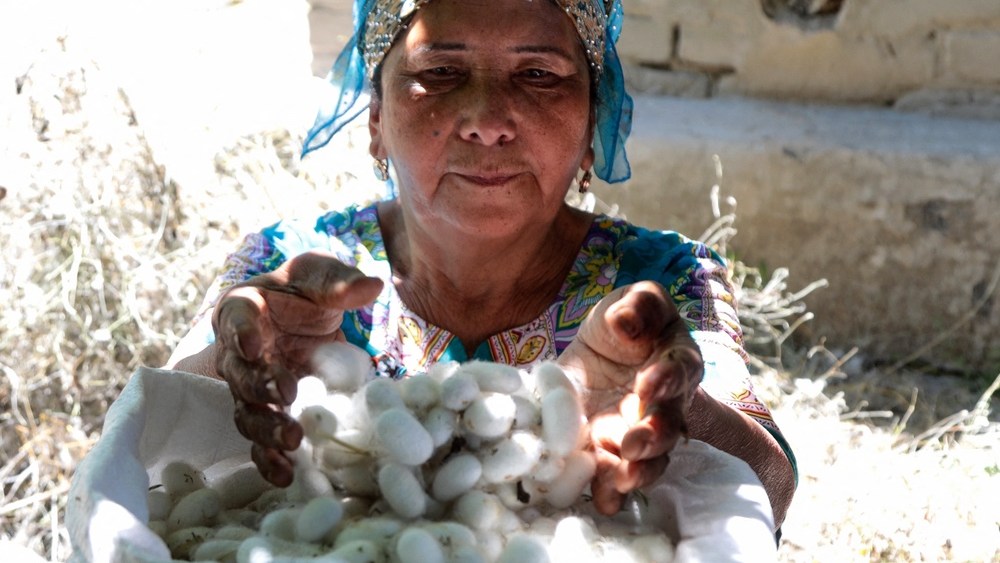
More than a decade after the Uzbek Forum for Human Rights first warned of forced labor in Uzbekistan’s silk sector, cotton and wheat farmers otherwise uninvolved in sericulture are still being compelled under threats of land seizure, water cutoffs, fines and physical violence to provide a steady supply of silkworm cocoons for the benefit of private companies, the organization said.
Efforts in recent years to end state-imposed forced labor and child labor in the Central Asian nation’s cotton fields notwithstanding, there has been little momentum to do the same for silk despite similar patterns of quotas and coercion, according to a new report published Thursday.
“The cocoon and silk sector was overshadowed by this bigger problem of forced labor of cotton pickers, which was always the focus of our work,” said Umida Niyazova, founder and director of the Uzbek Forum for Human Rights. “Nothing has changed because nobody has been talking about it.”
But the implications for the broader industry could be significant. Uzbek silk enters global supply chains at multiple stages as raw silk, silk yarn, silk fabric, finished goods and silk waste. A growing raft of laws and regulations target goods tied to forced labor, including measures in Canada and Mexico and the European Union’s Forced Labour Regulation and Corporate Sustainability Due Diligence Directive, and Section 307 of the U.S. Tariff Act. Uzbek silk cocoons also already appear on the U.S. Department of Labor’s forced labor goods list.
The organization spent three years working on the report, interviewing 85 farmers, home-based producers and representatives of silk-producing companies, reviewing official documents governing the sector and poring over hundreds of social media posts from silkworm producers. Uzbekistan is the world’s third-largest producer of silkworm cocoons after China and India, with 2025 exports to countries such as China, Turkey, India, South Korea and Vietnam amounting to some $87 million.
The stories Niyazova found were startlingly similar: Although cocoon production was unprofitable and labor-intensive, cotton and wheat farmers described signing contracts with officials associated with silk-processing enterprises known as “clusters” because they feared that refusing would trigger severe retaliation, which could jeopardize their land tenure. Smallholder producers and rural residents often entered into similar arrangements in exchange for access to small plots of land for growing subsistence crops or feeding livestock, along with noncash benefits such as firewood, fertilizer or pension credits.
Both farmers and home-based producers said, however, that the contracts were often blank, containing neither the cluster’s name nor the prices it would pay. They also complained of nonpayment or delayed payment, compounded by arbitrary and unexplained deductions for the cost of silkworm eggs, paper and other materials necessary for cocoon production.
“It’s the same thing every year—farmers are forced to [rear] silkworms because they’re dependent on the system,” said one farmer quoted in the report. “For farmers who refuse to sign the contract, they send police officers after them. If they argue, [officials] might delay giving them seeds, or they might not give them diesel. In short, don’t even doubt it—it’s completely coercive.”
While the practice of assigning cocoon production quotas to public-sector institutions, such as schools and kindergartens, largely ended between 2018 and 2020, pressure on cotton and wheat farmers has only intensified, Niyazova said. In March, for instance, a presidential decree declared that cotton and wheat farmers are collectively responsible for meeting 65 percent of cocoon production quotas.
At the same time, cocoon cultivation lasts between 25 and 28 days from late April to early June, coinciding with farmers’ busiest season. Because they are unable to properly tend to their crops or apply necessary chemicals during this period, their yields suffer. Some farmers told monitors that they’ve had to bribe officials to be released from the obligation to produce silkworm cocoons or to avoid punishment for quota shortfalls.
“It’s a systemic architecture of coercion that facilitates forced labor and exploitation,” Niyazova said.
Even for the home-based producers known as kasanchi, whose choice to produce cocoons is mostly voluntary, the state-imposed price paid for their work is so low that they generally don’t turn a profit. Failure to meet production quotas, they said, can result in penalties such as land lease terminations or fines.
Producers, who are expected to cover costs such as electricity and water, also spend considerable time at home rearing silkworms. In the final 10 days of the cultivation cycle, the worms must be fed large volumes of mulberry leaves five to six times a day. During rearing, producers and their families are exposed to strong odors, cleaning chemicals and pesticide residues on mulberry leaves, which can cause respiratory issues and inflammation of the hands and eyes.
“No matter how many people are in the house, we all work,” one home-based producer said. “Not getting enough sleep for a month and fatigue will not leave us.”
As with earlier reports of systemic child labor and forced labor in the cotton sector, before officials acknowledged those practices, the response from authorities has been mostly denial, Niyazova said.
A spokesperson for Uzbekistan’s ministry of agriculture told Sourcing Journal that it would review the report and “remains open to discuss the challenges identified and possible ways forward, building on the progress and experience achieved in the cotton sector.”
Uzbekipaksanoat, Uzbekistan’s state-backed silk industry association, did not respond to a request for comment. In a September statement issued after learning of the Uzbek Forum for Human Rights’s report, however, it said it “is ready to investigate any substantiated objections and appeals in the sector.”
“If concrete evidence is provided, they will be reviewed in the established order, and if a violation is confirmed, appropriate measures will be taken,” it said. “Uzbekipaksanoat is in favor of examining any appeals and providing a legal assessment of existing problems. However, each case must be evaluated based on specific documents, contracts, payment information and other evidence.”
Nate Herman, executive vice president of the American Apparel & Footwear Association, said it was “urgent” for the industry to eliminate all coercive practices in the agricultural sector. The association is a member of the Cotton Campaign, a coalition of human rights organizations, trade unions, investors and business associations that lifted an 11-year boycott of Uzbek cotton in 2022, citing the country’s breakthrough in harvesting cotton “almost entirely” without coercion. The Cotton Campaign lists the Uzbek Forum for Human Rights as a frontline partner.
“At the same time, we must allow farmers to exercise their rights to freedom of association and to bargain collectively,” he said. “This is essential for Uzbekistan to demonstrate its readiness to participate in the textile supply chains of global brands.”
The Uzbek Forum for Human Rights is urging the Uzbek government to extend the reforms it’s made in cotton production to the silk sector, abolish cocoon quotas and establish land tenure security for farmers and home-based producers. Equally important, it said, silk enterprises must create conditions that ensure decent work and pay for cocoon producers.
Such abuses, Niyazova said, are easy to end—“you just have to stop forcing people to produce.”
“And if the state needs people to produce cocoons, it can incentivize people; it can give them subsidies; it can pay them more,” Niyazova said. “There is an entire rural population that knows how to do this work, and they will produce this if you pay them more. Silk is such a luxury, right? But to be truly that, it has to avoid exploitation and forced labor.”