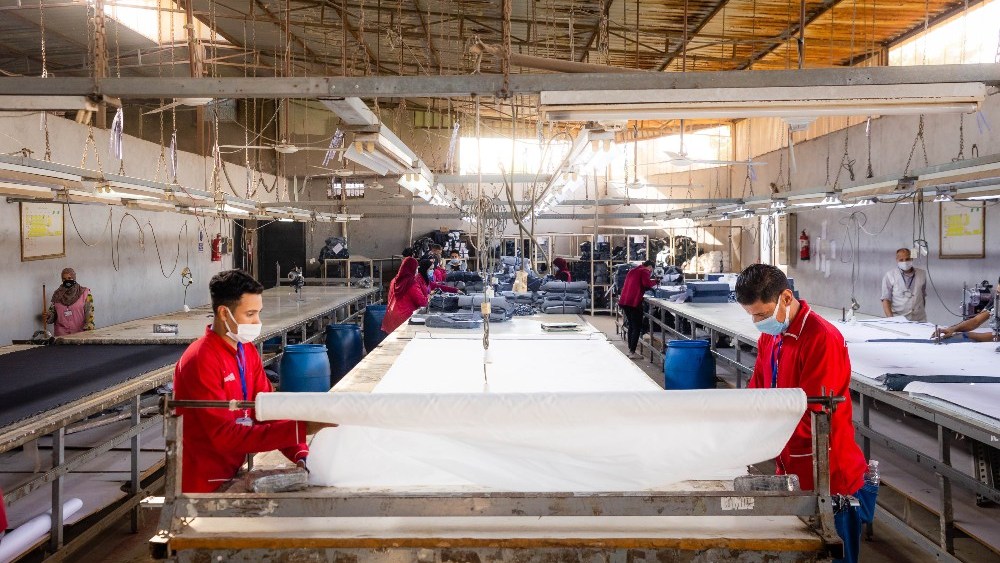
Exports have been on an upswing in Egypt.
While manufacturers are wondering if this is just another quick oscillation, analysts told Sourcing Journal that this is no momentary blip, but rather evidence that many global brands are seeing the country as a long-term regional supplier and export hub.
The numbers appear to back this up: while overall exports from Egypt grew 21.7 percent in 2025, apparel exports increased by 20 percent during the same year, up from $2.85 billion in 2024 to $3.39 billion. In 2026, this momentum continued with 15 percent growth over the first seven months, reaching $2.13 billion. June alone recorded a 47 percent increase, reaching $355 million.
Analysts believe this is no isolated trend.
“In the next 10 years, it will shift to a completely new level,” said Yasmine Helal, national project coordinator for the GTex Menatex Programme of the International Trade Centre (ITC) in Egypt—a joint agency of the World Trade Organization and the United Nations that helps small businesses in developing economies transition to global markets.
The GTex Menatex program specifically drives textile and clothing export competitiveness across North Africa and the Middle East. “I look at it as a very good opportunity for Egypt—not only to increase the level of investment in the industry, but also to drive growth in the sector and the productivity and skills of workers.”
A new labor law introduced in September 2025, which regulates compliance with international standards and relations between employees and employers, has also helped. The legislation has brought in clearer rules for fixed-term contracts, remote work and part-time hours, helping garment factories adjust staffing to fluctuating global export orders.
It’s not only global buyers who are shifting their gaze; there’s also been an evolution in the way local manufacturers view business as regional players establish a foothold in Egypt.
“We are seeing a big change in the way manufacturers operate,” said Sherin Hosni, CEO and executive director of the Apparel Export Council of Egypt (ECE). “Companies are increasingly investing in vertical integration, local sourcing, productivity improvement, compliance, sustainability, technology and higher value-added products. The industry is moving from simply competing on cost toward competing on speed, flexibility, quality, reliability, and the ability to meet international compliance requirements.”
Manufacturers from around the region have been investing, especially given Egypt’s duty-free access to the U.S. market under the Qualifying Industrial Zone (QIZ) agreement.
The QIZ is a trade pact between Egypt, Israel, and the U.S. that allows goods manufactured in specific Egyptian zones to enter the U.S. duty-free and quota-free. The deal includes a stipulation that the apparel must have a minimum of 10.5 percent input from Israel, and must be manufactured in certain geographic areas in Egypt such as Greater Cairo, Alexandria and the Suez Canal Zone.
Helal spoke about the geopolitical changes that have encouraged greater diversification in sourcing, alongside preferential trade agreements with the U.S., Africa and Latin America, and the fluctuating U.S. tariffs in other regions.
“There has been a lot of movement,” she said, pointing to several factors driving the shift, including the increased global focus on near-shoring, with companies looking for faster speed-to-market.
The lower energy costs in Egypt also help. “While energy costs have been rising sharply in other countries, it has been closer to a 15-20 percent increase in Egypt in the last few years,” she said. Meanwhile, there has also been an aggressive build-up of support for the installation of solar panels at factories, along with a broader push toward greener production.
“We’ve seen a lot of Turkish companies relocating their operations to Egypt, and when they move here, they are already used to vertical integration; this way they move to a country that understands how this works,” she said.
For years, global manufacturers adding production in Egypt have cited lower productivity as a challenge, but Helal said that is changing fast, as companies put a greater emphasis on efficiency.
“We have been focusing on productivity and efficiency, because it is important that these are rising; on increasing the quality and the savings when it comes to waste and the competitiveness of the companies that we work with,” she said. This did not make workers redundant, she explained but rather “increased efficiency” and freed them up for other roles.
Industry analysts point out that this change is apparent across sectors in recent years, with many companies having increased productivity by 25-40 percent.
And while there is a worldwide fear that machines and AI will eventually replace workers, Helal is clear that workers are indispensable to the production process. “When it comes to apparel manufacturing, labor plays an important role,” she said. “Even if AI or new technology can be used in design or planning, when it comes to the production line, labor plays a great role.”
Part of the change in recent years has been the demands around speed to market—a stark contrast to the more leisurely way of doing business in the past.
Ayman El Bouhy, chairman at Champs Land, an Egyptian sportswear manufacturer operating out of the Mekka Industrial Zone in Abu Rawash, spoke about the fast-growing changes in the industry and inside his own business.
“Honestly, we didn’t set out to get bigger, we set out to get faster,” he observed. “In teamwear you’re working to someone’s season, not a catalogue, so if a sample takes three weeks you’ve already lost the order. We’ve pulled that down to about ten days. And we’ve cleaned up how we produce—less water, less ink, less fabric on the floor—partly because buyers ask about it now before anything else, and partly because it was the right thing to do. The growth came after that, not before it.”
“No doubt that Egypt is going to be the new textiles and garments hub in the near future,” he said, adding that the “migration of the old known titans of the industry from China and Turkey cannot go unnoticed.”
“We recognize the increasing demand and the growing number of inquiries every day. The announcements of new giant factories opening near the ports confirm the shift to Egypt,” he said.
Despite the boom, significant hurdles remain. What are the biggest challenges?
“People, and it’s getting harder,” answered Champs Land co-founder Nada El Bouhy. “There’s no shortage of hands in Egypt; there’s a shortage of supervisors, mechanics and technicians—the roles that take years to build rather than weeks to hire. And now the Turkish and Chinese factories setting up here are hiring exactly those people, at salaries the local market never used to see.”
“With inflation on top of that, the gap between what they can offer and what a factory our size can offer keeps widening. You train someone for three years and then watch them leave for a number you can’t match,” she added. “So we build our own: promoting from the line, training in-house, and trying to give people a reason to stay beyond the salary. It’s slow and it’s expensive, and it’s still the single thing that decides how fast we can grow.”
Abdelrahman Ali, executive manager at Digitex Egypt Ltd, reiterated the point, noting that while the industry’s deliberate diversification strategy and growing confidence in the domestic market alongside exports appear to be cause for celebration, difficulties in retaining skilled labor persist. “The entry of a growing number of foreign manufacturers into Egypt has intensified competition for both buyers and skilled workers, putting additional pressure on margins,” he said.
Digitex is a prominent commercial textile and apparel manufacturer established in 2014, with a commercial office in Cairo and a manufacturing complex spanning 100,000 square meters in the 4th Industrial Zone of Sadat City.
“The other part of it is that compliance and certification requirements from international buyers continue to grow more demanding, requiring ongoing investment in social and ecological standards—such as OEKO-TEX, SEDEX, GRS, the Higg Index, and WRAP—just to remain qualified as a supplier. Navigating these challenges requires continuous investment in workforce stability, certification readiness, and buyer relationships to remain competitive,” said Ali.
However, he pointed out that the growth had, thus far, been worth the investment.
“Our total sales grew 53 percent from 2023 to 2024, reaching 536 million Egyptian pounds or approximately $11.94 million at the 2024 exchange rate,” Ali noted. “But what stands out most is the shift in our sales structure: local market sales more than doubled from 2023 to 2024 and grew a further 55 percent in 2025, rising to 398 million Egyptian pounds or $8.08 million over the three years.”
While Egyptian companies are growing, global investments have been rolling in, particularly from Turkish manufacturers which have been coping with soaring costs and Chinese manufactures concerned by the tenuous trade relationship with the U.S.
The Suez Canal Economic Zone (SCZONE), which has large industrial parks built directly alongside or within a short drive of the Suez Canal shipping lane and its main ports (like Port Said and Suez), offers logistical advantages for shipping as well as lower taxes and fees.
In just a single six-month window during mid-2025, 19 separate Turkish apparel firms applied for operating licenses inside the zone to build fast-turnaround apparel facilities.
Parallel to the Turkish expansion, Chinese companies have been moving fast. In December, the year rounded off with several high-profile international companies making major commitments to Egypt. Among them, the Jasan Group officially signed its contract for the $100 million West Qantara complex, while the Xinfengming Group signed a landmark synthetic polyester fiber agreement to anchor raw-material processing inside the broader SCZONE.
Analysts point out that the growth from these and many other investments made in 2025 and 2026 will yield results over the coming years, further reinforcing predictions of continued export growth from Egypt.
Yasmine Helal believes that this widespread optimism is not misplaced.
“In the next 10 years, the industry will shift to a completely new level,” she said. “So I would say these are the best of times.”