
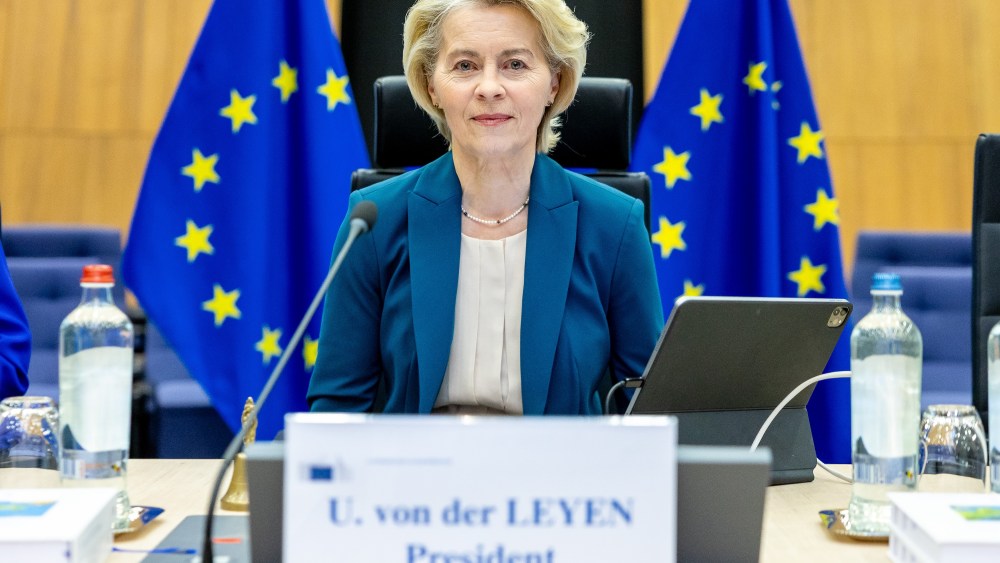
EU officials gathered in Strasbourg, France late Tuesday with hopes to compromise on terms that would finalize the bloc’s trade deal with the U.S. ahead of President Donald Trump’s July 4 deadline.
Earlier this month, President Trump threatened to escalate tariffs on European auto imports to 15 percent from 25 percent because the EU hadn’t moved quickly enough to implement provisions agreed upon within the handshake trans-Atlantic trade deal struck in Scotland last July.
“A deal is a deal,” the U.S. mission to the EU posted on X ahead of the meeting, saying the bloc “must live up” to the initial agreement, which applied a baseline 15 percent tariff on nearly all EU goods.
According to a report from Reuters, EU negotiators are expected to agree to scrap more import duties on U.S. goods to comply with the trade deal.
Under the terms of the initial deal sealed between Trump and European Commission President Ursula von der Leyen, the EU agreed to remove all import duties on U.S. industrial goods and grant preferential access to U.S. farm and sea produce. The bloc also had agreed to purchase $750 billion in energy from American sources and invest $600 billion into the U.S. economy.
The European Commission, which handles trade matters for the EU, has said it maintains options to protect the bloc’s interests if Trump were to follow through on his threat to increase the tariffs.
There has been internal debate related to deployment of these options. Many members of the European Parliament (MEPs) have pushed for protective elements like a “sunrise clause,” which would stipulate that EU duty reductions only take place when Washington cuts tariffs on European steel and aluminum products to 15 percent from current levels of up to 50 percent.
The MEPs also seek the ability to suspend the deal if the U.S. goes back on its obligations and have also floated a “sunset clause” that would automatically terminate the EU tariff concessions on March 31, 2028 unless it was renewed.
However, many member state governments have not been as keen on bringing these measures into a legislative text, and would rather implement a deal without further delay. Their concern, as expressed in the talks, is that adding such clauses could antagonize the Trump administration and introduce uncertainty for European businesses that would rely on the new trading conditions.
If language is agreed upon in Tuesday night’s meeting, a final vote of approval in the European Parliament would be expected from June 15-18.
The ratification of last year’s deal was blocked by the European Parliament when the Supreme Court ruled Trump’s International Emergency Economic Powers Act (IEEPA) tariffs were unlawful in February, raising questions about its viability and benefits for EU member states. Parliament also nixed ratification after Trump made repeated threats that the U.S. would annex Greenland, a semi-autonomous territory of Denmark.
Amid the numerous delays, Trump’s EU envoy Andrew Puzder said the president “has seen enough,” in a Monday op-ed in Politico.
“Trump has repeatedly demonstrated he prefers a deal to a dispute—and we have a deal,” Ambassador Puzder said. “The EU still has time to choose cooperation over confrontation. Our sincere hope is it will.”
A final version of the bill must be agreed by parliament, the commission and the European Council, which represents the EU’s 27 member states. Once the three institutions agree on the language, it will need to be voted on.
According to data from the Census Bureau, EU countries took up the largest share of U.S. imports from January to May 2025 at 20.2 percent, or $303 billion in total goods. Mexico and Canada were a distant two and three, representing 14.6 percent and 11.2 percent of imports, respectively.