PARIS – The House of Creed’s heritage continues to shape its strategy today.
The oldest existing high-end niche fragrance brand, dating back to 1760 with roots in the U.K. and France, Creed has unique positioning. It takes an artisanal approach and has a fully vertical operation structure for perfume-making.
“There’s no redo to do on the brand,” said Nathalie Berger-Duquene, chief executive officer of Creed, which has been part of L’Oréal’s portfolio since March 31. “This is a little bit of the magic. When you have a brand with such a strong positioning, storytelling and history, it’s just to make the story of the brand accessible to people.”
Related Articles
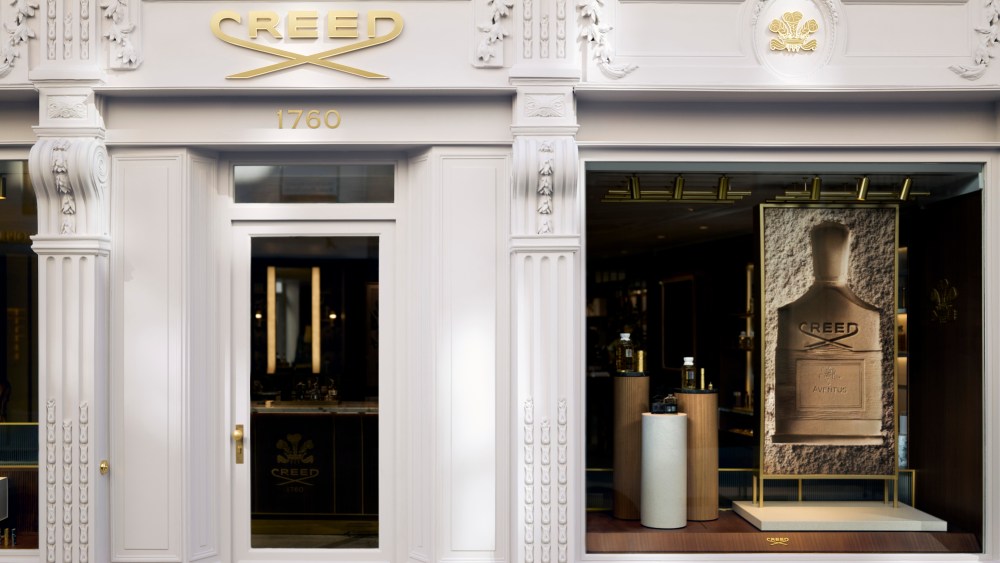
That story is being told partly via Creed’s recent store design. Take the two-story, nearly 1,075-square-foot flagship on Paris’ Rue Saint-Honoré – the city’s central perfume-shopping thoroughfare – that opened in June.
“It’s one of the most beautiful addresses in Paris,” Berger-Duquene said. “Having a boutique on Rue Saint-Honoré is very important to express what the brand stands for.”
The location in a former mansion was chosen not only for its beauty, but its being steeped in history.
“We tried to have modernity and a residential feel when you enter,” Berger-Duquene said of the boutique. “But celebrating also the heritage of the brand. It’s always a very important balance for us.”
She explained Creed celebrates a “living heritage … meaning it really needs to be anchored in time.”
The store is meant to be where relationships are forged with staff members, who help with brand and product discovery, while connections are made and discussions take place among fragrance lovers.
Berger-Duquene described Creed’s beauty advisors as “storytellers.” In Paris, seating is available on the ground floor and in a private salon one level up. Guests are offered tea, water or Champagne.
“It’s important to have people taking the time if they want,” she said, adding for those who are time-strapped, “we also have speed dating.”
Décor is made of noble, luxurious, long-lasting materials, such as green marble from Italy, with each piece being unique, and walnut wood. The color beige was chosen for its warm, welcoming aspect.
“That makes you feel like at home or in a very nice hotel around the world,” Berger-Duquene said.
Formerly, Creed boutiques boasted white marble and a more linear aesthetic.
The Paris location is the first freestanding store in France to reflect the new store design. Such debuts include, as well, boutiques in Berlin; Atlanta, GA; Melbourne, Australia; Kaohsiung, Taiwan; and Tokyo.
Creed will by year-end 2026 have 75 freestanding stores, including its three in Paris. Upcoming openings will reflect the new design, too.
“Each location is very precisely chosen,” Berger-Duquene said. The objective is to keep opening in major cities worldwide.
In the Saint-Honoré boutique, there are archival elements from Creed, including a copy of a warrant from Napoleon III for Charles Creed. A vintage pair of scissors reflects James Henry Creed’s start as a bespoke tailor on Conduit Street in London’s Mayfair district.
“Everything started with tailoring, and now the house has shifted to fragrances, but always with the same precision,” Berger-Duquene said.
The store stocks the entire Creed perfume collection, which counts approximately 70 fragrances. At present, the most iconic and bestselling Creed fragrance is Aventus, from 2010.

Price points for Creed fragrances in the U.S. range from about $380 for a 50-ml. eau de parfum to $510 for a 100-ml. edp. The brand has colognes, absolutes, candles and home atomizers, as well.
“We are working to have boutique exclusives,” Berger-Duquene said. The Saint-Honoré boutique, for instance, is the only to carry Fleurissimo Saint-Honoré.
New Creed fragrances are inspired by the olfactive ingredients and brand heritage.
“Our role is to make sure that everything we do respects this incredible heritage,” she said.
The brand communicates on fragrance ingredients and stories. On Instagram, for instance, it shares how its perfumes are produced in its own factory in France. The brand’s visual identity shows the ingredients, too.
For Iris Debonair, which was introduced in September, the institutional campaign tells the story of a debonair, and videos present the two key ingredients – iris from Landes, France, and lavender from Kent in the U.K. – and how they’re harvested.

“We have a relationship with farmers from generation to generation,” Berger-Duquene said.
The late Olivier Creed, a sixth-generation Creed family member, who headed The House of Creed, served as master perfumer for the brand, had a personal relationship with the Capua family in Italy, for instance.
His son, Erwin Creed, serves as the eponymous brand’s ambassador now.
The House of Creed has another relationship with an oud producer, who wanted his 80-year-old oud to be magnified in a perfume, so it went to the brand, according to Berger-Duquene.
“We created the fragrance around it,” she said. That is Oud Zarian.
“It’s a very different way of creating fragrances, where the key ingredients – and super noble ingredients – are in the heart of the creation,” Berger-Duquene said.
Creed fragrances contain a high percentage, of up to about 40 percent, of natural ingredients. Since those evolve due to the natural environment, Creed’s master blenders work with the farmers to select the exact quality of ingredients to maintain the same scent.
“These people are really artisans,” Berger-Duquene said.
Some Creed fragrances are dubbed “millésime,” borrowing the appellation, meaning a great vintage, from the wine world.
Olivier Creed has been cited as saying: “Our millésime perfumes are blends of high-quality natural raw ingredients that are weighted, mixed and macerated, in most cases by hand, in a small artisanal factory near Fontainebleau, France. The process is labor-intensive, but Creed is driven by artistry and perfection.”
Creed perfume bottles are handcrafted in France. The company ethos states: “When others industrialize, we ritualize.”
L’Oréal acquired Creed from Kering along with other holdings from Kering Beauté in a 4-billion-euro deal. Through Creed, L’Oréal aims to establish itself as one of the leading players in the niche fragrance market – the subcategory of the growing perfume industry that’s booming the most today.
For its part, Kering bought Creed in June 2023 in another blockbuster deal estimated at between 2 billion euros to 3.5 billion euros. In its full fiscal year ended March 31, 2023, Creed had made sales of more than 250 million euros.
By February of this year, brand sales had reached around 350 million euros, and L’Oréal executives believed Creed could swiftly become a “billionaire brand.”
Today, Creed is growing by double-digits, according to Nicolas Heirionimus, CEO of L’Oréal, during last month’s call with financial analysts and journalists to discuss the company’s third-quarter results.
“I am very happy with the performance of Creed,” he said. Hieronimus reiterated that Creed fills a gap in L’Oréal’s premium-end fragrances, and that Iris Debonair is performing well.
“That’s also contributing to our overall fragrance performance, both in male and female,” Hieronimus said.
Creed currently has more male than female consumer. “With the more recent launches … we are making fragrances for fragrance-lovers and not for women or for men,” Berger-Duquene said.
Wild Vetiver, for instance, launched in March, was developed to crystalize the essence of an English garden party.
“Since [its introduction], we can see that more women are entering our boutiques and younger consumers,” Berger-Duquene said, noting that when Creed talks heritage, it captures more younger people’s attention, and that’s “quite beautiful.”
Creed’s number-one geographic region is the U.S. “We are opening new boutiques also in Asia, in the Middle East,” she said. “We are a global brand.”
Creed seeks to reinforce its positioning in the key regions of the world. “We see that in China our consumers are younger and more feminine,” Berger-Duquene said. Creed’s Silver Mountain Water fragrance is beloved there.
The fragrance category is developing strongly in China. “Creed has a place around the table,” she said. “So it’s very energizing.”
Overall, the brand has largely built its following by word-of-mouth. “It’s for those who know,” Berger-Duquene said. “This is also the beauty, and we don’t want to change it.”