Mechanically recycled cotton is ready to scale. According to Amsterdam-based nonprofit Fashion for Good, recyclers have unused capacity, but brand concerns around aspects such as inconsistent fiber quality, fiber length and price premiums are holding adoption back.
Fashion for Good is looking to boost the use of recycled cotton through its newly launched Cotton Reloop Matrix project. The initiative aims to first gather data about the mechanically recycled cotton that is accessible today and compare it to brands’ specifications for knit and woven apparel. Based on trials with recyclers and mills, the project will also develop a standard operating procedure for spinning and processing recycled fibers.
“Recycled cotton has been talked about as a scale-ready solution for years, but the industry has been working from fragmented data and siloed testing,” said Katrin Ley, managing director at Fashion for Good. “This project is about closing that gap with hard evidence. By plotting real recycler capabilities against real brand quality targets, and by co-developing the operational standards to support them, we can move recycled cotton from a case-by-case experiment to a category the industry can actually plan around.”
Per Textile Exchange, cotton accounted for 19 percent of global fiber production in 2025, yet recycled cotton was only 1 percent of total cotton produced. Fashion for Good noted that mechanical recycling is a “crucial pathway” to recycle cotton into new cotton goods. Post-industrial and post-consumer cotton can be used in chemical recycling processes, but the resulting fibers are not cotton, but rather materials like man-made cellulosic fibers.
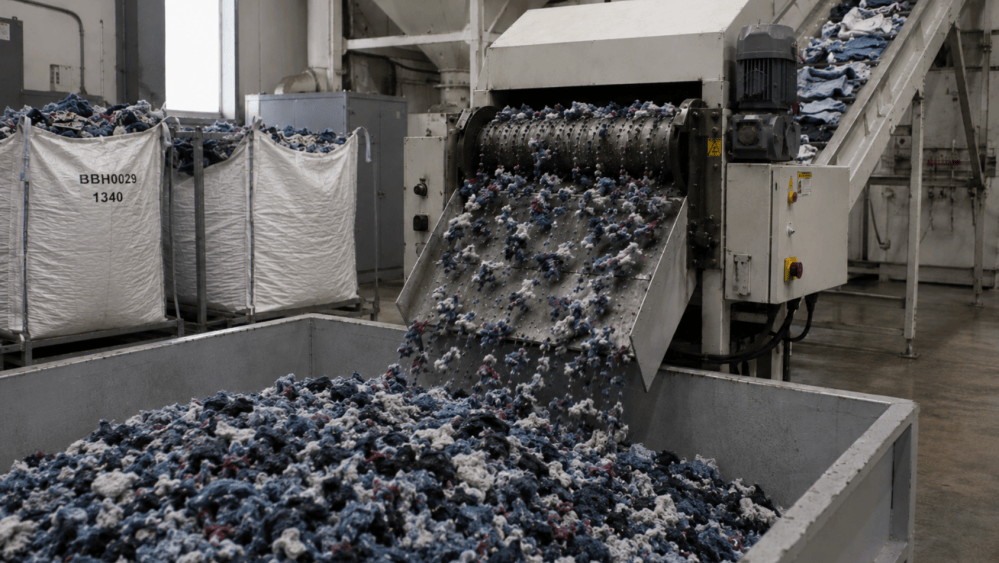
Mechanical recycling comes with some inherent challenges. After textiles undergo shredding, the resulting fibers are shorter and weaker than virgin cotton, and only around half the processed material meets parameters needed for new products. These same quality considerations have also kept recycled cotton content at a low percentage of yarn or textile compositions.
“Recycled cotton isn’t new to us: it’s a fiber we’ve worked with for years,” said Nikki Player, senior director of raw materials at Reformation. “What’s been limiting is the ability to scale to higher blend percentages without compromising fabric quality or hand feel. What this project offers is a shared reference point where brands and recyclers work from the same evidence. We hope this opens the door to greater scalability and uptake over time.”
Per Fashion for Good, one of the hurdles for recycled content is that brands often compare the quality to 100 percent virgin cotton, with which it cannot compete. This initiative aims to create a more realistic view on recycled fiber quality and create standard, objective quality benchmarks for recycled cotton. A Quality Matrix will identify recycled cotton that meets commercial requirements while also pinpointing areas where quality could be improved.
For this initiative, Fashion for Good tapped retailers C&A, Bestseller and Reformation and vertical manufacturer Interloop as innovation partners. Additionally, manufacturers Arvind Limited and Shahi Exports will act as advisory partners, while Uster Technologies—a machinery firm focused on fiber quality technologies—will serve as ecosystem partner.
Alongside recyclers, the project’s partners will create 10 demonstrator fabrics and undergo five quality enhancement trials at the mill level. From these tests, the partners and Fashion for Good will create a Trade-off Analysis that plots how recycled content, price and quality intersect and shape each other.
At the end of the project, Fashion for Good will release the Roadmap for Cotton Circularity report, which will lay out what is needed from a data perspective to scale the use of recycled cotton in different product verticals and regions.
This cotton-centered circularity initiative follows Fashion for Good’s introduction of the textile-to-textile recycling-focused Circular Fiber Collective and its efforts to map textile waste.
Innovation alliance
In addition to partnering with Fashion for Good on the Cotton Reloop Matrix project, Interloop has newly become an Innovation Partner of the organization. As part of this new partnership, Interloop will have a seat on Fashion for Good’s Innovation Committee.
The partnership will allow Interloop to test out technologies and tap into Fashion for Good’s network for opportunities to collaborate to develop and bring new solutions to market. A few of the fellow Innovation Partners include Adidas, Birla Cellulose, Levi Strauss & Co., PDS Limited and PVH Corp., among others. It will also have the chance to participate in Fashion for Good projects and pilots.

Specializing in categories like hosiery, knitwear, activewear and denim, Interloop has invested in sustainable innovation, such as its banana leaf-based fiber and its proprietary Looptrace traceability platform that established end-to-end tracking for cotton products.
“The industry has no shortage of promising ideas; the opportunity lies in turning more of them into solutions that can work at scale,” said Faryal Sadiq, chief marketing officer at Interloop. “Through this partnership, we want to bring our manufacturing experience into that process while learning from and collaborating with some of the strongest innovators and partners across the industry.”