Whether it’s creating a high jewelry brooch heaving with glittering gemstones set on titanium and gold or a leather bag charm just big enough to fit an Apple Airtag, it all comes down to turning craft and heritage into a competitive business edge.
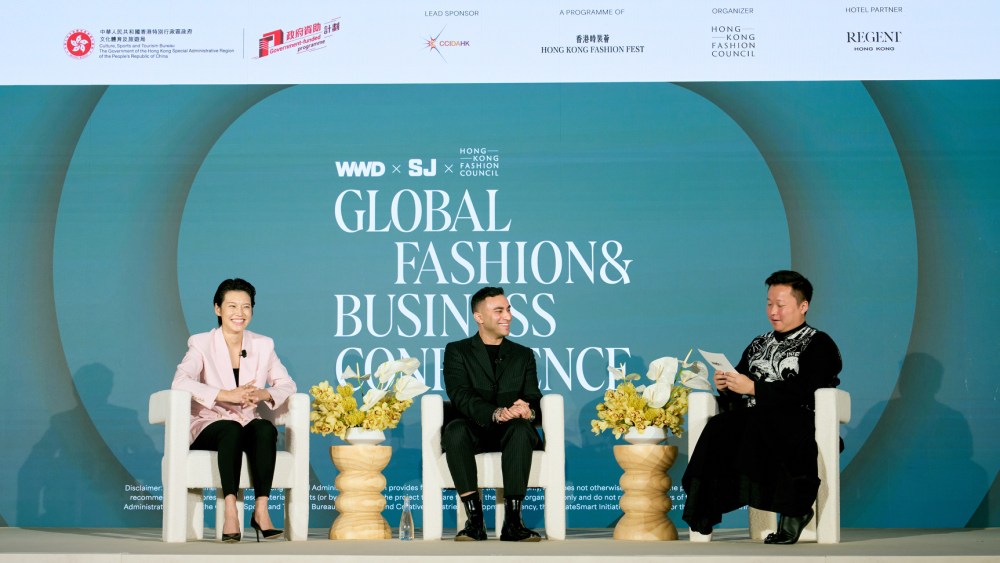
That was the underlying message of “Past, Present and Future: The Importance of Heritage in Inspiring the Consumers of Today and Tomorrow,” a panel discussion moderated by WWD’s London and China market editor Tianwei Zhang at the Global Fashion and Business Conference, hosted by WWD, Sourcing Journal and the Hong Kong Fashion Council.
Yuting Hung, global brand director of Cindy Chao the Art Jewel, and Omar Sabré, chief executive officer and creative director of leather goods label Maison de Sabré, alighted on how a singular focus on craft can become a driver of differentiation and staying power, and why transparency matters more than ever.
You May Also Like
On the surface, their spheres and stories couldn’t be more different.
Cindy Chao operates in the rarefied high jewelry segment, unveiling a couple of pieces a year during Paris Couture Week and at art fairs, such as the recent edition of Art021 in Shanghai. Less than a decade old, Maison de Sabré’s fast-growing accessible leather goods and tech accessories business moves at the pace their clients do and is on track to hit the $100 million mark in revenue this year.
But both brands have turned the founders’ passion for handcraft into a driver of growth and staying power.
Chao, the daughter of a sculptor and granddaughter of an architect who reconstructed and designed more than 100 temples across Asia, eschewed formal training before launching into jewelry in 2004.
By 2009, one of her butterfly creations was inducted into the Smithsonian’s National Museum of Natural History, a rare honor for a living jeweler, let alone one from Asia.
For the jewelry executive, the key to success is not “what we’re doing different, it’s how we’re pushing the boundaries and edges.”
First, there’s Chao channeling of Asian heritage and culture into her process, eschewing a literal approach with phoenix and dragons motifs in favor of “that poetic feeling, the twists and turns, the mix of materials” with unusual combinations involving diamonds, precious metals as well as wood and ox horn, for Hung.
But equally important is a crystal clear understanding and identification of its target. “There are markets everywhere,” Hung said. “But it doesn’t necessarily mean that you have to sell to everybody.”
What matters most to Cindy Chao collectors is having “something that’s special…that no one else has” and that’s why the brand takes a borderless approach to finding the right techniques — and hands to execute them.
The brand works with ateliers in Geneva and France because “in addition to that sensibility, what we need is technique,” according to Hung.
And that doesn’t mean keeping to ancient tools. “A lot of Cindy’s pieces need to be [executed] under the microscope,” the jewelry executive said. “That’s what we’re doing to create something that’s a bit different from what you see [elsewhere].”
That premise is also how Maison de Sabré went from a leather phone case as its sole product offering eight years ago to a company on track to hit the $100 million mark in revenue this year.
“We really transformed that product from something that was completely ubiquitous…to something that was elevated and playful and luxurious,” said Sabré, who cofounded the brand with his younger brother, Zane.
Rather than positioning accessibility and craftsmanship as opposing forces, he framed them as mutually reinforcing. Take leatherworking techniques, often left behind in “this really rapid growth age everyone wants to pursue,” he said.
“Our responsibility is to bring that craft into modernity and to present it in a way that’s fresh, that’s innovative, that’s relevant to the client,” he said.
Exhibit A: the brand’s popular bag charms, such as the Hello Kitty collaboration with Sanrio. Rather than printed leather, they’re made from leather marquetry using offcuts from other Maison de Sabré products — and are sold for around $90.
But doing this at scale — plus keeping the brand’s overall average price in the mid-three-figure range — requires operational discipline, from sourcing and manufacturing its materials to quality control.
Transparency has become another lever of differentiation in the age of social media.
As consumers increasingly research brands ahead of purchases, “we’re there really to enlighten their educational sense behind the product,” Sabré said. “So that when they come to see it in person, it’s like an aha moment…then they start to become advocates for the brand.”