
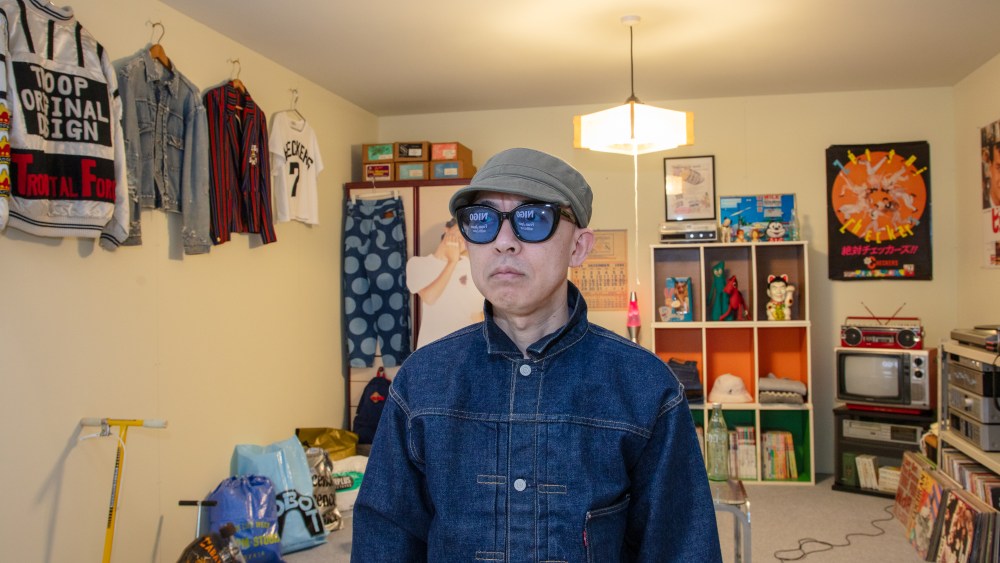
LONDON — Nigo has been fashion’s quiet tectonic force for more than three decades, and his creative ideas have traveled from the backstreets of Harajuku to Paris runways.
But his retrospective at London’s Design Museum, “Nigo: From Japan With Love,” framed his life story less as a triumph of hype than as a spiritual journey. He once defined looking outward to America, hip‑hop and global luxury and is now increasingly preoccupied with looking inward to Japanese craft, ceremony and his own sense of “old age.”
Unraveling across four chapters in the basement of the museum by Holland Park, the exhibition, running till Oct. 4, features more than 700 objects, with the majority of them sourced from his own personal archive.
You May Also Like
“I received the offer, and it happened to come at a time when I was thinking about bringing together the story of my 55 years, so I was grateful for the opportunity to do it,” said the current creative director of Kenzo, adding that the cultures of London and Tokyo are quite similar in some ways, making London an ideal pick for the retrospective.
Esme Hawes, co‑curator of the exhibition, described it as both a cultural history and a self‑portrait of Nigo.

Instead of opening with Bape’s signature camo motif or major collaborations with the likes of Louis Vuitton and Nike, the exhibition began somewhere quieter: a full‑scale recreation of the designer’s 1980s teenage bedroom in Maebashi, just outside Tokyo.
“Nigo was very keen that we start from the very beginning,” Hawes explained during a walk-through with WWD.
“Initially, we came up with a concept which charts his entire career from fashion college to [his fashion store] Nowhere and then A Bathing Ape. But Nigo was like, ‘No, we’re starting from the very beginning,’” Hawes added.
Growing up during Japan’s post-war economic boom, the designer was steeped in the lingering presence of American military culture and the flood of U.S. pop references that followed. For Hawes, that cross‑pollination, and how teenagers at that time processed it, is fundamental to understanding his work.
“Lots of young people were looking toward American pop culture and fashion as a sort of rebellion to these very traditional Japanese values. Nigo really lapped that up and really absorbed that,” she reinforced.

The first section, “The Future Is in the Past,” put these early influences on full display within USM bespoke canebits with key items including 1950s Levi’s denim jackets, vintage baseball caps and varsity jackets; figurines from Donald Duck to Star Wars; Japanese toys, music and magazines, and even a Japanese tabletop game reimagining American baseball.
“Nigo as a collector is something that we really wanted to get across in the exhibition. The way he has done that throughout his career, and really used his collection as a toolbox from which he takes ideas and inspirations. You can see that across, even now with his work with Kenzo,” Hawes said.
Nigo, born Tomoaki Nagao, called those pieces his real education in fashion. “With vintage pieces, what’s inside can be more important than what you see on the surface. For me, everything I have held over the years has been a kind of teacher,” he added.

The second chapter, “Evolution,” showed what he did with those references. In 1993, Nigo cofounded the Harajuku shop Nowhere with fellow designer Jun Takahashi and, in the same year, launched A Bathing Ape, a cult streetwear brand now owned by the Hong Kong-based fashion retailer I.T.
With limited means, he built a model that would become an industry standard across both streetwear and luxury.
“The really early Bathing Ape pieces were quite a DIY project to begin with, but he was only producing five of each jacket or T‑shirt. Partly that was because he had limited resources, being a young person setting up a business in the ’90s. But also, Nigo didn’t want everyone to be wearing the same thing, which I think is a really interesting concept,” Hawes said.
“Through that scarcity, he created this kind of hype around the products, but also this sense of luxury as well. In the ’90s, that wasn’t so prevalent within the fashion and streetwear industries, but Nigo really brings that to the forefront,” she added.
The exhibition also tracked Nigo’s shift through early Bape sweatshirts and jackets, along with innovative marketing ideas that became his signature, such as T‑shirts packaged like spray cans, membership cards styled as credit cards and a slew of collaborations with Kaws, MAC, Pepsi, Disney and Nintendo.

The third installment of the show, “The Nigo Effect,” highlighted major collaborations such as sunglasses created with Pharrell Williams and Marc Jacobs for Louis Vuitton’s spring 2005 show, a men’s look from Williams’ fall 2025 for Vuitton, his ongoing partnership with Nike, as well as key looks he has designed for Kenzo.
Nigo said he has been “fortunate enough” to work with brands that once defined his teenage fascinations, and emphasized that his success was a collective effort with peers like Williams, Takahashi and Kaws. “There has never been jealousy or resentment. Street culture was created collectively by our generation. If even one person had been missing, it might not be what it is today,” he added.
Last year, Human Made, the label he launched with Williams in 2010, made history with its initial public offering on the Tokyo Stock Exchange, becoming the first streetwear brand to go public.
Yet for all the color and noise of Nigo’s achievement, the exhibition’s final act, “New Traditions,” was notably subdued.
This part focused on his deepening engagement with Japanese ceramics and the tea ceremony as seen in a life‑size glass tea house, and 25 handcrafted ceramic works from his Tokyo studio inside, placed on traditional Tatami mats.

“Nigo was really keen that we showcase his relatively newer found passion for ceramics,” Hawes said.
“He’s training to be a master of tea ceremony, which can take years and years. It requires a lot of dedicated practice. Nigo was very keen that we end the show in that way, because this is something that he’s spending more and more of his time doing,” she added.
On the rear wall of the tea house hung a work of calligraphy by Yuichi Inoue that translates simply as “old age.” It was Nigo’s choice to close the show on that word.
“Respecting the past is important,” the designer said. “The history of American vintage is about 130 years, but the Japanese tea ceremony and ceramics have around 450 years of history. It would be impossible to fully understand them in one lifetime, but I believe they will continue to influence me in the future.”