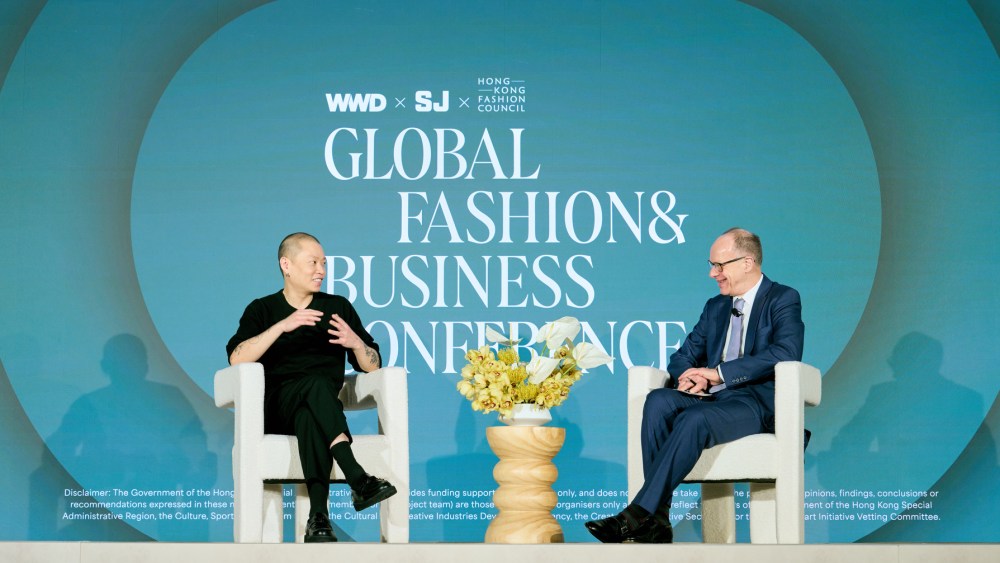
From Michelle Obama’s historic inaugural gowns to cultural collaborations, Jason Wu shared with Fairchild Media Group’s chief content officer how he charts a path built on conviction, creative integrity, and a deep sense of personal and cultural identity at the WWD x SJ Global Fashion and Business Conference in Hong Kong.
Launching his namesake label at the age of 23, Wu said the early years were marked by a blend of naiveté and daring.
“I think it takes a certain amount of ignorance and cockiness to be able to do that. And I think that’s important because to do something interesting doesn’t always make sense on paper,” he added.
You May Also Like
The fashion industry soon thrust him onto a much larger stage when Wu designed First Lady Michelle Obama’s first inaugural gown in 2009. It was a watershed moment that he described as both exhilarating and overwhelming. He dressed the first lady again for Barack Obama’s second-term inauguration ceremony in 2013.

“A lot of people thought I started overnight, which was not the case. I had already been in business for three years. I worked largely within the industry, but nobody in the general public knew who I was,” the designer said.
The overnight recognition stemming from the historic moment of dressing Michelle Obama tested Wu’s resolve and forced deliberate choices about the brand’s direction.
“It was both exciting and daunting at the same time. I didn’t find out until the night of, and I saw it on TV, and all of a sudden, CNN was on the line at 11 p.m., and the next morning, I was on Anderson Cooper. It was kind of a roller coaster, but I said no to a lot of things. I didn’t want to become like an entertainer. I am really a behind-the-scenes person, and I’m interested in design,” he said.
Ultimately, his strategy was one of patience and integrity. Over the years, Wu’s aesthetic matured alongside his own personal development.
“I’ve been through my fair share of amount of good times and difficult times. I think life experience eventually contributed to my work, to give it more depth. The idea of being perfect is no longer ideal for me,” he said, adding that despite taking influence from Christian Dior and Yves Saint Laurent, confidence and experience marked his evolving style.
A defining theme of Wu’s recent work is his conscious engagement with cultural themes and collaborations across disciplines.

Take his recent collaboration with Chinese artist Tong Yang-Tze for the spring 2025 season, for example. Wu simply called up her studio and said, “Can we collaborate? Because I think more people need to know about what you do.”
“For lack of a better word, fashion can make something sexier, and I thought that was a really interesting way to not only take something that inspired me a great deal in my own work, but also to use my platform to bring awareness to somebody that I think more people need to know about,” he said.
Similarly, Wu’s collaboration with the Rauschenberg Foundation for spring 2026 was also organic by design.
“There’s almost no planning when it comes to collaboration. I think when it becomes a formula, it becomes boring, and people can detect that. Consumers now are very smart, and they understand when something is authentic, and they understand when something is conjured up in a conference room,” he added.

Looking forward, Wu said he remains committed to curiosity and growth.
“Having been in the industry for almost 20 years, fashion is, in itself, very different from what it is today and what it was when I started. It will continue to evolve. The one thing I have to question myself all the time is what makes what I do relevant? And by that, I mean, everybody has a lot of clothes. So we have to deliver meaning, and also for myself as well, that what I’m doing is not just pumping out more merchandise to the world,” Wu said.
“I still enjoy what I do. I am still curious about approaching new things, new topics, and collaborating with new people. That’s what I want to do for another 20 years, and maybe make my mark in places more than just fashion,” he added.