
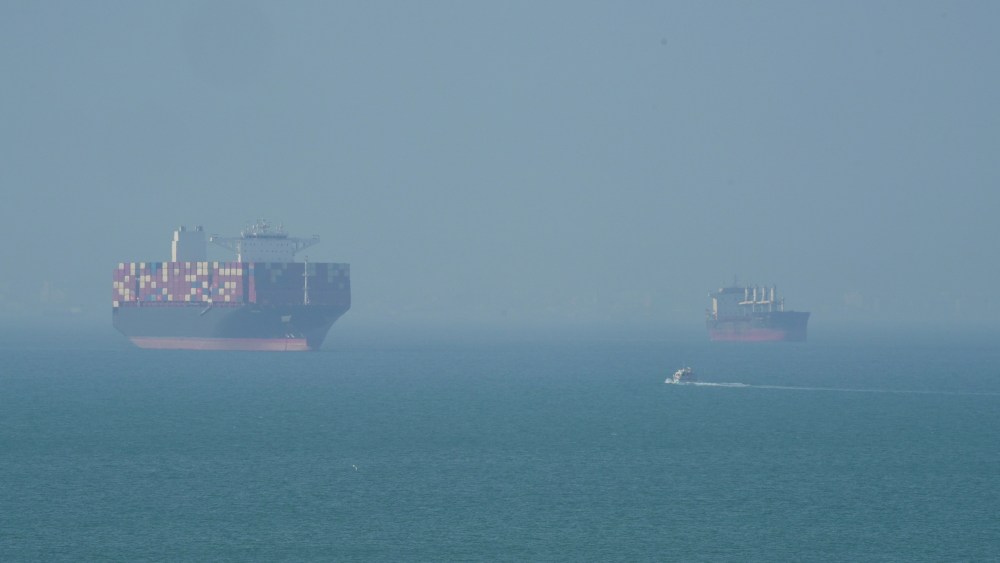
While Iran’s threats against shipping in the Strait of Hormuz have rattled energy markets and pushed up freight rates since the start of the war in Iran, schedule reliability across global shipping improved in the weeks after—a glaring contrast from what occurred at the start of the Red Sea crisis.
According to data from maritime shipping analysis firm Sea-Intelligence, global schedule reliability in March 2026 improved by 3.9 percentage points from the month prior, exceeding normal pre-pandemic seasonal baselines tracked from 2011 to 2019.
Those baseline averages typically increased 1.2 percentage points from February to March, with this year’s sequential shift seeing an additional 2.7-percentage-point structural improvement.
The story in the Red Sea painted a far different picture for worldwide schedule reliability.
While November-to-January baseline averages declined 7.7 percentage points during the measured period, an additional 2.6 percentage points of structural drag held down reliability between November 2023 and January 2024.
During these three months, Iran-aligned Houthi militants in Yemen began attacking commercial ships, resulting in major ocean carriers opting to snub the Suez Canal to instead sail around southern Africa’s Cape of Good Hope. The mass diversions resulted in a 10-to-14-day extension of transit times for goods traveling from Asia to either Europe or the U.S. East Coast, knocking many service schedules off their usual loop at the same time.
“At the global aggregate level, the Red Sea crisis created a measurable drag on global schedule reliability. Conversely, the Hormuz disruption has not yet registered as a global negative event,” said Alan Murphy, CEO of Sea-Intelligence, in a Thursday update. “Unlike the Red Sea crisis, which acted as a transit time penalty, the Hormuz blockade created a hard volume shock. Faced with an impassable strait, carriers did not hold vessels in indefinite anchorage. Instead, they overwhelmingly chose to abandon the blocked network entirely, leading to a near total collapse in vessel arrivals to the Middle East.”
The impacts to logistics operations have largely been localized to the neighboring countries in the Gulf, with Murphy pointing out that carriers were forced to abruptly offload their diverted Middle East bound pipeline cargo at the nearest viable hubs outside the blockade. This includes ports on India’s west coast including Nhava Sheva and Mundra, as well as Colombo in Sri Lanka.
“Because these hubs received massive, unplanned discharges of cargo, a landside bottleneck was generated,” Murphy said. “The sheer volume of this dumped cargo quickly overwhelmed physical yard space, causing schedule reliability crises on unrelated trade lanes which used the same transshipment hubs in their service strings.”
CMA CGM is the latest container shipping company to leverage landside operations in an attempt to keep cargo moving in the Persian Gulf.
The ocean carrier signed a deal with AD Ports Group to extend its reach beyond their shared terminal at the U.A.E.’s Khalifa Port, giving the company multiple inland and gateway routing options across the country and the wider region.
The partners plan to anchor CMA CGM’s ocean-borne cargo flows across AD Ports’ consolidated inland intermodal network of railroad-linked container depots, dry ports and cargo depots. The network extends trade corridor optionality to the borders of Saudi Arabia and Oman.
“By linking maritime services more directly to inland cargo flows, this partnership supports more efficient routing, stronger supply chain resilience and improved service reach for our customers,” said Jesper Stenbak, regional director in the Middle East Gulf, Indian sub-Continent and Indian Ocean of CMA CGM Group in a statement.
The move from CMA CGM follows the recent decision from Hapag-Lloyd to use third-party feeder services to pick up and move goods at Gulf ports that were transported via land.
Project Freedom back on?
Although ocean carriers are pursuing more landside alternatives, vessels trapped in the Persian Gulf could soon catch a break.
On Thursday, the Wall Street Journal reported that the Trump administration is now aiming to restart its operation to guide ships through the Strait of Hormuz.
President Donald Trump first announced “Project Freedom” Monday, with the U.S. military escorting two American-flagged ships, including a Maersk-owned vehicle carrier, through the passage.
But only two days later, the operation was put on hold without much elaboration, other than that Pakistan and other countries requested it to move negotiations forward that would end the war.
The WSJ report revealed that the administration originally scrapped the plans after Saudi Arabia and Kuwait imposed restrictions on the U.S. use of their military bases. Both Middle Eastern countries had reportedly shared concern with Trump over Iranian attacks on Gulf states, as well as fear over a lack of American protection.
According to the report, defense officials told the WSJ that any resumption of Project Freedom would involve the U.S. directing commercial ships through a narrow path that has been cleared of mines under the protection of American warships and aircraft.