PARIS — Consumers are already using artificial intelligence to make beauty choices, such as by trying on color cosmetics or new hairstyles virtually. But those tools are in the process of making a huge leap.
Soon, a bot might be buying — not just suggesting — mascara, hair color, skin care or myriad other products for you.
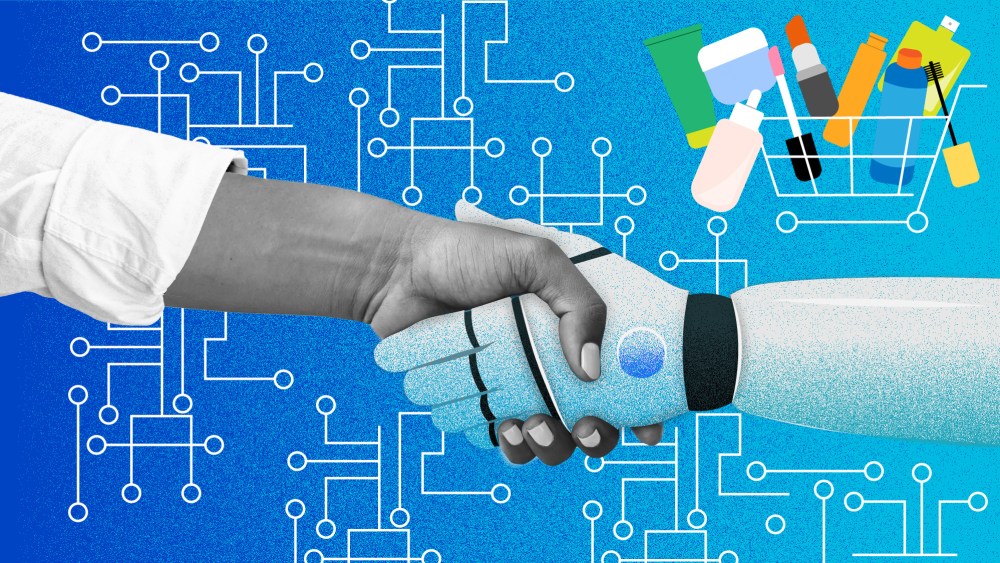
Agentic AI is a swiftly emerging evolution of artificial intelligence that’s changing the game, with ever more autonomous and enterprising bots, or agents. They don’t just answer questions the way generative AI does, but can perform multiple tasks to achieve a particular goal, without being given step-by-step instructions.
Related Articles
“A new era, a new generation is coming,” said Wayne Liu, Perfect Corp’s chief growth officer and U.S. president.
Think of agentic AI as a well-connected, proactive personal assistant. And such assistants can even work together on a task.
“It’s like a human-plus-machine network,” Liu said. “So the AI is not operating individually. Basically, there is an interconnected agent system working together.”
Every agent has some level of autonomy (with non-prompted behavior) and makes decisions based on results. They work through tasks.
Emily Pfeiffer, principle analyst, commerce technology at Forrester Research, gave a theoretical example of how agentic AI could work: “Agentic would mean, you have a budget of $30. ‘Go out and buy me the [mascara] you think I’m going to like the best,’” a consumer might say,” she explained.
Agents would then start communicating with each other in a multistep agentic process. That might include looking at various sites, comparing prices and making purchases. A personal agent within the network could get to know you well, then reach out to other more specialized shopping agents for purchasing ideas.

“They can sense the environment, make a decision for you, and then they can take action,” Liu said.
Going to a wedding and need a look recommendation? “What’s your role in this wedding? Are you the bride? Are you the friend?” Perfect Corp’s new YouCam AI Beauty Agent might ask.
If you’re the friend, the agent knows you won’t want to steal the bride’s thunder, and therefore will recommend less flashy options, for hairstyles and clothing.
This is the future.
“As we enter The Synthocene Era, a future in which synthetic and human intelligence merge, beauty is becoming more emotionally intelligent, responsive and autonomous,” said Olivia Houghton, The Future Laboratory’s insights and engagement director, and lead beauty, health and wellness analyst.
“Generative AI and agentic commerce are transforming how consumers discover, select and even emotionally connect with products,” she continued. “Rather than scrolling through endless product grids, people will soon rely on AI agents that understand their style, mood and values — curating, comparing and even purchasing on their behalf.”
Helping to pioneer the next generation of digital beauty aid is Perfect Corp’s Beauty Agent, launched on Nov. 10 within its YouCam Makeup app. The tool is billed as being the first conversational AI beauty experience for consumers. The agent is more than a smart assistant, since it is creative and can decipher how people express themselves.

Perfect Corp already has tools such as virtual makeup try-on, skin analysis and hairstyle changes.
“[With] agentic AI, all these dots start to connect,” Liu said. “It’s more a conversation, like: ‘I’m going to Egypt. What can you recommend for me?’” The agent might account for the dry environment and strong sunshine there, then give suitable recommendations, mindful of what’s available in that country.”
To help give proper recommendations, the agent needs to understand the person. So it analyzes a photo of their face, considering shape and skin tone, as well as external conditions.
The agent could possibly show how to apply the makeup via a personalized virtual tutorial and try-on. Users can get expert skin care advice or try new fashion styles, too.
A lot more will come, since the few existing agents today do not work together in a broad ecosystem or economy. But imagine Sephora and Ulta Beauty each has an agent. Then Perfect Corp’s agent should be able to interact with them and take action — like make a transaction — on its own volition.
“We’re in the very early days in terms of actually being able to purchase in that environment,” Pfeiffer said. “The products and the process are both still very limited — usually it’s only single-item purchases limited to the websites that have deals with the answer engines to send the product data in.”
Those are generally the largest retail platforms, such as Shopify, Walmart and Amazon.
In order for agentic commerce to become widespread, there will need to be standard protocols for agents to communicate with each other. Other hurdles include consumer trust, payment and privacy concerns.
“Right now, our Beauty Agent is more like a superintelligent beauty adviser,” Liu said.
Shoppers are ready for super-charged beauty-shopping assistance. According to Audrey Depraeter-Montacel, Accenture’s global beauty industry lead, AI has become the top source of beauty recommendation for consumers among active users.
“It’s rapidly becoming a partner for consumers to select their product, their routine and now — with agentic AI — it’s more than that,” she said.
A sophistication of use cases will come to market. “The tech is evolving every day, becoming smarter and smarter,” Depraeter-Montacel said. “It’s a big revolution for this industry.”
Houghton believes that in an agentic future, beauty brands will not just be vying for consumer attention, but for algorithmic preference. “Success will depend on how well beauty products are indexed, understood and recommended by intelligent systems capable of emotional reasoning and contextual interpretation,” she said.
Houghton explained beauty’s next evolution will hinge on machine empathy: AI that listens, feels and anticipates. “As generative and agentic systems mature, brands must design for both hearts and hard drives, creating experiences that are as emotionally resonant as they are intelligently automated,” she said.
What else could be in the pipe?
“B-to-c, we might say rather than creating a subscription on a brand’s website for the mascara I’m going to run out of, maybe I tell my agent in ChatGPT or Perplexity or Google Gemini to ‘make sure I don’t run out of mascara. Buy it for me at the best price you can find, as often as I’m going to need it,’” Pfeiffer said. “We’re not there yet. It’s hypothetical, but I don’t think it’s science fiction. It’s just not today.”
Another challenge Depraeter-Montacel noted is how to find the appropriate way to leverage agentic AI without decreasing a beauty experience’s emotional aspect. “Each brand needs to define what’s the purpose, how they want to use those technologies and in which type of experience,” she said.
Liu suggested with the new tech, the beauty industry needs to keep an open mind and embrace uncertainty and probabilistic thinking.
“We don’t know what exactly is coming,” he said. “You have to leverage this uncertainty, turning the unpredictable into advantage.”
“We’re very early days,” Pfeiffer said. “But this is going to move really fast — and it’s not going to feel like early days for long.”