At almost 40 years old, La Canadienne has evolved from a cold weather boot brand to a premium weatherproof lifestyle brand.
Established in 1987, the brand is distributed across North America, primarily in premium department stores, and at its own retail doors in Montreal and Toronto.
According to president and chief executive officer Nicholas Niro, who joined the company in 2019, the brand pairs Montréal design aesthetics with European shoemaking expertise.
You May Also Like
The footwear focus remains on comfort and fit, and the line now has expanded beyond boots and includes its men’s collection, La Canadienne Homme. Category extensions for the brand over the last five to seven years includes outerwear, handbags and accessories.
Footwear News: Tell me about the brand’s DNA and La Canadienne’s waterproofing feature.
Nicholas Niro: The brand has always had a strong DNA for cold weather winter boots with the waterproof element. We’ve developed a very strong and loyal clientele around that singular product, and in the last five to seven we’ve invested in the brand and [have trademarked] the term City Dry, which is out waterproof technology. We now apply it to our entire footwear collection. So, it’s not just about cold weather anymore. It’s all [closed-toe] footwear, whether it be loafers, pumps, sneakers and, of course, boots and booties.
The added value of the City Dry technology makes our product and brand stand apart in the industry … If you live in the northeast of the U.S. or in Canada, you can experience sunshine, rain, and snow all in one day.
FN: How have you incorporated it more broadly in the collection?
NN: We took the same philosophy in terms of the waterproof treatment in our leathers and suedes, and we applied it to the full range of our footwear expansion. The [leather and suede] is treated through in the drum. It’s not just a surface treatment, and so we work with our exclusive tanneries to achieve that goal.
As we evolved our brand image, we really moved to a positioning of ‘Made for Life in the City’ [in 2020,] and we wanted to take our wardrobe of our customer from day to night, and work to play, and that allowed us to also expand our footwear assortment.
FN: Tell me about your expansion into other shoe silhouettes?
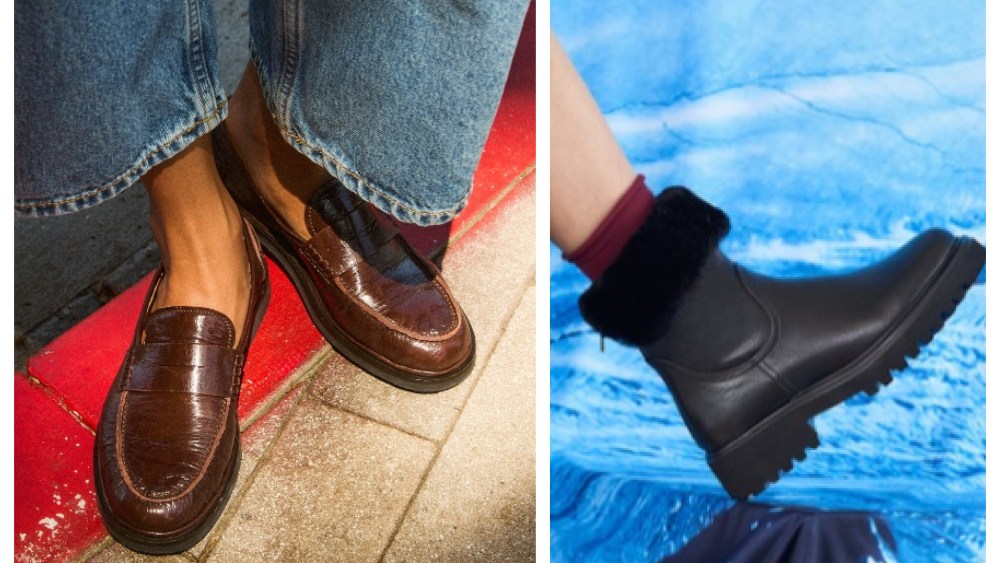
NN: The boots [for cold weather styles] are the point of entry for most customers because that’s what we’re best known for. But we really have successfully transitioned into a full footwear brand offering some loafer styles as well as other silhouettes. We’ve also developed our spring-summer business. Sandals have been performing very well in the market.
FN: How large is your footwear collection now? We see people wearing boots and booties in the summer too, maybe not the shearling-lined, but at least some of the thinner leather and suede boots.
NN: Our shearling-lined boots are not just function. They are a fashion element now. Customers are just loving them because of their cozy factor, and so we do sell those very early on in the fall season. Often in our pre-fall sales, we’ll see shearling items pop up right away, and that goes true well into spring as well. Booties are all year-round. We use breathable materials, so everything is leather, breathable linings, and different soles from lug to transitional, so our boots can live in a wardrobe all-year round.
FN: What are you noticing in terms of style trends? What are customers gravitating towards?
NN: For fall ’26, we’ve really seen an evolution of a more sophisticated styling. So, thinner soles, a bit more transitional, less heavy bottoms. Of course, on our true cold weather [footwear, heavy bottoms] are always valid. But in terms of the transitional booties, we’re definitely seeing a really strong trend toward a more dress aesthetic. [In addition,] brown suede has by far been the strongest material last year and this year. But in terms of actual unit sales, black leather still remains No. 1.
FN: Is black more a cold weather color? And why is brown resonating with consumers?
NN: Customers are investing in our product. They see it as items that are timeless [and] that will live in their wardrobe for several years. Black is a safe color in footwear. But brown is the color that is a must-have this season. We’re seeing a big trend in apparel in a lot of earth tones. We focus a lot on tonal filing — shades of taupe from head to toe, or brown, what we call toast, which is like an earth tone.
FN: Tell me more about comfort and fit in your shoes. Is it about materials, arch cushioning, wider widths?
NN: First, our lasts are several of the lasts that have been in the collection for over a decade, and we always update styling, such as the soles or the heels. But the last, that’s really an important starting point for our customers in terms of fit. Second, in terms of insoles, we already have a cushion memory foam for extra comfort. Third, our lining. We are well known for our microfiber lining and that’s a breathable fabric.
Combined, what it feels like when you put your foot in is that the shoe doesn’t need to be broken in. It fits like a glove the moment you try on the shoe. These are all elements that really add a huge comfort feature for the customer. And our boots always have an elastic gusset or panel just to give that extra give and flexibility so the footwear doesn’t feel rigid on your foot or on your leg.
FN: You worked at Stuart Weitzman from 2010 to 2019 in various roles, including director of global marketing. What were the learnings from working with Stuart himself and the team that you brought to the table when you joined La Canadienne?
NN: My experience with Stuart was very, very fruitful and pivotal in my career. The learning was that there was a lot of core product, and investing in icons that customers can identify is key. That philosophy has certainly informed a lot of our strategy here at La Canadienne.
On the other hand, introducing your customer to newness every season, whether it’s new styles or new colors and materials, gets them excited. And customers need that excitement, even if they end up buying the basic black boot at the end of the day. Presenting and marketing and storytelling newness in the collection is the key, and Stuart always had an incredible imagination for that.”