MILAN — “I actually discovered this brand on eBay,” said Ridgely Cinquegrana tapping his finger on a glass display.
Behind the window, tiny glass bottles hailing from the ‘20s and ‘30s stood as alluring tokens of the rich heritage of Satinine, a Milanese fragrance house tracing back to 1883 and that has been silent for more than half a century.
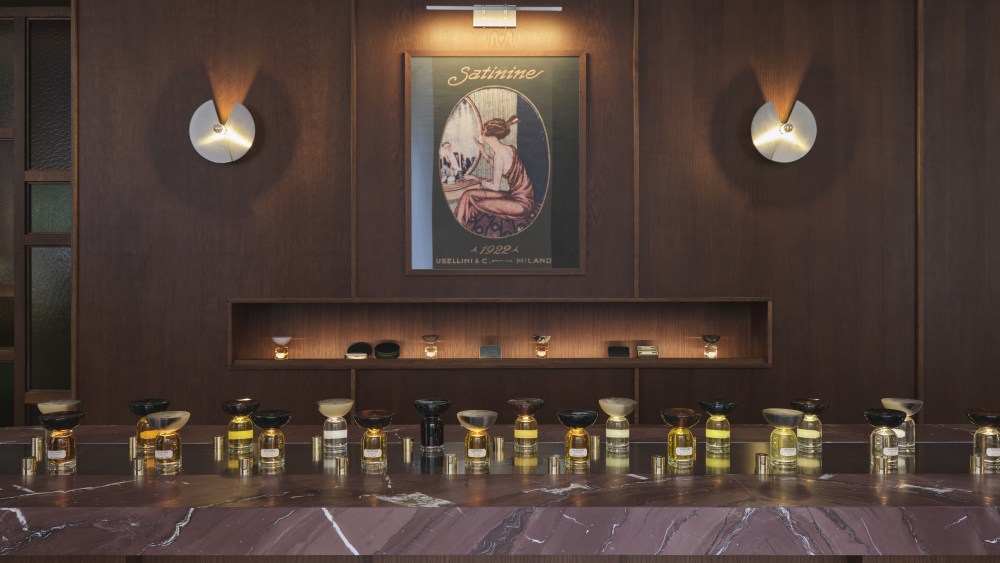
On Wednesday, the label made its official comeback with the opening of a store, dubbed Officina Satinine, that marks the first step of a relaunch orchestrated by Cinquegrana.
Related Articles

A beauty veteran who formerly served as managing director of L’Oréal’s designer fragrance division in Spain and as president of Loewe, Cinquegrana has a knack for all things vintage, from watches to fragrances. Ever since stumbling upon Satinine online, he thought that one of Milan’s secret gems deserved to be known, confident that its heritage will be cherished by today’s beauty customers.
“I’ve been thinking about this project for the past 10 years, but since I live in Miami, it would have been difficult for me to do it,” Cinquegrana told WWD. The venture finally kicked off last year, with the help of Andrea Galletti, who now serves as chief executive officer of Satinine.

Cinquegrana has been a longtime friend of Galletti’s family and has witnessed the CEO’s growth through the years. He followed him closely in his previous experiences, first in London, where Galletti was international sales and marketing manager at Cinquegrana’s company United Perfumes — which contributed in propelling Fornasetti Profumi and Cire Trudon’s international businesses — and then in Milan, when he served as commercial director at Fueguia 1833.
Last year, Cinquegrana told him he had three projects he’d like to launch and that Galletti could pick his favorite. After initial hesitation on going solo, Galletti decided to take the risk and opted for Satinine.

“This was the most beautiful,” Galletti said with a smile, pointing not only to the brand’s rich history but also to its intrinsic artistic quality, expressed in the fragrances’ vessels, as well as documents, posters and visual assets.
Today, Satinine is a registered trademark owned by the Profumieri Milano company, which also curates the brand’s archive. This holds more than 150 original memorabilia across perfumes, pocket calendars, advertising posters and commercial materials dating from the ‘20s to the ‘60s, with the oldest document preserved being a 1903 pocket calendar.

The brand was founded in Milan by Lorenzo Usellini, who initially focused on the import and distribution of toiletry articles. After World War I, Usellini ventured into fragrance creation establishing “Satinine Officina Odoraria.” With the help of his three sons, his work gained international attention in the ‘20s and ‘30s, especially with the “Orchidea Nera” and “Caccia alla Volpe” fragrances cased in flacons crafted by Bormioli Glassworks and displayed at the new store.
At the time, the company increasingly stood apart from French competitors for its focus on studying and applying Italian biodiversity to create in-house olfactory compositions. Such a trait was considered instrumental by both Cinquegrana and Galletti in revamping the brand. Hence, they set up an in-house manufacturing facility to be independent in their production and ensure the use of natural ingredients from Italian cultivars in formulations.

This mirrored one of the insights Galletti carried over from his experience at Fueguia 1833, the Argentinian niche fragrance brand founded by Julian Bedel. “The extraordinary thing about the label was looking at perfumery from a different angle and produce everything internally. I’ve always worked in this industry but there I learned a different way to work with ingredients,” said Galletti.
It’s a lucky coincidence that the CEO found the perfect location for the Satinine store in Via Mengoni 4, a stone’s throw away from Milan’s landmark shopping arcade Galleria Vittorio Emanuele II and the Fueguia 1833 flagship in town.

While Cinquegrana praised the space’s proximity to the city center and luxury hotels as well as its layout ensuring three windows overlooking a bustling street, the address signals a different strategy compared to many niche beauty brands that cram the Brera district, instead — including the likes of Campomarzio70, Montale Parfums, Acca Kappa and Officine Universelle Buly 1803.
Satinine also adds to a cohort of local brands and new ventures increasingly eager to target the niche beauty customer by banking on rich storytelling and old-school aesthetics, such as in the case of Officina Profumo-Farmaceutica di Santa Maria Novella and Eredi Zucca, for example.

To reprise Satinine’s own artistic quality, Cinquegrana and Galletti collaborated with Italian talents ranging from Mara Bragagnolo, who curated the sophisticated interiors of the store, to product designer Franz Degano, who created the new vessels for the brand’s fragrances and home diffusers.
Bragagnolo worked with local artisans and manufacturers in blending selected Italian materials, tactile surfaces, satin lighting and bespoke design elements nodding to the city.

As she reimagined the space winking to the entrance halls of historic Milanese buildings, she had Lombard terracotta-tiled flooring and glossy ceramic tiles contrasting with oak boiserie, cardinal marble and a standout burl-and-mother-of-pearl counter. Satin-steel details and dim lighting developed in collaboration with lighting designer Martina Frattura add to the space, which is divided into different areas, from one evoking a reception and aimed at conviviality moments with customers to a cocoon-like room to discover fragrances privately. A corner conceived as a curatorial area will soon be reworked as an olfactory library to showcase all the ingredients used in the brand’s creations, teased Galletti.

“For me, today there’s no reason to shop in physical stores, since there are so many choices online. If you do, you have to receive something else from the store you step into,” he said.
In addition to informing the discovery and hospitality moments in-store, such an approach trickles down to the product assortment. For its relaunch, Satinine reprised and revisited with modern ingredients its iconic fragrances but also introduced new juices, currently offering a catalog of 21 perfumes. These come in a new, sculptural packaging designed by Degano that draws inspiration from Italian Art Déco. Customers can personalize the bottles by choosing the geometric cap of preference — available in green, tortoise and horn — or favor even higher-end options in marble.

The new versions of “Orchidea Nera,” or “Black Orchid” in English — the blend of florals and exotic wood Usellini introduced in 1929 — and the leathery woody perfume “Caccia alla Volpe,” or “Fox Hunt” he launched in 1932 are priced at 268 euros and 281 euros, respectively, for the 100-ml. size.
Overall, prices for the same format range between 248 euros for the citrusy “Scorza” and 672 euros for the floral oud “Luna d’Egitto,” or “Moon of Egypt.” A 5-ml. format is also available retailing between 22 euros and 60 euros, with set of four fragrances offered in a refined tin box.

Diffusers are equally chic as they were conceived to double as vases and home design objects, each sitting on bio-resin trays. The four different home fragrances and refills are priced between 120 euros and 180 euros, while the entry-price products are soap bars with oat extract or prickly pear, each retailing at 20 euros.
Cinquegrana sees potential in expanding the assortment with scented candles, shaving kits and brushes, as well as by exalting customization, from packaging personalization up to the creation of bespoke fragrances.

As for distribution, he said there is no rush to add doors to the Milanese outpost. “True luxury for me is not pushing and forcing sales. People will come to us and we will pick the right distributors. This store is our place to experiment and fine-tune the project,” he said.
In the meantime, Cinquegrana looks to leverage the in-house olfactory lab also to launch separate ventures or collaborate with indie talents and entrepreneurs, as the facility ensures independency and agility without imposing constraints of minimum orders.