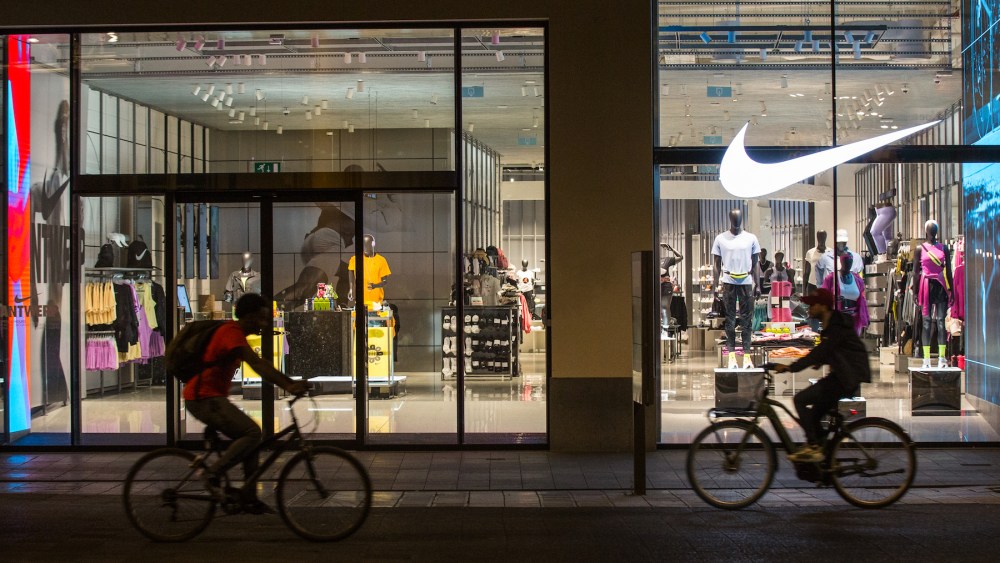
Analysts are taking a deep dive on Nike Inc. and wondering where the Swoosh goes from here in its turnaround.
UBS softlines analyst Jay Sole raised the question of whether Nike has lost its “superpower” status.
“We believe Nike’s “superpower” over most of its history has been its ability to be all things to all people,” Sole wrote in a research note, adding that the brand has been admired by all age, gender, race and geographic groups. And while it could sell “billions of dollars worth of lower-priced products and still be recognized as the best, more prestigious, most high-end sport brand in the world,” Sole says that with a “meaningful portion of growth” coming from lower-end channels, the brand may be eroding its reputation as a high-end brand. And that could result in Nike losing its ability to connect with high-income customers, he concluded.
“This ‘all things to all people’ characteristic explains Nike’s very large total addressable market (TAM) and why it dwarfs almost all other brands in terms of revenue and market share,” Sole wrote, adding that there are now reasons to question whether this reach is even still feasible.
You May Also Like
Sole rationalizes that Nike faces a much tougher competitive landscape. The emergence of brands such as On and Hoka, and the renaissance of brands like Asics and New Balance, have made it harder for Nike to be viewed by consumers as the most premium sports brand that it was 10 years ago. “These rival brands have carved out high-end niches that could be pushing Nike downmarket in the minds of consumers, the UBS analyst reasoned.
He also said that Nike’s distribution appears to be skewing toward lower-end channels, such as reverting back to Kohl’s, DSW, Academy Sports and Amazon. And Sole even questioned whether Nike has, in fact, regained its position in the U.S. run specialty channel.
“Thus, the question is where are the places to buy premium Nike product and what percentage of its distribution do these channels represent,” he pondered. Other than Nordstrom, Dick’s Sporting Goods, Nike.com and a few other places, Sole said the majority of Nike’s U.S. revenues seem to be from mid-tier department stores, mid-market sporting goods stores, off-price and the company’s own outlet stores.
He emphasized that this doesn’t mean that Nike can’t sell higher-end product, only that investors can’t be sure that Nike isn’t training its customers to “expect to pay only mid-range to low-end prices” for its merchandise.
Another issue Sole noted is that Nike historical strength in basketball appears less relevant today. “Nike’s superpower is based, in part, on being able to maintain an image of being the best sports brand despite selling a lot of commodity products,” Sole said. “Basketball was a vehicle for being able to do that. It’s unclear whether Nike can use basketball in the same way today. Plus, it’s not clear what other method Nike has to regularly refresh its image with US consumers.”
Sole also mulled how big Nike’s fashion-driven sportswear business should be moving forward.
“A decade or so ago, Nike said sportswear should never become more than 30 percent of its mix, otherwise the brand risks compromising its integrity as a sports performance brand,” Sole recalled.
The UBS analyst said that Nike noted in its last earnings call that sportswear is now more than 50 percent of total sales. “For Nike, its ‘sportswear’ category is essentially its fashion business. All other categories, such as running, basketball, soccer, training, tennis, etc. are ‘performance’ categories,” he said. Sole also raised the question of using sportswear as a category to drive short-term growth, which he said might have been a misstep in retrospect.
But he also said Nike’s ability to sell fashion products has a direct correlation to its strength in sports — because when “Nike satisfies an athlete’s need for performance products, the athlete is happy with Nike and then wants more of the brand as part of his or her daily life.”
This perspective “gives Nike an ability to credibly and authentically sell fashion product to a loyal performance product customer who isn’t confused about what the Nike brand stands for,” Sole concluded. “We believe Nike’s commitment to sport and investment in performance product innovation and sports marketing is how it built its brand equity.”
So what might have gone wrong? Sole said over the past five years or so, Nike led with fashion instead of sports, meaning it was selling to a customer who was buying fashion trends and fashion trends shift quickly. “We believe that for Nike, the fashion trend has moved away from them and now many customers have moved on to other brands because they were never consumers of Nike sports products,” Sole said. In short, they “didn’t have the loyalty to the brand that sports help Nike create,” making Nike another fashion brand competing with others in the marketplace. Sole said Nike should consider returning its sportswear business to a level closer to 30 percent.
Sole isn’t the only analyst who raised questions around Nike’s two main categories of business.
BNP Paribas Equity Research’s senior analyst Laurent Vasilescu queried whether Andy Caine was the right person to replace Tony Bignell as chief innovation officer. He noted Caine’s background as creative designer of sportswear, and said that his experience is on the lifestyle piece of the business.
Vasilescu also noted issues with the brand’s performance offerings, noting how Nike at one point received pushback with the Major League Baseball uniform designs as players complained that spectators could see through to the undergarments.
As recently as last week, new global soccer jerseys appear to have puckering around the shoulders. The BNP analyst concluded that instead of offering soccer team kits ahead of the World Cup, Nike needs to do is “fix its performance innovation mishaps.”