
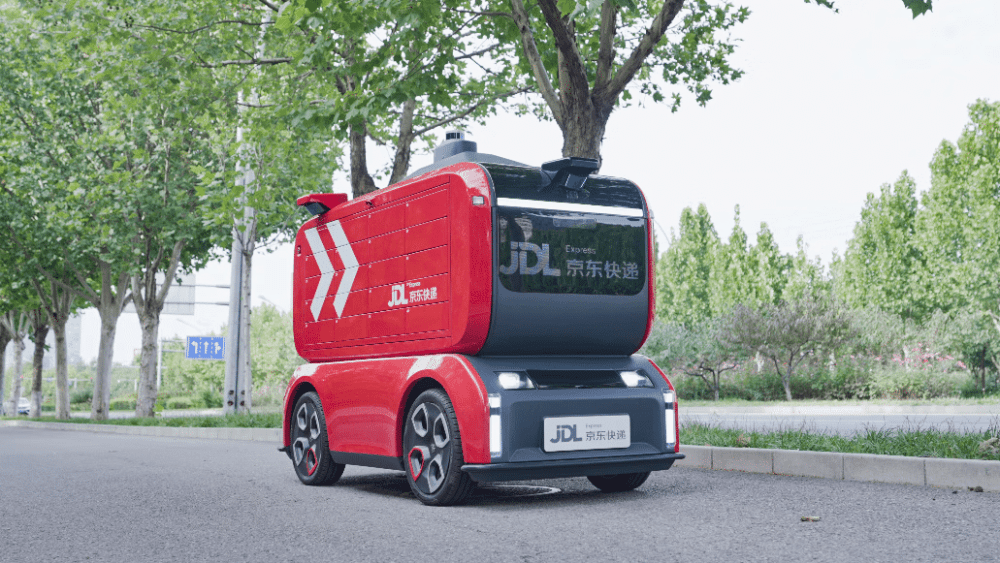
JD.com founder and chairman Richard Liu Qiangong sees a future where all of his company’s 700,000 delivery workers are entirely replaced by robots.
But the executive sought to quell concerns that the proliferation of robots throughout the supply chain would mean mass unemployment, both at his company and across the Chinese economy.
“In the future, when robots are delivering parcels, sooner or later, there will be a day when couriers are basically no longer needed,” Liu said. “It will definitely be robots delivering parcels. But I really do not want our 700,000 brothers to go without meals, without jobs.”
According to Liu, the logistics provider had signed contracts with about 120 schools in China to retrain its army of couriers for new work such as repairing and maintaining robots.
At the Asia-Pacific Economic Cooperation CEO Forum in Beijing on Sunday, Liu unveiled the mass retraining initiative, dubbed the “Nirvana Project,” alongside a pledge to open the company’s AI technologies to international partners.
“As a corporation, if you develop new technologies, they should be used to make human lives better and work more engaging, rather than depriving people of their right to work,” Liu said during the panel.
Additionally, Liu said robot repair jobs would become common “because robots are machinery…they will always, at some point, have faults.”
The founder followed up comments he made in May, when he said that JD.com would not fire any employee whose job was being replaced by robots. Liu committed to ensuring impacted employees would be retrained and reassigned elsewhere.
Liu did not forecast when robot deliveries would become widespread in China. However, the company has sought to do its part in ensuring that robotics will dominate its supply chain over the next five years.
Late last year, JD Logistics, the company’s supply chain and logistics wing, unveiled it would purchase 3 million robots, 1 million autonomous vehicles and 100,000 drones through 2030.
The announcement followed the unit’s continued deployment of hundreds of autonomous vehicles across more than 10 provinces and 30 cities nationwide as of last August. In November, Liu said the delivery vehicles had surpassed several million kilometers of testing. On top of that, unmanned trucks had internally accumulated over 700,000 kilometers of their own.
JD Logistics also expected to launch its first completely unmanned delivery station in April, which would include spaces for its autonomous delivery vehicles, as well as areas for delivery drones. However, the company never confirmed the opening of the warehouse.
Top competitor Alibaba is also banking on an abundance of autonomous technology throughout its supply chain over the next few years. Its logistics arm, Cainiao, expects more than 200,000 unmanned vehicles to be deployed across the Chinese logistics industry within by 2030.
As of April 2025, Cainiao said its autonomous vehicles had delivered more than 40 million parcels, accumulated more than 5 million kilometers of self-driving experience and were deployed in more than 30 counties and municipal-level regions in China.
The developments coincide with the growth of “gig workers” in China, which are expected to reach 320 million in 2026. This represents a 60 percent increase from the 200 million that had been in those jobs in 2021, according to the China New Employment Forms Research Center.
Policymakers have sought to assure that gig workers, which often come in the forms of drivers for delivery and ride hailing, won’t be casualties of the increasing adoption of robotics technologies across China.
In March, Wang Xiaoping, China’s human resources and social security minister, said the government was exploring effective ways to expand areas such as social insurance coverage for 25 million workers across 17 provinces. Wang said the ministry is seeking to expand the program nationwide.
Wang also noted China will continue to roll out standards to better regulate the development of newer professions resulting from the shifts—such as artificial intelligence (AI) trainers and drone pilots—and evaluate workers’ performances.
Like its counterparts in Washington, Beijing has made a concerted push into robotics and AI, with the technology featuring in China’s 2026-to-2030 “five-year plan” policy strategy that was approved and released in March.
According to the International Federation of Robotics, China aims to position robotics at the heart of its modern industrial system and pivot its AI research toward physical applications “with robots as the main drivers for economic growth.”