PARIS — Gold surging beyond $5,100 an ounce for the first time in January left a chill for most, but the high jewelry scene remained as effervescent as ever.
While a number of big players have now moved their major launches to the spring — and splashy destination locales — Place Vendôme cornerstones and newer signatures made good use of the moment to showcase storied pasts, creative chops and new ways of working.
Houses such as Boucheron and Chaumet gave new incarnations to elements mined from their deep archives, whether a signature motif or even a historic address. Bulgari pushed its definition of precious by highlighting precious clutches. Others including Messika, Repossi and Graff, dovetailing their high jewelry with a broader selection of their offerings.
With reason: the already flourishing sector shows no signs of flagging.
You May Also Like
Already a shock absorber in a difficult market, jewelry is set to continue growing with a high single-digit compound annual growth rate over the years to 2030. Its status was made even more compelling across price segments by precious metal content, creative value, and the aura of the brands.
Prospects are further reinforced by the prospect of a K-shaped economy, a widening of income and wealth inequality that was described by Bernstein analyst Luca Solca in a recent research note.
This ongoing interest in jewelry as a top-performing category is changing the face of a period that traditionally has been devoted to its uber-luxe segment. As the price gap between fine offerings and high jewelry shrinks, January is now a wide-open playground and jewelers are comfortable stretching collections across price points.
Take Patcharavipa Bodiratnangkura. Her fine jewelry line’s latest collection played with rare natural woods such as thuya from Morocco, South American snakewood, or white oak hailing from Thailand, paired with 18-karat gold and diamonds.
Patacharvipa pieces set with stones well under 0.5 carat cost between 2,600 and 5,500 euros, but swap the center stone for a 10-carat princess-cut and the price tag leapt north of 520,000 euros.
Also straddling that boundary was third-generation diamantaire Sahag Arslanian. At his new boutique on Avenue Matignon, he showed rows of diamonds going from lightest pink to vibrant peach, or the faintest blue to stronger hues.
Such tones excite collectors and often make headlines with prices in the tens of millions, but he “wants to make things that are in the realm of jewelry you can wear” regularly, he said.
So instead of facing a $7 million price tag for an 8-carat fancy intense purple-pink diamond, his client could have a 0.6-carat stone for a mid-five-figure sum as a pendant or quotidian ring.
For Valérie Messika, couture week is when her retail partners traditionally come to discover her brand’s latest fine jewelry lines. New this year was the genderless Moderniste collection, playing on faceted planes in polished and brushed gold, gem-set or not.
It was also the first time she unveiled four sets continuing her “Terres d’Instinct” high jewelry collection — themes are teased in July and fully unfurled with runway shows during October’s Paris Fashion Weeks.
“Given the expansion we’ve had in high jewelry in recent years, it felt indispensable to place ourselves during couture at the beginning of the year, something we didn’t do before,” she told WWD. “We gained in terms of legitimacy, because don’t forget that eight or 10 years ago, we weren’t an actor” in the segment.
While clients angling for the most rarefied pieces show no signs of flagging interest, Messika described the skyrocketing price of gold as “a catastrophe.”
“If it lasts, we will have to be bold and think outside the box,” she said. “You’ll have to be creative to find palliative measures and solutions to continue making jewelry desirable without becoming unaffordable.”

Skyrocketing precious metal prices have “strangely had a beneficial effect,” said Sarah Madeleine Bru, whose Paris- and London-based jewelry business evolved toward a greater emphasis on bespoke work in the past year, with five-figure orders trickling in.
“Clients do have a budget but they also have more wiggle room,” she continued. “Not only do they feel like they’re treating themselves, but they also see it as an investment, which helps justify the expense further.”
That said, she has to navigate carefully given daily hikes in precious metal prices, with white gold and platinum now neck-and-neck. “When I quote, it’s now valid for a week, where it used to be two or three,” she added.
Ensuring clients can soften the blow is what motivated Loyal.e founder Maïssa Zard to introduce a gold buy-back program in January, an idea that sprang from her rediscovery of long-forgotten childhood and teenage jewelry.
“With the historic rise in the price of gold, I realized that instead of letting them sit in a drawer, why not transform them into a Loyal.e piece that I could proudly wear every day,” Zard told WWD. “This surge in prices is a reminder that a gold jewel is not just an object of desire.”
The day’s gold price is displayed in the B-Corp-certified French jeweler Paris store, and consumers get credit toward new purchases from the brand.
Clients are receptive to “the simplicity and transparency of the process, which feels reassuring and efficient,” and leave “with the satisfaction of having participated responsibly in the creation of their future piece of jewelry,” the founder said.
But for established players, a moment of immersion in a collection’s back story, either through a visit to archives, a grand setting, or a glittering soiree, remained the preferred method.
Never mind the dismal winter weather: Dior recreated the gardens the late founder so loved inside a Parisian townhouse to accompany the reveal of “Belle Dior,” an expansive 57-piece collection where artistic director of Dior Joaillerie Victoire de Castellane embraced the house founder’s passion for gardens and celestial bodies.
Moons and stars adorned from the Soleil Céleste set, comprising a striking necklace with long gem-set lines radiating in a glittering plastron and a 5-carat pear-cut yellow diamond, earrings, rings, and a transformable brooch-cum-hair clip.
She even created poetic dreamscapes on the dials of the D de Dior Précieuse à Secret Diorama jewelry watches. Throughout, her eye for color shone in gradients of blues comprising tanzanites, sapphires and blue-green tourmalines, or pink ones playing off rubellites, pink spinels and spessartite garnets.
Elsewhere, January collections skewed rather compact.
Chaumet drew on a motif and technique combination from its archive in a capsule of nine pieces, while Boucheron condensed its early history in a quartet of transformable jewels and Mellerio dug deep in its coffers for the ancient rose-cut diamond that was the star of its sole high jewelry piece of the season, the “Comet” ring.
For its “Envol” capsule, Chaumet brought editors to its archives to highlight the filiation of the enameled wing motif it developed. Present in its design vernacular since the 19th century, it was at the heart of a design that caught the eye of Gertrude Payne Whitney, the Vanderbilt heiress and sculptor who later founded the eponymous New York museum.
In its latest incarnation, deep midnight sapphires matched with delicate, translucent blues executed in grand-feu enamel. Transformation remained key in these designs, which included an aigrette tiara with a 3.92-carat center stone that required 850 hours to make. With a distinctive V-shape nodding to an aigrette, the wings element could be also be affixed to a gold handle to turn into an opera eye mask.
A few doors down, Boucheron retraced its founding era in “Nom: Boucheron Prénom: Frédéric,” a nod to the way a person’s identity was recorded on professional cards back in the day.
Creative director Claire Choisne zoomed in on the ways the founder changed the face of jewelry, from setting up shop in the corner building at the tail end of Rue de la Paix that it still calls home to its creations that followed how women became free to dress and adorn themselves unaided.

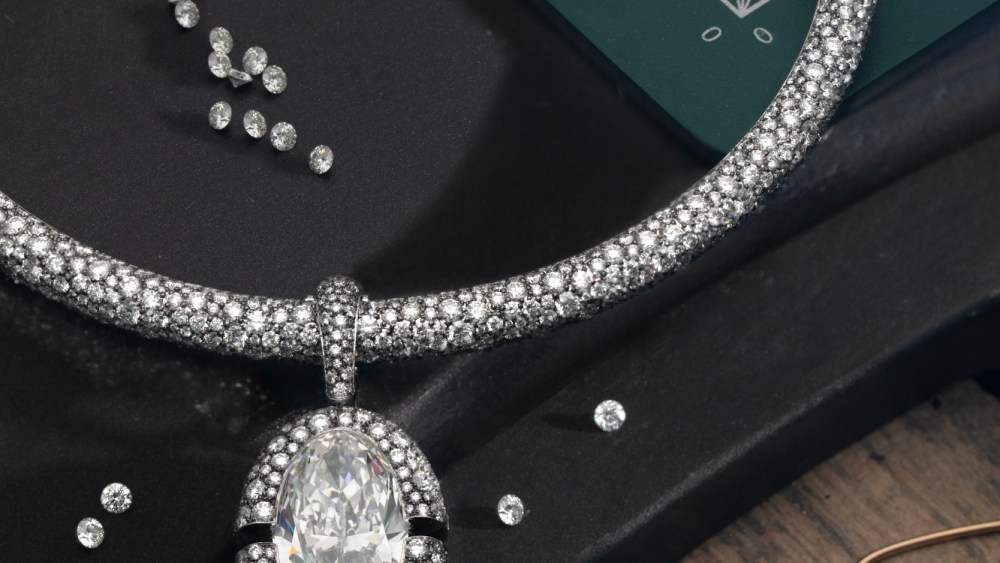
Most striking was “The Untamed,” an open tumble of ivy leaves that is based on the very first question-mark necklace sketch. Dated around 1879, this design had been executed in simpler versions but never yet in its full glory — a 40-centimeter leaf line that stretches from the neck to the waist that required 2,600 hours of work and over 3,000 pavé-set diamonds.
Other jewelers put the spotlight on their technical chops, expanding their mastery of traditional metalworking and gem-setting with new ideas or tools.
Repossi finessed the rose gold used in its latest spiraling Blast high jewelry pieces, playing up its yellow gleam under a gradient of orange gemstones.
Anna Hu’s orchid-inspired jewels were all the more lifelike thanks to the engraved titanium and nano-electroplating employed to make them.
Exceptional gemstones remained par for the course at Graff. But it harnessed 3D technologies to lighten the metal structure underpinning a masterpiece necklace with a geometric diamond setting further livened by a scattering of pear-cut diamonds and sapphires evoking water droplets — and a 31-carat emerald-cut sapphire.
Meanwhile, brands without a permanent Paris presence paired with designers, accenting couture looks with their jewels. Rahul Mishra’s latest collection were accompanied by jewels from 32-year-old brand Tanishq, while one-year-old Indriya Jewels teamed up with Gaurav Gupta.
For the first high jewelry collection of the four-year-old Thayná Caiçara label, founder Thayna Soares Sineiro staged a runway show in a gallery on Rue Saint-Honoré.
Stars on the runway were pieces inspired by the colorful fauna of her native Brazil set in Paraíba tourmalines, emeralds, diamonds, sapphires and rubies, priced between 12,000 and 93,000 euros.
It’s a moment that she felt couldn’t be missed for a jeweler. “I see a big difference between January and July,” she told WWD. “July has more bloggers, artists; clients, I see more in January, a movement I noticed in recent years.”

Other brands made front row appearances, like Milan-based newcomer Maison Antoine, whose nature-inspired rings and earrings were spotted on Nicole Kidman.
But for husband-and-wife duo Nicola Galuppo and Eliana Sbaragli, who launched the brand in 2024, it’s about conversations rather than straight-up carats.
“Our client is a person who is already a client of Bulgari, Van Cleef & Arpels, this type of brand,” said Galuppo. “They don’t search for iconic [shapes], because they have them but they want ‘real high jewelry,’ which means not just a piece but a stone — not just its size but its particulars.”
Such an approach is what helped the brand hit the 6.5 million-euro mark in sales for 2025, its second year, according to the cofounders.
A$AP Rocky’s Pavē Niteō label got its soft launch at the Chanel couture show, as sharp-eyed editors asked the multihyphenate artist about the clutch of imposing skull rings he wore, all designs he created in collaboration with Venetian jeweler Codognato.
But the week wasn’t all work and no play.
Cartier trotted out the third chapter of its “En Équilibre” high jewelry collection in the wood-paneled drawing room of the Arts Décoratifs. As eye-catching as were designs such as the Panthère Algarrobo necklace with its 50-carat aquamarine, plus more to spare in the shape of hundreds of gemstone beads, they were the appetizer to a lively dinner with British actress and brand ambassador Gemma Chan.
At the Bibliothèque Nationale, France’s national library, Bulgari celebrated its idea of culture being carried in each creation — here the precious minaudieres clutches imagined by creative director of leather goods and accessories Mary Katrantzou, with a dinner attended by the likes of Olivia Palermo and Johannes Huebl, Paloma Elsesser, Camille Razat and Kelly Rutherford.

Meanwhile, De Beers London fêted its largest-yet flagship on Rue de la Paix with a soiree at nearby Hôtel d’Evreux that culminated with a showcase by Lily Allen. Along with the transformable Echo necklace — boasting six different combinations including a tiara and earrings — it’s the energy of a youthful brand that CEO Emmanuelle Nodale wanted to telegraph.
“If I had all the money in the world, I would just have dinner parties with all my jewelry out,” joked Academy Award nominee Kate Hudson several nights later in the same gilded salons, this time taken over by Italian green diamond specialist Garatti. Hear, hear.