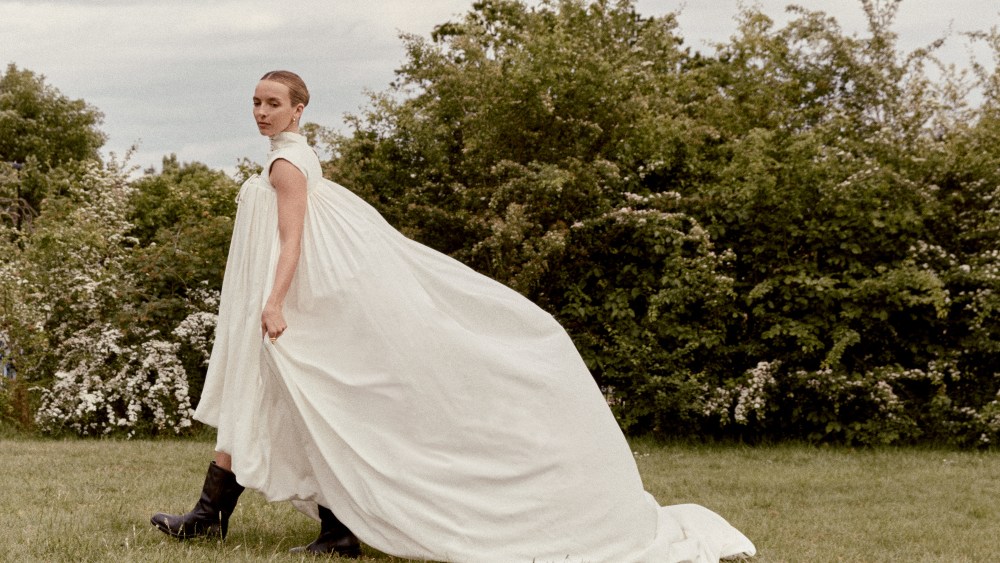
It’s rare that an actor shows up to a shoot with a best friend in tow, but Jodie Comer does it all the time. She goes everywhere — even on film sets — with her dog, a fluffy cream and butterscotch Australian labradoodle with an air of calm and a sweet, inquisitive gaze that follows the actress everywhere. “We’re like Batman and Robin,” says Comer. “My dog is my life.”
Comer, the award-winning stage-and-screen actress who rose to fame playing the multilingual Russian assassin Villanelle in the BBC thriller “Killing Eve,” has had to channel a similar air of calm and awareness for her latest film, “The Death of Robin Hood,” which will be released on June 19.
Shot in the wilds of Northern Ireland, and starring Hugh Jackman, Bill Skarsgård and Noah Jupe, the film was a departure for the 33-year old actress whose past roles have been louder, more action-packed and angsty.
You May Also Like
Written and directed by Michael Sarnoski, the film is an arty, offbeat take on the myth of Robin Hood, and tells the story of a repentant 13th century warrior, played by Jackman, who regrets his life of murder, marauding and revenge.

After a bloody, final job alongside his longtime lieutenant Little John, the injured and limping Robin spends his final months in a remote, hillside priory run by Comer’s Sister Brigid, a religious mystic with her own demons who helps him heal physically and spiritually.
The role was quiet, mediative — and a challenge for the 33-year-old actress. But Comer is always one to push her limits, defy convention, and take on roles that are dark, nuanced and not pretty. She is an actress with a capital “A,” and despite winning BAFTA, Emmy, Tony, Olivier and myriad other awards, which she keeps on a desk in her spare room at her London home, Comer is determined to prove herself and fulfill her potential.
Body and Soul
She worked hard on Brigid, reading books about 13th century healing, medicine and alchemy, tapping into the character’s thoughts on mythology and philosophy and channeling her poise and grace in the face of so much tragedy.
“My energy is not still, and the role is different to how I operate as a person. But what I admired about Brigid was her ability to be a keen listener and observer. And while it was definitely a change for me, I felt so held by the material and trusted the director,” says Comer, who’s reclining on a sofa in a private London home surrounded by greenery.
She’s just torn open a little pack of Haribo gummies after a long day’s shoot, and is chewing thoughtfully.
“There were so many undercurrents to Brigid. She is having to hold so much in, but she’s still a matriarch with so many people seeking her lead and her care,” says Comer, adding that it took one read of the Robin Hood script for her to say “yes” to the project. She’d been eager to work with Sarnoski ever since she saw his 2021 film “Pig,” about a reclusive truffle hunter whose beloved pig is kidnapped.
“It’s rare to sit down with a script that feels complete — and sings! It was stunning. It felt poetic and I found Brigid’s poise and grace really inspiring. She is able to transmute her pain, and not meet violence with violence, and I found myself pondering how I would behave if I was confronted with someone from the past who had inflicted so much pain on me,” she says.
Comer was also fascinated by her research, and in particular attitudes to the body and soul during the Middle Ages.
“At the time Brigid was treating people there was a fundamental sense of hope, and belief in the self. The soul and spirituality were just as an important as physical and matter. Body parts were associated with astrological signs, and there was this kind of notion of people being linked up to something greater. Brigid tells stories, and at the time there would have been song and prayer to help with [a sick person’s] morale,” she says.
Comer herself is a natural carer. Midway through the interview, she lays a little blanket near her feet for the dog, who is keeping a close eye on proceedings. She keeps a bowl in the same bag as the blanket, while a retractable leash sits on a nearby chair. The dog has a name, but she wants to keep it private.
When it comes to herself, she’s more open, talking about fashion and what she wears. For the interview, Comer is in a variation of her day-to-day uniform of jeans and trainers. The jeans are Agolde, the trainers are leopard print Adidas x Wales Bonner Sambas, and the top is a cute Free People cardigan that resembles vintage thermal underwear.
“My dream outfit is me looking like I’m in some kind of pajamas,” she says with a laugh, although she’s happy to go glam, too. She names Givenchy‘s Sarah Burton as one of her favorite designers, and wears Khaite, Alex Eagle, vintage Chloé (which she picked up at Selfridges) and The Row, although the latter is only for special occasions due to its famously hefty price tag.
“If I’m going in on The Row, I have to really justify it,” she says with a laugh.

Going to Darker Places
The relationship between body and spirit also plays a big part in one of Comer’s upcoming projects, a musical film called “Stuffed,” about a taxidermist whose secret ambition is to stuff a human being. She finds a man, played by Harry Melling, on the dark web who volunteers to do it.
The musical is based on a short film by the writer-director Theo Rhys, and is cowritten with writer-composer Joss Holden-Rea, who created the original music and lyrics. It is based on Rhys’ award-winning short film of the same name, which was released in 2021.
After reading the script, and listening to the music, Comer says her first thought was, “‘What!?’ I could not believe what I was reading and hearing — it was just so surprising. The film is macabre, but it is also tender, funny and unassuming. It is stylized, and felt really original. What a breath of fresh air in a world in which so much is getting remade. I’m really excited by it, and I think the people will be surprised when they see it.”
If Comer has her way, “Stuffed” won’t be her last body-related horror film.
Asked which directors she’d like to work with, Comer names Lynne Ramsay, whose work includes “We Need to Talk About Kevin,” based on the bestseller by Lionel Shriver, and “Die My Love,” about a young mother losing her mind to postpartum depression. She’d also like to work with Julia Ducournau, the Palme d’Or-winning director known for the body horror drama “Titane,” and “Raw,” about a veterinary student who craves human flesh.
It’s difficult to imagine those dark yearnings coming from a dog mom who loves yoga, holiday cooking classes and spending quality time with her family when she’s back home in Liverpool.
But Comer has clear reasons for her interest in the genre.
“Body horror is usually a symbol for something, and as a viewer you’re encouraged to lean in a little bit more and interpret it. There also seems to be something quite daring about it. There are also quite a lot of things regarding our bodies that feel quite taboo, or that we’re quite shameful of, and [those films] kind of pull the cloak off of that — which I like,” says Comer.
She added a dash of raw physicality to Brigid’s character in the “The Death of Robin Hood.” There is no nudity or sex in the film, and Brigid’s relationship with Robin is platonic. But he does catch her alone one night, masturbating on the ground in front of a candle-strewn, outdoor altar, under the stars. The scene is discreet, and she is clothed but the moment is intimate and erotically charged.
“Brigid was so in tune with nature — and herself — I felt like it was an opportunity to move emotion. It wasn’t gratuitous or necessarily about her being sexually attracted to him, but I feel like his being at the abbey and his energy and the conversations they were having probably would have stimulated something for her, and given her a way to release something that she was holding on to,” says Comer.
“Although the scene was never explored in that much depth, that’s how I made sense of the moment, which was almost quite somatic. It was her way of shifting something that was going on inwardly. It was a poignant moment for me, because I’m not sure how much of Brigid’s backstory was going to remain in the film. She wasn’t born a holy woman — it was a role she took on,” she adds.
Jackman says working with Comer “felt beautiful, easy, simple and natural. There was a commitment and a desire for something deep, truthful, real and epic that we shared. Every day I would come away, just being blown away by Jodie and my other fellow actors Bill and Murray [Bartlett]. It’s one of those movies where a lot more is said outside of the lines, and that’s when you know when there’s a real connection. And I think audiences will feel that.”

The Life of an Actress
From the moment she started going to drama school as a 12-year-old, Comer knew acting was for her. She originally went for fun, and to spend time with her friends on the weekends, but it got real very quickly. She did small jobs, such as radio plays, “and I didn’t want to do anything else. I just loved it, found it fulfilling and wanted to put everything into it,” says Comer, adding that her parents were supportive, and always encouraged her take responsibility for her decisions.
She doesn’t come from an acting family. When she was growing up her mother worked for a commuter rail company in Liverpool while her father was a physiotherapist and masseur for Everton football club. After radio, she moved to television, appearing in British series including “Holby City,” “Silent Witness,” “My Mad Fat Diary,” and period shows including “Lady Chatterley’s Lover,” and “The White Princess.”
Since her breakthrough role in “Killing Eve,” she has appeared in myriad feature films including “Star Wars: Episode IX — The Rise of Skywalker,” “The Last Duel,” “The End We Start From,” and “28 Years Later.”
In March, Comer wrapped a sell-out U.K. and Ireland tour of “Prima Facie,” a one-woman show where she plays a thrusting, working class barrister who defends men accused of sexual assault, and then becomes a victim. In 2023, she scooped a Tony Award and a Laurence Olivier Award for her performances on Broadway and in London’s West End.
In addition to “The Death of Robin Hood,” and “Stuffed,” upcoming projects include “The Last Disturbance of Madeline Hynde,” a psychological thriller directed by Kenneth Branagh who last year compared Comer to Meryl Streep. “I consider myself fortunate to have worked with her at this stage in her career,” he told The Times of London last year. “As somebody once said of the young Streep, ‘I wish I had shares in her future.’”
Just like Streep, Comer also has a gift for accents, local and foreign. She may speak with a strong Scouse, or Liverpool lilt, but in “Killing Eve” she speaks English and Italian with a Russian accent, and slips easily between posh English, Australian, nasal New Yawk, French and German. She can also do regional English accents, including Essex and Newcastle, the latter of which she had to put on for “28 Years Later.”
Comer was born with the talent, but she also works at it. “I think I just have a good ear. I was always doing silly impressions and stuff at home, or if there was an advert [on TV or radio] with an accent, me and my dad would always joke around and do it. So when it came to doing auditions, I wasn’t scared of trying” she says.
She still does a lot of prep.
“I probably got a bit out of hand on ‘Killing Eve,’ and it is always important to me to do an accent for a reason. Some come easier than others, but you want it to feel authentic, and you want to get to a point where you’re not having to think about it.” She says the Newcastle, or Geordie, accent needed a lot of work “because I wanted it to be an authentic portrayal.”
Comer was proud to take “Prima Facie’s” Liverpudlian barrister, Tessa Ensler, to Broadway and showcase her native accent in America.
Phoebe Waller-Bridge, creator, head writer, and executive producer of the first season of “Killing Eve,” says Comer has enormous range.
“She has the ability to go from glacier to blow torch in a matter of seconds. She is dexterous as hell, and so exciting on set — without any ego. She’s a professional firework — always emotionally truthful while being constantly surprising. I loved her innate sense of mischief, and her ability to show all the colors of a character in a look. That superpower of hers is what powered Villanelle. She’s the dream,” she says.
Sarnoski also admires Comer’s protean qualities, and wanted her to play Brigid for a number of reasons, including the “childish sweetness she can access — which you see in ‘Killing Eve.’ But she also has this depth, poise and mystery to her in a lot of other roles. She feels weirdly ageless and outside of time — both young and seemingly ancient, with a complexity and range that the prioress needed.”

The Road Ahead
Comer wants to do more of everything — more stage, screen and TV — as long as she’s acting and learning. She loved “Prima Facie,” and would like to return to the stage with an ensemble cast.
“The beautiful thing about theater is there’s room for experimentation and playfulness. You have that immediate relationship with the audience, and it’s very kinetic and alive. There are a million possibilities and opportunities every night to explore something new, unlike TV or film which both have a finality to them. The theater is more of an actor’s medium, because once you go on stage, it’s your show. If you want to try something, you have the freedom to do it,” she says.
“The stage is also very exposing, which is why I wanted to do ‘Prima Facie’ in the first place. I was scared of it, and I didn’t know how I was going to get to a point of being able to do it. But I knew that within that journey there was going to be a tremendous amount of growth. There’s also a discipline to theater. You have to look after yourself, protect your voice, use different muscles and tell a story through every fiber of your body. There are no close-ups.”
Fashion could also play a part in her future. Comer loves the business but hasn’t a lot of exposure to date, save for a Loewe ad campaign in 2019 at the height of “Killing Eve,” and one with the British skin care brand Noble Panacea. She sat front row at the spring 2026 Givenchy show last year and said she’d like to get more involved. “These are wonderful opportunities and a byproduct of doing the job that I do. You meet so many amazing, creative people, and I’d be so, so open to it,” she says.
But any fashion or beauty brand working with Comer also needs to make room for her best friend, and remember to bring a bowl, and some treats, on set.
Photographs by Charlotte Ellis
Styled by Alex Badia
Makeup by Wendy Rowe
Hair by Christian Wood for Kenra
Senior Market Editor, Accessories: Thomas Waller
Senior Market Editor: Emily Mercer
Nails by Michelle Humphrey
Fashion assistants: Delaney Williams, Ari Stark, Kimberly Infante
Production: Joel at JOON Productions
Fashion intern: Mary Wenthur