PARIS — Jonathan Anderson has officially joined the pantheon of creative directors featured at Dior’s permanent exhibition space in Paris.
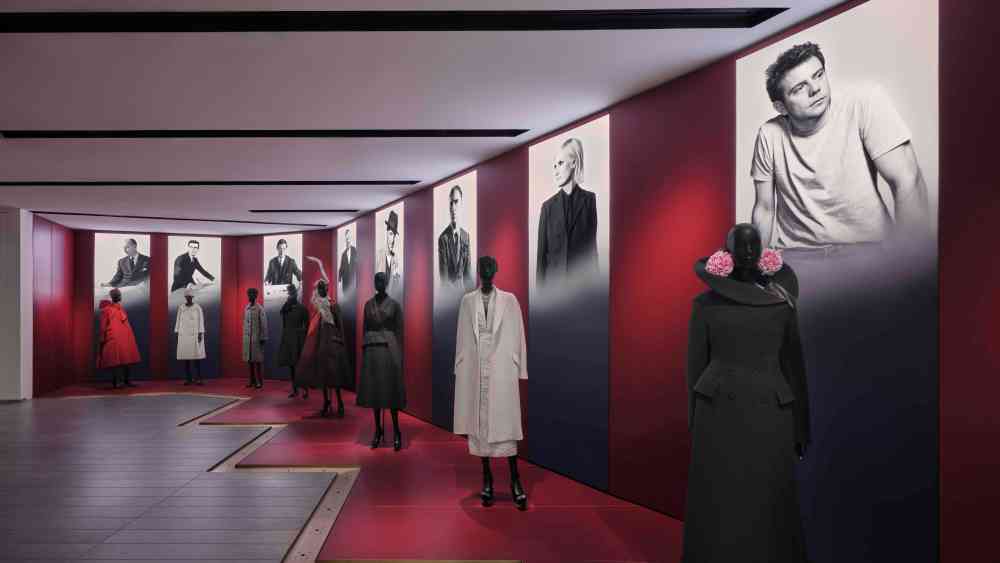
A large portrait of the Irish designer wearing a gray marl T-shirt now welcomes visitors in room three of La Galerie Dior. It sits alongside photos of the previous seven couturiers who have helmed the French fashion house, going all the way back to founder Christian Dior.
Each image is accompanied by a signature design: in Anderson’s case, the black Rêve coat with a swooping collar from his debut haute couture collection presented in January.

It’s one of around 15 designs culled from his first year as creative director of women’s, men’s and haute couture collections, now sprinkled throughout the space at Dior’s historic flagship in Paris, which periodically updates its presentation, in addition to staging temporary shows annually.
You May Also Like
The themed rooms have been tweaked to highlight the historic brand codes that Anderson has homed in on — including the bow and 18th-century ornamentation.
Olivier Flaviano, head of La Galerie Dior, said the design of the exhibition took its cue from Anderson’s first couture show.
“There’s a real radicality in the form, which is super interesting, yet it’s infused with a sense of refinement and femininity, which is equally compelling,” he said. “Jonathan Anderson’s pieces help us see more clearly this tension that is at the root of the Dior style.”

Several looks from the spring 2026 couture collection are featured.
The off-the-shoulder draped Ombre dress, worn by Rihanna on the cover of EE72 magazine, features in the “Enchanted Gardens” room, while the bulbous pleated Clémentine dress, inspired by the work of ceramic artist Magdalene Odundo, sets the tone for the spectacular “Le Bal Dior” room, now drenched in shades of orange and red.
Anderson’s cream Noeud pantsuit is displayed alongside designs by Dior, Yves Saint Laurent, Marc Bohan and John Galliano in room five, christened “The Art of the Bow.”
“I love bows to close a décolleté, trim a hat or to fasten a belt. I like them big, small or enormous, in any way and in any material,” Dior wrote in his “Little Dictionary of Fashion” style guide published in 1954.
The room features original documents including sketches and photographs, among them a Henry Clarke portrait of model Victoire Doutreleau wearing the 1954 Curaçao dress, which has a draped detail at the waist that featured heavily in Anderson’s debut women’s ready-to-wear collection.

In addition, he has reprised the brand’s signature medallions adorned by the “fontange” bow, named after the Mademoiselle de Fontanges, a mistress of King Louis XIV. They feature in an 18th-century-themed cabinet of curiosities that also contains a couture evening clutch covered in French fabrics from the period of Queen Marie Antoinette.
For the first time, the museum is presenting a selection of looks from its Diorling ready-to-wear line, launched in the U.K. in 1968 and designed by Jorn Langberg, artistic director of the Christian Dior London subsidiary. With its geometric and floral patterns, the line captured the spirit of Carnaby Street in the Swinging 1960s.
“The essence of the Dior spirit is unveiled through the 150 models on display: from the modernity of the Diorling ready-to-wear, created in London in 1968, to the tradition of balls featuring haute couture gowns that will make visitors dream more than ever,” Olivier Bialobos, Dior’s deputy managing director in charge of global communication and image, said in a statement.
Above all, he noted, the exhibition illustrates Dior’s adage: “The Parisian tradition of couture is renewal.”