Since the inception of her namesake label, Kate Barton has been a designer to watch for her innovative approach to fashion with the use of technology. During New York Fashion Week, the young, emerging designer continued to push the envelope with an interactive presentation, developed by Fiducia AI, that allowed guests to virtually try on her fall collection.
“I thought the best way to introduce the fashion industry and community in general to technology is showing it in real life, and showing how people can actually use it like in an event setting, because it helps them grasp it more. I think there’s this bridge between people accepting [AI] and actually thinking that they can understand and try it out. That was kind of the concept around the event,” Barton told WWD.

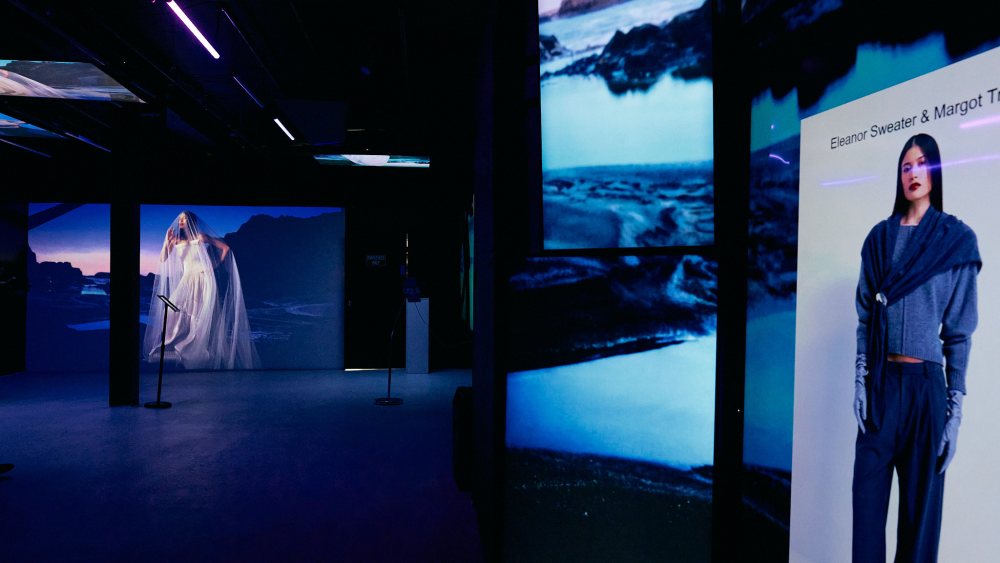
The presentation featured multiple installations, including large screens featuring her latest campaign, said to be made using Amazon’s VR set, featuring real models wearing her new real collection garments against AI-generated backgrounds.
You May Also Like
“The goal of it was not to take away from having clothes in person and all of that. It was more so with runways, clothes go by so quickly that you don’t see all the details, so I wanted all the zoomed-in details of the draping, the hardware, the silhouettes, like every little detail, to be shown on the lifesize screens,” she explained.
In addition, guests could visit the downstairs level of her presentation to virtually try on the looks through additional large-scale virtual screens, utilizing Fiducia AI’s newly unveiled SpeedShotX Visual AI Lens (built with IBM Watsonx, IBM Cloud and IBM Object Storage).
“There were huge lines for the try-ons,” Barton said of the activation, which enabled guests to see their hyper-realistic virtually generated outfit by snapping a picture of themselves after selecting their favorite look. She added the technology is so accurate that guests did not even need to remove their big winter coats to engage with the activation.

“The cool thing about this software that Fiducia produced with us is it has other features too, such as an AI agent, where you can ask questions about my brand in any language and the AI Lens that’s trained to detect new arrivals in our collection,” she explained, noting the virtually generated try-on images can also be shared via a QR code. In addition, a customized function allows users to view the garment’s materials, cost, descriptions and photos.
The designer said the technology serves as an answer to how she can continue to build the Kate Barton community more accessibly, and beyond in-person events. In this vein, the designer has implemented and launched this function on her e-commerce platform.
“For the event, we did it with our new fall collection, but now for the website, we wanted to launch it with our spring 2026 line. Why we did that is I wanted to first convince people in person that this is the future of how people can shop online. Now, I’m excited to see how the reaction is to actually doing it for clothes that we have available to sell,” she said.

Barton’s tips for utilizing the e-commerce try-on function at home?
“Good lighting, camera positioned at about the waist height, and standing 7 to 8 feet back from the camera,” she said, adding it has a three-second timer built in and works best on mobile, but can also be utilized on the computer.
In the future, Barton said she’s excited to continue adding customized functions to the platform, sees opportunity in utilizing it for virtual or in-person events and is excited for her community to engage more personally with the brand.
“I really wanted to reinforce that this technology isn’t taking away from the clothing, the craftsmanship or the experience — it’s meant to enhance the experience,” she said.