Geopolitical unrest, rising costs and trade wars have tested the denim industry’s commitment to innovation. Yet pockets of innovation are gaining traction.
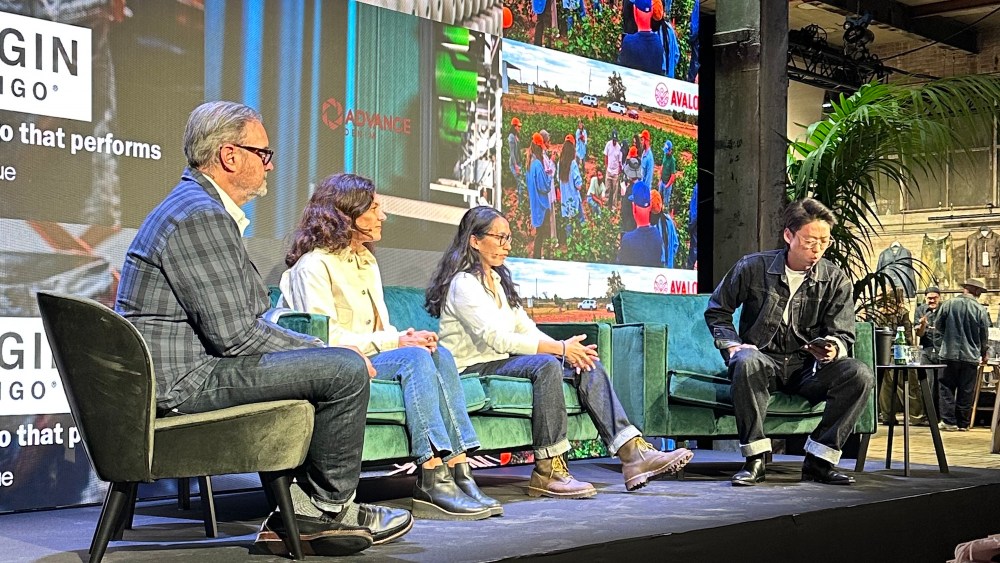
At Kingpins Amsterdam last week, industry experts discussed the must-have ingredients for scaling innovation. While long-standing business relationships can build trust and facilitate collaboration, they aren’t enough to innovate. Broader adoption requires accessible storytelling, measurable results and a solution-oriented approach that demonstrates how new technologies can address real-world challenges.
Lowering adoption barriers has been a key focus for Huue, a Berkeley, Calif.-based biotechnology startup that uses bioengineering and microbial fermentation to convert sugar into sustainable, non-toxic indigo dye for denim.
Corinna Chen, CEO of Huue, said innovation breaks down when companies work toward new products but don’t understand how a large industry like the denim sector operates.
“They’re not looking for a science project,” Chen said about Huue’s clients. Instead, she said brands and players across the supply chain are looking for finished products that work in the factory.
“That’s the engine,” she said, adding Huue’s goal is to show that “we’re factory ready, that we’re manufacturing ready, and that we’re skill ready, especially for this industry.”
Challenges are prevalent in denim manufacturing. However, Mark Ix, Advance Denim’s director of North American marketing, said there is “a lot of low-hanging fruit where you can make it more sustainable [and] make it more efficient.”
Advance Denim has built its foundation on championing new technologies, but innovation must go beyond technical potential. The Chinese mill prioritizes solutions that can be integrated into existing production processes while offering clear commercial appeal. After all, Ix said even the most promising innovation can fail if it doesn’t resonate with customers.
“There are a lot of great ideas out there, and I feel you have to layer those innovations,” he said. “You’ve got to be able to take the innovation into your manufacturing facility and make it work. Then you’ve got to have it proven with the product, but also one of the key breakdown points is from the product to the consumer. Is the customer excited about the innovation? Is it something that really is pushing the boundaries? And can the brand talk about it in a quick manner to its consumer? You’ve got to go through all these hurdles to be able to get a consistent innovation in the in the in the market.”
Advance Denim sees these qualities in Avalo, a North Carolina-based agricultural biotechnology company. In June, Advance became Avalo’s founding mill partner for the denim market across China, Vietnam and Cambodia. The multi-year agreement will give Advance exclusive access to Avalo’s high-quality, dryland cotton as it scales. The cotton will be spun, woven and finished for denim programs for some of the largest fashion brands and retailers in the world.
Ix said the partnership allows the mill to source cotton grown with less water and develop more regenerative products for its customers. The value proposition is straightforward: solving real problems with practical, market-ready solutions.
Tricia Carey, Avalo’s chief commercial officer, said the company’s “co-create” strategy is rooted in on-the-ground collaboration, bringing all stakeholders into the process, from farmers to brands. This approach also drives innovation by ensuring new technologies address real challenges cotton growers are facing.
It’s also important to manage expectations properly. Carey said the marketing narrative sometimes outpaces the innovation itself. Companies may overstate the innovation’s capabilities and what it can realistically achieve. Additionally, partners need to have a clear understanding of how the innovator, supply chain and brand will share the risks associated with adopting a new technology.
“That’s when things can really implode,” Carey said.