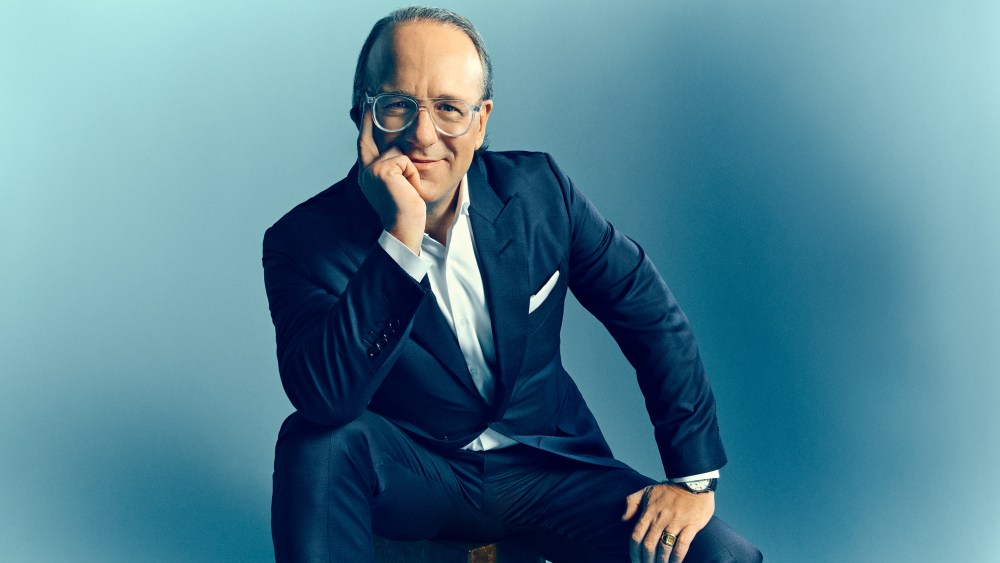
PARIS – The “elephant in the room” was quickly addressed during the Estée Lauder Cos.’ panel at the Deutsche Bank Global Consumer Conference, held in Paris Tuesday morning.
“A year ago, when we were on this stage, we spoke a bit about portfolio optimization,” said Stephen Powers, managing director, head of U.S. consumer packaged goods research at Deutsche Bank AG, addressing Stéphane de La Favorie, president and chief executive officer of the Estée Lauder Cos. “And in that context, the conversation was mostly about organic optimization over time. Just to address probably the elephant in the room: You’ve obviously since that time looked at a very large acquisition of a portfolio of brands, and you’ve continued to be active in minority and majority investments in other assets, as well as hiring advisors to overall do a portfolio review.”
Related Articles
The large deal referred to was a possible merger with Puig, before talks officially ended on May 21.
“As we reset and think about the business and your strategy from here, how do we think about the role of M&A going forward?” Powers asked. “Do you have the right portfolio of brands to achieve what your aspirations are, or do you need something more transformational from an M&A perspective to achieve the value creation targets that you set?”
De La Favorie said Beauty Reimagined, Lauder’s five-part strategic plan, is about the rebalancing of company growth from a geographic, category and channel standpoint.
“It is true when you look at the portfolio of the Estée Lauder Companies in prestige beauty, we are the leader in skin care around the world, with a very strong position in Asia-Pacific and many other markets around the world,” he said. “We are the leader in makeup, especially with brands like MAC.”
But fragrance is the smallest product category for the group among the largest categories.
“We are extremely proud of the portfolio of luxury brands – artisanal niche – however people are calling them that we have, from Le Labo to Tom Ford, Jo Malone, Kilian and so on and so forth,” de La Favorie said. “But it is true that when you go from east to west, the more west you go, the higher the penetration of prestige fragrances is, especially in Europe and in Latin America.”

In Europe, roughly 40 percent to 50 percent of the business is generated from prestige fragrances, while in Latin America that can be upward of 50 percent or 60 percent.
“We have less of a presence on this,” de La Favorie said. “So when – if – an opportunity one day comes we can look at it. But I want to be very clear: It has to be accretive from a growth standpoint. It has to be accretive from a profitability standpoint over time. It has to create shareholder values. And if we cannot reach the growth and the profitability at the right price point, then that is not an option. This is why this deal didn’t go through, because it was not at the right price.”
He said as the president and CEO of the Estée Lauder Cos., he would never do anything that does not make sense financially for the company or its shareholders.
“Strategically it may make sense because the complementarity of the portfolio [is] very interesting, but it has to make sense financially,” de La Favorie said, adding that Lauder will continue to look at opportunities, even though M&A not at the heart of Beauty Reimagined.
“One of the things that people have questioned is: ‘Is it the right time?’” de La Favorie said, of major deal-making. He explained that as part of the company’s Profit Recovery and Growth Plan, or PRGP, Lauder is in the midst of a major transformation from an operational, cultural and leadership standpoint.
“This transformation in 29 days is over in terms of approval of the PRGPs,” de La Favorie said, adding the transformation’s execution will largely be complete by the end of the current calendar year. “Which allows us to [make a] more transformational deal if we decide to in the future. But, again, it has to be at the right price, and it has to make sense within the existing portfolio of the Estée Lauder Companies.”
In answer to the question about whether Lauder has the right portfolio of brands to compete in today’s prestige beauty market, de La Favorie said: “The answer is absolutely ‘yes.’
“We have a fantastic portfolio of brands,” he said. “We have many markets around the world where we’re getting market share – China, even in the U.S. – we are on the right trajectory in the emerging markets online around the world.”
The executive explained Lauder divides its brand portfolio into three groups: large brands that are a billion dollars or close to that and more; brands between $500 million and $1 billion in net sales, and the smaller brands.
“Our large and mid-sized brands are very, very good,” de La Favorie said. “And we have some really up-and-coming smaller brands that are growing fast. Think about a brand like Kilian, that now is the fastest-growing brand in the company. We have Le Labo as a mid-sized brand that is the second-fastest growing brand in the company.”
The Ordinary is performing extremely well, too, while La Mer, among Lauder’s largest brands, is gaining share in practically every market globally.
“I am very proud of the portfolio of brands,” de La Favorie said, adding that last year while on the Deutsche Bank stage, there were questions surrounding whether Lauder’s brands were impaired after three years of company deleverage. That compares to today, when the group is registering market share growth.
“It is the proof that our portfolio of brands is very strong. But I’ve also been very public that we will be part of the M&A discussion,” de La Favorie said. “We’ve always been part of the M&A conversation.”
Of the company’s 25-plus brands, just four were created by the group, he reminded.
“Sometimes, we have to revisit the portfolio, and we are looking at it,” de La Favorie continued, reiterating Lauder has hired advisors to review some of the brands. “Sometimes brands don’t fit anymore the consumer needs.”