
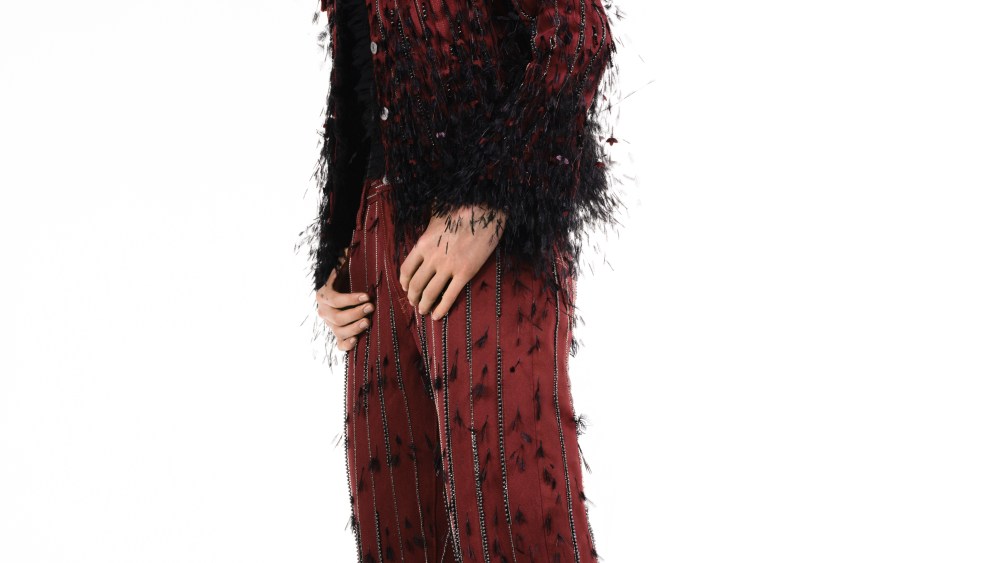
AN AMERICAN IN PARIS: Denim brand Levi’s made its couture week debut Monday with a intimate showcase for its collaboration with Christelle Kocher.
The designer, who is artistic director of Chanel-owned Maison Lemarié as well as running her own label Koché, reinterpreted classics from Levi’s using couture techniques including feathering, embroidery and sculptural details.
“They gave me carte blanche to create a dialog between French craftsmanship and exceptional couture and their iconic styles and raw materials to create something that’s never been done before,” Kocher explained.
You May Also Like
The initiative, more than a year in the making, is part of a drive by the denim heavyweight to implement more locally relevant initiatives in key geographies as well as to court a VIP clientele, Mathilde Vaucheret, Levi’s vice president Europe marketing and brand experience, told WWD.
“We’re an American brand, but how do we translate that internationally?” she said. “The challenge was to premiumize thanks to Christelle and her know-how, and to go into haute couture, which is unknown territory for us,” she explained.
The collaboration was teased on the red carpet in Cannes in May, when model Toni Garrn wore one of the designs in the collection, a denim bustier gown with a silk mousseline skirt embroidered with coated denim and feather petals and Swarovski crystals.
While Levi’s has been involved in fashion collaborations before — for instance in tandem with Jeanne Friot, who presents her genderless designs during men’s — it was its first time at Paris Couture Week.

Kocher spent time at Levi’s innovation lab in San Francisco to explore the technical possibilities of different denim weights and treatments, and reinterpreted some of the brand’s classic styles, including 501 jeans, the Trucker II jacket and the Baby Brooklyn bag, to create 10 different looks. Working with artisans at Maison Lemarié and elsewhere in Paris, she cut jeans open at the sides, encrusted them with beads and inserted pleated side panels, for instance.
Elsewhere, denim was used as an adornment, coated and cut into tiny rectangles and stitched onto a gown, for example. Shirt-weight denim was pleated meticulously to enhance the bust, while three-dimensional capes were sculpted from denim and mousseline cutouts, died and fringed then embroidered on with feathers and beads. Certain pieces necessitated more than 300 hours work, Kocher said.
Time-consuming though the project has been, the designer, who champions a “couture-à-porter” approach, continues to work on custom projects under her Koché label, with which she has sat out showing for the past few seasons but is planning a public comeback in 2027. “I’m actively working on a new chapter for Koché,” she said. “You’ll know more early next year.”