
The investment arm of warehousing giant Prologis and the American Bureau of Shipping (ABS) are the chief backers of a new venture capital fund aimed at investing in shipbuilding projects as the U.S. seeks to revitalize the industry.
Early-stage venture capital firm TMV is launching TMV Logistics, a $200 million firm that will fund pre-seed through Series A companies dedicated to rebuilding core infrastructure projects across maritime, shipbuilding, ports and intermodal logistics.
The fund says it will invest across five core technology themes: industrial-grade autonomy and operationally resilient systems; verticalized robotics; maritime dual-use technologies; energy transition and next-generation fuels; and operational AI for decision-making and orchestration.
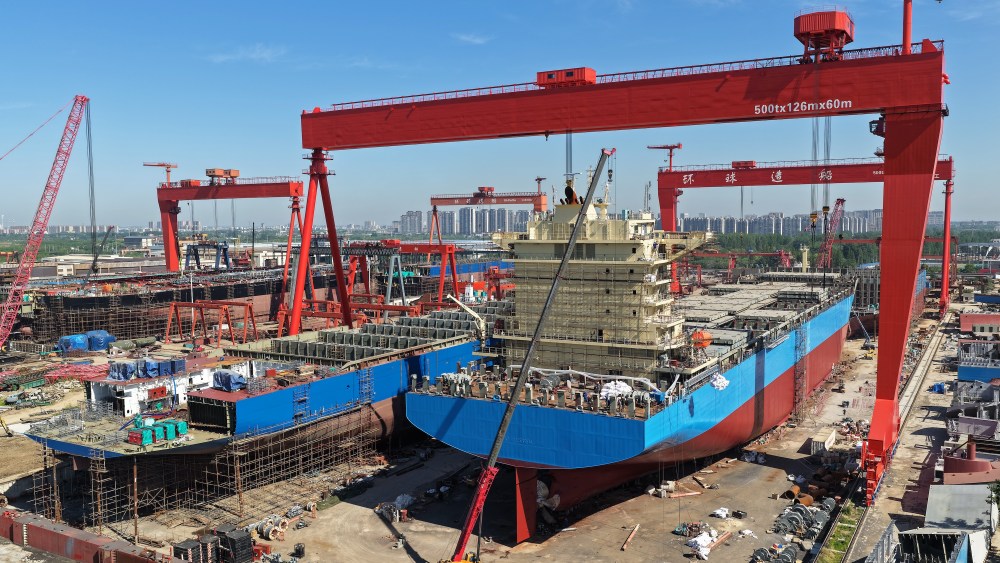
The fund follows the Trump administration’s heavy push to revive a sector that has ceded most of its global market share to China, South Korea and Japan in recent decades. China’s massive ramp up of its shipbuilding capabilities has been considered a national security threat in some circles in Washington, with the U.S. Trade Representative’s office deeming its dominance of the industry “unreasonable” last January.
According to a report by the Center for Strategic and International Studies, a single state-controlled shipbuilder, the China State Shipbuilding Corporation, produced more commercial vessels, measured in tonnage, in 2024 than the U.S. has built since the end of World War II.
In line with the administration’s goals, the U.S. Navy has proposed a $65.8 billion budget proposal for 2027, up 46 percent from the current year’s $47.3 billion in expected investments.
The U.S. is playing a massive game of catchup, even as it has secured $150 million in commitments from South Korea to assist in its maritime revitalization efforts.
In January, data from shipping consultancy Clarksons indicated that China’s shipbuilders saw their global market share fall for the first time in five years, dropping from 70 percent in 2024 to 63 percent last year. South Korea, the world’s second-largest shipbuilder, gained ground as its market share rose from 17 per cent two years ago to 21 percent in 2025. Japan was third in global market share at 5 percent, Clarksons said.
The state of American shipbuilding is not the only concern for the fund. The proposal also comes as U.S. ports and intermodal logistics networks face growing pressure to increase capacity amid geopolitical disruption, energy volatility and labor constraints.
“We’re in the foothills of a multi-decade rebuild of maritime and industrial infrastructure,” said Marina Hadjipateras, co-founder and a managing partner at TMV in a statement. “What’s changed is not just capital, but who is deploying it. Operators are no longer sitting on the sidelines—they’re using venture as a strategic tool.”
In addition to providing capital, Prologis and ABS will serve as active strategic collaborators supporting diligence, shaping product development, and acting as potential customers, design partners and ecosystem integrators for TMV’s portfolio companies.
“With a global footprint across logistics real estate, we see firsthand how constraints at ports and along maritime corridors ripple through the entire supply chain,” said Will O’Donnell, managing director of global corporate development and growth at Prologis Ventures. “Investing in maritime innovation is a natural extension of our work to improve flow, visibility and efficiency from port to warehouse at global scale.”
Founded in 1862, the nonprofit ABS provides classification, certification and technical advisory services for marine and offshore assets to enforce safety standards and protect critical infrastructure.
“ABS has long believed that the future of maritime safety and performance will be shaped by closer collaboration with innovators at the frontier of technology,” said John McDonald, ABS chairman and CEO in a statement. “Our partnership with TMV Logistics reflects that conviction. By combining ABS’s technical leadership with TMV’s early-stage access and ecosystem reach, we are positioning ourselves at the source of innovation that will define safer, more resilient and higher-performing global fleets, shipyards and maritime infrastructure.”
Since its inception in 2016, TMV’s portfolio has grown to more than 50 investments across maritime, logistics, AI and healthcare. With $230 million in assets under management, TMV’s portfolio companies have collectively raised more than $1 billion in follow-on funding.
The firm’s advisors include senior leaders from Maersk, Flexport, intermodal terminal operator ConGlobal, Port of Los Angeles container terminal operator Fenix Marine Services, and large gas carrier owner Dorian LPG.