If cave paintings tell the stories of the earliest human life, factices — the once-ubiquitous oversized perfume bottle replicas — play a similar role in revealing the histories of fragrance.
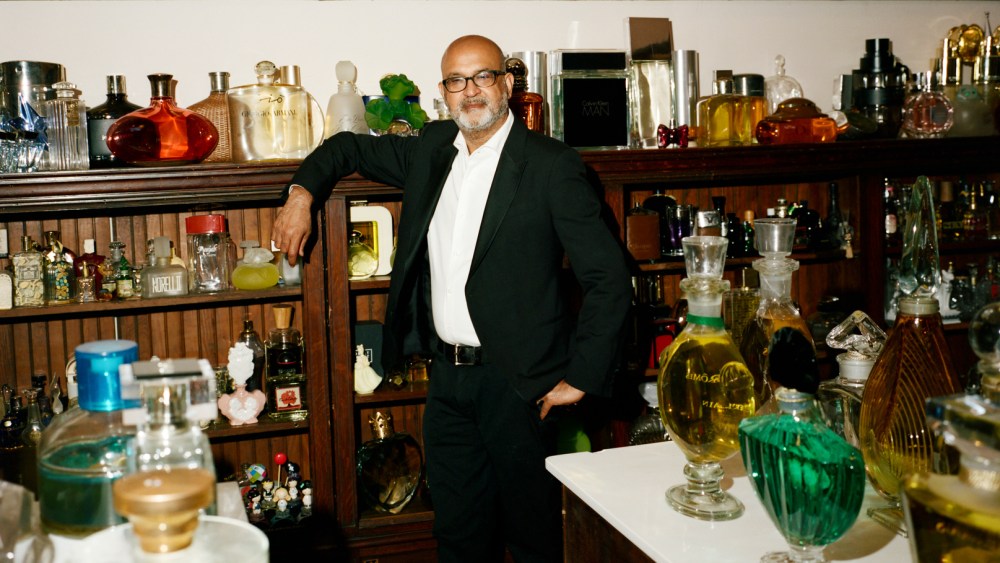
At least, that’s how factice collector Sudhir Gupta sees it. And standing in his 2,500-square-foot The Facticerie museum in Hackensack, N.J., where nearly 4,000 of the rare bottle replicas are on display, it’s hard to argue otherwise.
“These are pieces of history,” said Gupta, who is by day the founder and chief executive of beauty wholesaler Eau de Luxe, and has been a factice collector for more than 30 years — since he encountered his first Nina Ricci L’air du Temps factice as a graduate student working at a Canal Street perfume shop in the ’90s, and saved up $2,000 to buy it.
Related Articles
“All my money goes into these bottles,” he said.
Today, his collection of supersized bottles includes nearly every high-heeled Carolina Herrera Good Girl flanker; variations of Chanel No. 5 not known to most, including a limited Red Edition introduced for the Russian market; Versace; Lanvin; several Dior pieces, including a floral Miss Dior version designed for the wedding of a Saudi royal; discontinued Marina Picasso perfumes from the ’90s, housed in flacons inspired by the works of her grandfather Pablo Picasso, and a mini army of artful bottles from Guerlain — Gupta’s favorite brand to collect — including several rare Shalimar editions, and more.
“I used to go to pharmacies, local flea markets and mom-and-pop stores; I would collect one, two, three factices a year,” said Gupta, adding that come 2008, department stores like Neiman Marcus and Bloomingdale’s began phasing out the large bottles, and thus he began building his collection more quickly as he sought to rescue as many as possible from being thrown away.
“Initially, I was collecting them out of passion, but from that time on, it became my mission.”
In 2023, Gupta set a Guinness World Record for the largest collection of factices, amassing more than 3,000 in his collection ranging in value from $2,000 to $100,000. It was Gupta’s wife, Mercedes Acosta, who encouraged him to open a museum where the bottles could be on view for the public. The Facticerie, designed by Acosta, first opened its doors in Long Island City in 2018, then moved to New Jersey in 2021.
“I don’t see it as a collection; I see it as a living archive of craftsmanship and heritage,” said Gupta, who even purchased the Lascoff Drugs signage and display cabinets in 2012, when the iconic Upper East Side pharmacy shut its doors, and now displays them at The Facticerie. “I feel it has to outlive me.”