Handmade goods have never been more desirable. They’ve also never been more at risk of disappearing.
As consumers increasingly seek out products with provenance—items promising story, craft and a human touch—one documentary examines the disconnect between rising demand and the realities facing the artisans behind them.
Across continents and craft traditions, the documentary, “Handmade Future,” traces a system in which value is often lost between maker and market. In some cases, artisans earn as little as $60 for pieces that later sell for thousands. In others, entire traditions are kept alive by just one or two remaining practitioners.
Fashion has spent the last decade insisting it can save the world—one artisan collaboration at a time. But “Handmade Future” lands on a messier truth: the same industry that claims to preserve traditional craft has also helped flatten it, remaking cultural specificity into something more palatable, more marketable—and, at times, less authentic.
The tension is simple: storytelling drives value, but access to that value remains uneven. At its core, the nonprofit project presses a question the fashion industry rarely answers directly: What happens to traditional craft when it’s redesigned for global consumption?
Here, Sourcing Journal hears insights on the subject from filmmakers Kirsten and Brandon Dickerson.
Sourcing Journal: The documentary spans countries and crafts yet still feels unified. Was that structure intentional, or something you discovered in the edit?
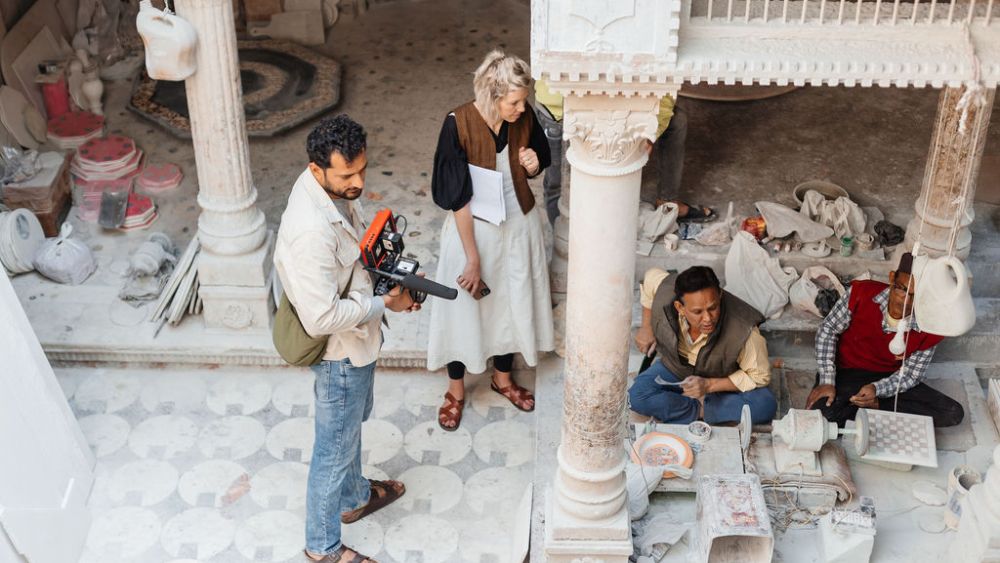
Kirsten Dickerson: I knew those connections were there, but I didn’t know exactly where they would lead. I’ve worked with artisans for decades—across production, advocacy and cultural exchange—so I had a strong sense of the landscape going in. What I wanted was to document the beauty of craft, understand the challenges each community faces and explore how they’re addressing those challenges.
We didn’t start with a fixed conclusion. We filmed extensively, and the themes only became clear in the edit—things like the role of the middleman, the complexities of designing with artisans, market access and the urgency of preserving cultural traditions. Those became the backbone of the story.
Brandon Dickerson: We knew the materials we were working with, but the final weaving happened in the edit. The structure came together once we saw how those threads interacted.
SJ: The film feels embedded in these communities rather than observational or intrusive. How did you achieve that level of access?
BD.: A big part of that comes down to Kirsten’s long-standing relationships. These weren’t cold introductions; they were built over years of trust.
KD: Exactly. I had deep relationships with community leaders in each location, and that trust extended to us. Some artisans didn’t know me personally, but they trusted the person who introduced us—and that trust extended to us. We were very intentional about consent and making sure everyone understood what the film was about. It was collaborative—we weren’t arriving as outsiders, we were being invited in.
SJ: The film presents the middleman as both essential and exploitative. How did your perspective on that evolve?
KD: Originally, the film was titled “Middleman.” I wanted to examine that role critically, including my own. But in the edit, it became clear the story was more hopeful. There are real challenges and exploitation, but there are also people acting as advocates—using their position in the supply chain to connect artisans directly to markets and sustain their work. We wanted to reflect both. The idea that we’re all part of the problem in some way, but we can also be part of the solution.
SJ: There’s a strong theme around generational knowledge—what gets passed down and what gets lost. What stood out to you?
KD: In some places, only one or two artisans remain who still know how to make something. In others, traditions skipped a generation but are now being revived. Portugal is a good example—after the dictatorship ended in 1974, there was a push to modernize, and many traditional crafts weren’t passed down. Now, some of those skills are on the verge of disappearing entirely. Globally, we’re seeing loss and revival happening at the same time, and that tension felt important to capture.
SJ: The film avoids guilt-driven messaging and leans more constructively. Was that a deliberate choice?
KD: Very much so. We wanted to show the challenges honestly, but not in a way that shuts people down. The goal was for people to leave feeling inspired—that they can engage, support and be part of sustaining these communities, rather than feeling overwhelmed or guilty.
SJ: How was the film produced, both logistically and fiscally?
KD: We filmed over about a year, often alongside my existing craft and culture tours, which allowed us to spend more time in places where I already had relationships. It’s a nonprofit film; about 98 percent of the funding came from individuals—many of whom had traveled with me and experienced these artisan communities firsthand.
BD: We kept production lean by handling much of it in-house. I worked as director, cinematographer and editor. Kirsten brought her background as an art director. Post-production was split between London and the United States.
SJ: Any distribution plans?
KD: This year is focused on screenings, festivals and community events. We want to create conversations around the film—panels, discussions and opportunities for people to engage directly. Longer term, we’ll explore wider distribution. If the film generates revenue, it will go back into an artisan fund to directly support the communities featured.
SJ: What do you hope people do differently after watching it?
KD: That they recognize these traditions aren’t abstract—they’re tied to real people, families and futures. Whether it’s a community of thousands or a single family passing down a craft, every effort to sustain that knowledge matters. And people watching the film can play a role in that.
“Handmade Future” debuted at the Justice Film Festival in New York City on Feb. 26 at the Fashion Institute of Technology. The 83-minute documentary, directed by Kirsten Dickerson, highlights global artisans pushing back against fast, cheap production. The nonprofit project later won the festival’s Impact Award, presented in partnership with FIT.
This article was published in SJ’s sustainability report. Click here to read more.