
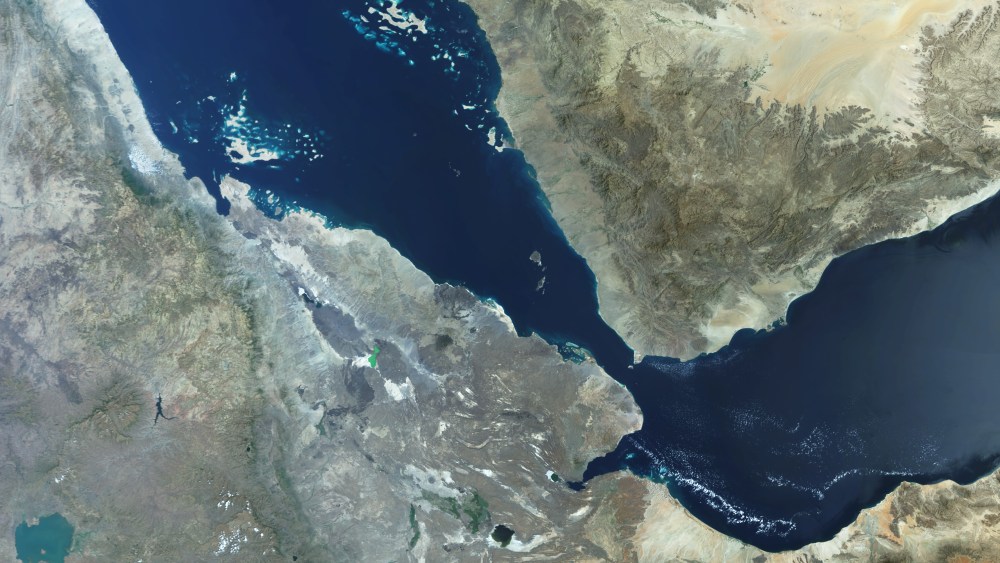
Iran-aligned actors made new threats against vessels in the Red Sea Monday, with Yemen’s Houthis saying they would institute a “complete and total ban” on Israeli shipping through the waterway.
“We consider all enemy movements to be legitimate military targets for our armed forces from the moment this statement is issued,” said Yemeni Armed Forces spokesperson Yahya Saree in a statement issued Monday.
But the warnings are unlikely to deliver any apparent changes to container shipping at large, which has continued to prefer to sail around southern Africa’s Cape of Good Hope on most Asia-to-Europe and some Asia-to-Americas routes.
Most vessels from major carriers including Maersk, Hapag-Lloyd and Mediterranean Shipping Company (MSC) have taken the longer path even after the Houthis initially agreed to suspend their missile and drone attacks on commercial shipping last fall.
“The vast majority of container traffic continues to divert away from the Red Sea,” said Judah Levine, head of research at freight benchmarking platform Freightos in a Tuesday morning update.
In the week ended May 24, 20 container ships sailed through the Suez Canal, while another 26 transited via the passage in the week ended May 31, according to the Drewry Red Sea Diversion Tracker.
The combined 46 vessels represented a decline of 15 percent from the previous two-week stretch, but was higher than in the weeks which followed the start of the Middle Eastern conflict, the maritime consultancy said.
In the week ended May 31, CMA CGM (seven ships) and MSC (two ships) were the only carriers to send vessels of more than 8,000 20-foot equivalent units (TEUs) through the Suez Canal.
CMA CGM has been the one major container shipping company willing to repeatedly test the waters, with the 24,000 TEU CMA CGM Notre Dame set to pass through the canal on June 15. Departing on its maiden voyage from the Port of Singapore on June 2, the ultra-large container vessel is sailing westward in the Gulf of Aden as of Tuesday night.
While the Houthis have not attacked a ship in the region since the start of the war on Feb. 28, words from Iran’s own military forces could fuel some concern among carriers.
Iran’s Islamic Revolutionary Guard Corps (IRGC) followed up the Houthi threat Monday with a warning of its own, saying it would team with the Yemeni-based group in extending hostilities to the Red Sea’s southern chokepoint, the Bab el-Mandeb Strait.
Esmail Qaani, the commander of the IRGC Quds Force, posted on X that other forces would join the Houthis if necessary.
“From the Strait of Hormuz to the Bab el-Mandeb, and from the Persian Gulf to the Red Sea, a new resistance security belt will be formed,” Qaani said. “The resistance operations of the unified front will be a decisive response to the Zionist regime and America in the region.”
Levine said the IRGC’s threats to close the trade conduit “would not change much for freight if implemented.”
However, according to Levine, “the added tension may push back the timeline for a [Strait of] Hormuz reopening, though the White House continues to assert that negotiations are making progress.”
The war took a drastic turn Tuesday when the U.S. and Israel launched its own airstrikes against Iran in response to the downing of a U.S. Army helicopter, despite a ceasefire having been in place since early April.
Over the weekend prior to the skirmish, Israel and Iran exchanged military strikes. Ahead of the U.S. involvement on Tuesday, Levine said the exchange “did not materially change the status quo in terms of the Iran war impact for the broader ocean freight and logistics markets: higher oil prices putting some upward pressure on freight rates via elevated fuel costs.”
Traders on prediction markets platform Kalshi price in a 50 percent chance that the Strait of Hormuz will return to normal traffic before Oct. 1.
There were only five transits made through the Strait of Hormuz, according to analysis from ship tracking intelligence firm MarineTraffic. According to the company, all crossings were made through the narrow Iranian-managed route rather than a normalized return to pre-crisis transit patterns.
“For shipping, the read-through is unchanged: Hormuz remains technically open, but traffic is still route-dependent, politically managed and exposed to sudden disruption from either security incidents or enforcement action,” said Anal Subasis, trade risk analyst at MarineTraffic, in a blog post Tuesday morning.