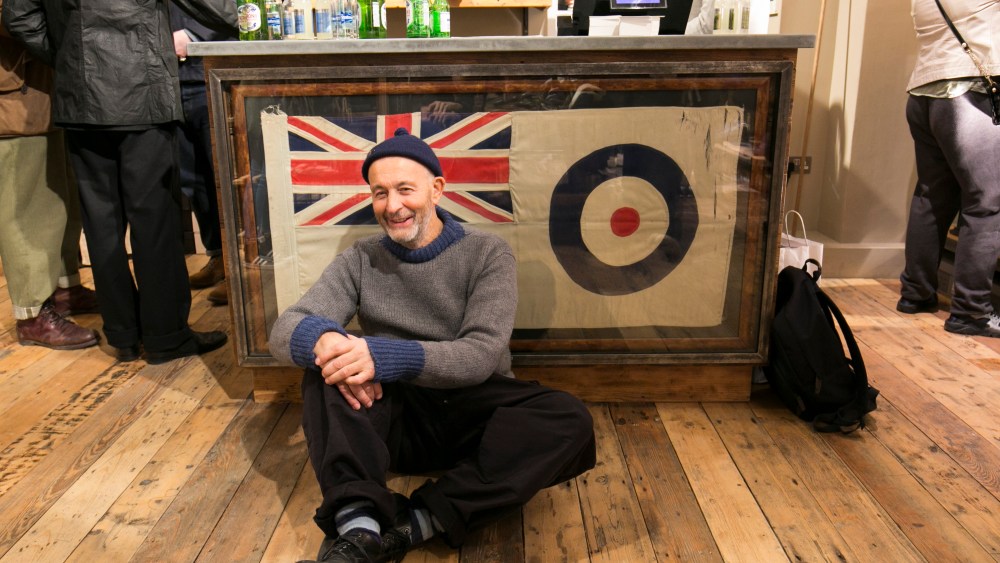
LONDON – Nigel Cabourn, the cult British menswear designer whose muse was the military uniform and whose archive of vintage clothing is among the largest in the world, has died aged 76, his company confirmed.
Cabourn made his name creating sporty, pin-sharp tailored clothing and outerwear inspired by the mid- century uniforms of military units ranging from the U.S. Navy and Marines, to Britain’s Royal Air Force, to the Swedish and Japanese armies.
He channeled the rigor, elegance and durability of those pieces, and his love for natural fabrics, such as denim, cotton and cashmere, into collections that were not only a hit in Britain, but in Japan and the U.S., too.
You May Also Like
A sports fan with a passion for early-morning boxing and mountaineering, Cabourn took great moments of physical daring, and turned them into special collections.
In 2013, Cabourn presented a capsule collection using a special Nino Cerruti cashmere fabric to honor the 60th anniversary of Edmund Hillary reaching the summit of Mount Everest. Designs included a “funked up” Montgomery duffle coat with deep pockets at the back.
Cabourn, a Newcastle native and proud northerner, had a knack for commerce, too.
During a career that spanned more than 50 years, the designer brokered licensing deals in Japan, where the brand has 11 standalone stores with local partner Marubeni, and undertook myriad collaborations with brands including Fred Perry, Aigle, Eddie Bauer, Converse, Filson, the German denim brand Closed and the Swedish ski brand Peak Performance.

In 2015 he purchased Lybro, a workwear brand that he transformed into a collection for a younger audience. It featured yards of Japanese selvedge denim which Cabourn turned into loose shirts, deconstructed jackets, waistcoats and roomy trousers meant to be layered and mixed with the Harris tweed suits from his main collection.
Another collection, the Army Gym, features retro-tinged athletic wear, such as thick cotton T-shirts, hoodies and sweatshirts inspired by army sports gear. At the launch, Cabourn said he couldn’t find anything that would allow him to punch, sweat and look good simultaneously, so he decided to make it himself.
During his long career, Cabourn also built an archive of 4,000 vintage military pieces, the result of his travels and extensive research into history, fabric and famous expeditions.
He spent four months a year scouring the globe in a bid to add to the archive. “New York, Tokyo and London are the three best places for these sorts of clothes,” Cabourn told WWD in a 2014 interview when Army Gym, his first store to open in the U.K. (and Europe) debuted on Henrietta Street in Covent Garden.
Cabourn said his favorites were British uniforms from the first and second world wars and American uniforms from World War II. “I love the United States Marine Corps. I also love the Mountain Division. It’s all about the mountains for me,” said Cabourn at the time, adding that he’d recently picked up some British military pieces, including an Irvin-style leather jacket and a rare World War I duffle coat.
The British Fashion Council described Cabourn as one of British fashion’s “most influential and enduring designers,” and said he leaves a legacy of “craftsmanship, authenticity and storytelling.”
The BFC said he inspired generations of designers “and shaped the global appreciation of heritage and utility-driven design.”

Andrew Groves, a professor and the director of Westminster Menswear Archive at the University of Westminster, said Cabourn’s influence on global menswear was considerable.
“He helped shift attention away from fashion as novelty and towards clothing as function, provenance, material intelligence and lived experience. He understood that the most interesting menswear often begins in military uniform, workwear and technical garments. He gave those references both historical weight and human force,” Groves said.
He added: “Nigel was also remarkably generous with other designers. A whole generation of younger menswear designers were taught, encouraged, supported or simply given time by him.”
Cabourn took a traditional route into fashion, studying fashion design at Northumbria University (then known as Newcastle College of Art and Industrial Design) between 1967 and 1971. During his college years he launched his brand, Cricket, and changed the name to Nigel Cabourn in the 1980s.
In an interview with The Heritage Post, a German menswear magazine, Cabourn said that he only started noticing vintage clothing in 1968 when he saw Americans wearing green army field jackets with Levi’s during the Vietnam War years.
A decade later, it was his old friend Sir Paul Smith who got Cabourn to look at vintage more seriously. “He used to work for me – and he introduced me to vintage. That was actually the first time I realized you could go into vintage stores. I had been in the business for almost ten years before I started buying vintage – at 38 years old,” said Cabourn.

Cabourn said it was during a 1978 trip to Paris that Smith found a Royal Air Force jacket in army green “with a very special button placket. Paul said to me, ‘Nige, this is what you should do. You should make army jackets like this.’”
Cabourn never looked back. Over the past decade, his collections were inspired by the style of Sean Flynn, the photojournalist son of Errol Flynn who disappeared on assignment in 1970 during the Vietnam War; the Royal Air Force, and the Women’s Auxiliary Air Force that patrolled the skies during World War II.
In 2015, Cabourn unveiled the Antarctic parka, a cozy number with coyote trim on the hood, a shearling collar and pricey, water-resistant, heat-preserving fabric developed by Britain’s Royal Air Force.
He is survived by his family, and the company said in a tribute on the designer’s Instagram page that his legacy will continue.