
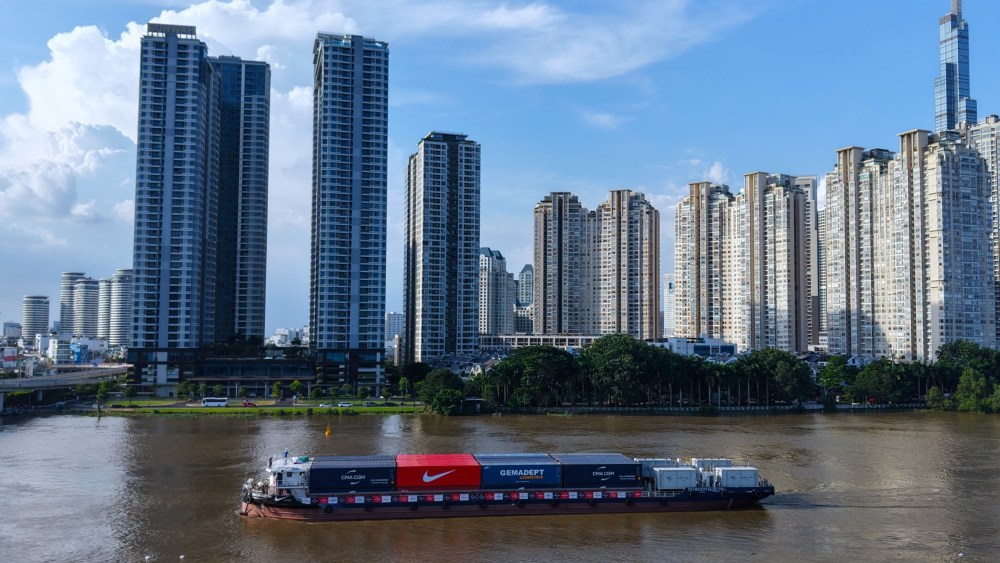
Nike is taking another step to reduce emissions across its global supply chain, and it’s focusing on the movement of products.
The athleticwear brand has debuted a fully electric inland waterway barge in Vietnam in tandem with CMA CGM and Vietnamese port operator Gemadept.
The barge connects Nike’s inland cargo consolidation hub in Ho Chi Minh City with the Gemalink deep-sea terminal in Cai Mep Port, covering a 112-mile round trip producing zero direct greenhouse gas emissions. It is Vietnam’s first fully electric river barge, Nike said.
Named CMA CGM Electra, the barge is designed to carry more than 50,000 20-foot equivalent units (TEUs) a year, and the partners estimate it will avoid about 778 tons of carbon dioxide a year versus road movement. It measures nearly 80 meters (262 feet) long, has a deadweight capacity of 3,500 tons, and can carry 182 TEUs.
According to a report from The Business Times, Nike is entering an eight-year agreement with CMA CGM to have its goods that would fill 90 percent of the vessel’s capacity.
The companies’ announcements give no barge cost and no timetable for the launch of any additional vessels. The initial investment in the barge is approximately twice that of a comparable diesel-powered vessel, CMA CGM Asia Pacific CEO Bo Wegener told the Singapore-based publication.
“Reducing emissions across a global supply chain takes more than any one company. It takes new ideas, strong partnerships and a willingness to rethink how we operate,” said Cimarron Nix, chief sustainability officer at Nike, in a statement. “This project is a great example of how we can turn innovation into practical solutions that reduce our impact while strengthening the resilience of our supply chain.”
The launch is built around a dedicated system rather than a single vessel, with CMA CGM saying Nike has committed to optimize use of the barge for Nike shipments transported between Binh Duong province and the Gemalink terminal.
The barge incorporates battery technology from CATL and can be recharged in approximately four hours using certified renewable electricity. The batteries can be swapped in around 30 minutes during container loading and unloading. Its dedicated charging infrastructure at Gemalink is supplied by a solar farm developed at the terminal.
According to CMA CGM, the solar farm could create local jobs and help enhance Vietnam’s competitiveness in renewable energy and sustainable logistics in Southeast Asia.
For the ocean carrier, the barge is presented as a scalable model rather than a one-off vessel, with CMA CGM’s executive vice president for assets and operations Christine Cabau-Woehrel saying the project “can be replicated easily in other geographies and with other major customers.”
“We are looking forward to duplicating and adapting this innovative solution with other cargo owners wishing to find solutions towards more sustainable transport modes,” Cabau-Woehrel said.
In February, CMA CGM established it would launch a separate electric and hybrid inland barge on France’s Fos-Lyon corridor on the Rhône River is due in 2028.
Transportation is one of four areas—alongside materials, manufacturing and its own operations—Nike focuses on as part of its aim to cut emissions across its value chain. The company touted that inbound and outbound transportation emissions were cut by 56 percent from fiscal 2020 to fiscal 2025.
Those gains have come largely from shifting modes and fuels, with Nike saying inbound air freight fell by nearly 85 percent since 2020 and was only 0.6 percent of inbound volume in fiscal 2025.
On the ocean, Nike participated in six of its logistics carriers’ sustainable ocean fuel programs, matching the equivalent volume of 28 percent of its global inbound ocean shipments.
Vietnam plays an outsized role in Nike’s supply chain. The Southeast Asia serves as the footwear seller’s largest manufacturing source, at about 52 percent of Nike Brand footwear and 34 percent of Nike Brand apparel in fiscal 2026.
The partnership predates the barge, although the earlier work was on the ocean leg and was not specific to Vietnam. From July 2023 to May 2024, Nike used sustainable biofuel for 36 percent of its volume with CMA CGM, cutting carbon dioxide by 25,000 tons.
For CMA CGM, the project expands the container shipping giant’s continually growing role in Vietnam. The company is investing $600 million to build a deep-water terminal at Hai Phong port which would be CMA CGM’s first docking facility in one of Vietnam’s northern ports.
CMA CGM owns a 25 percent stake in the Gemalink terminal, which has run at full capacity since its opening in 2021.
The terminal’s Phase 2 expansion launched in April 2026 will lift capacity from 1.7 million TEUs to about 3 million TEUs by late 2027, through a quay extension, a larger yard and five more cranes.
For CMA CGM, the barge fits a decarbonization strategy targeting net zero carbon emissions by 2050, alongside an October agreement with DSV targeting a 12,000-ton cut over two years through second-generation biofuels.


