
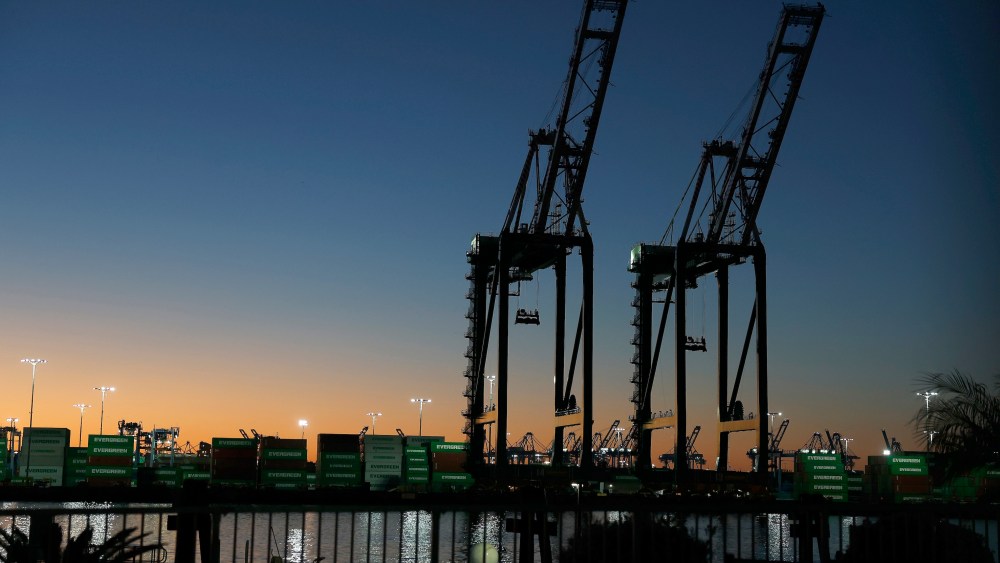
Import volume at major U.S. container ports is expected to remain below last year’s levels into early fall amid a rocky macroeconomic and geopolitical landscape, according to the National Retail Federation (NRF).
“With inflation rising and consumer confidence falling among global economic uncertainty driven by the conflict in Iran, the overall trend of lower imports is expected to continue after that,” said Jonathan Gold, vice president for supply chain and customs policy at the NRF, in a statement.
According to the Global Port Tracker report released by the NRF and trade consultancy Hackett Associates, inbound cargo volume is expected to see a significant, but “skewed” year-over-year bump in May and June. But annual declines will linger from July through September.
“The numbers show a year-over-year increase for the next two months, but that’s only because of the sharp fall-off in imports after ‘Liberation Day’ tariffs were announced in April 2025,” Gold said.
Amid the uncertainty, Hackett Associates founder Ben Hackett said retailers have been cautious about building up inventories.
“Containerized imports in the first quarter were down year over year, and forward demand is weakening,” Hackett said. “Stalling re-stocking efforts and rising geopolitical tensions are increasingly clouding the outlook.”
In March, the latest month that the Global Port Tracker shares final data, major U.S. ports handle 2.16 million 20-foot equivalent units (TEUs), a 0.6 percent year over year jump over the year prior. Sequentially, the number was up 13.6 percent from February, when many Asian factories were closed for Lunar New Year celebrations and bad weather delayed the arrival of cargo at some U.S. ports.
Ports have not yet reported April numbers, but the port tracker projected the month at 2.13 million TEUs, down 3.6 percent year over year. Logistics software company Descartes also calculated a decline within its monthly Global Shipping Report, with the firm’s numbers sinking 5.5 percent to 2.28 million imported TEUs.
Imports from China have continued to see a decrease as sourcing shifts to other countries, with Descartes data indicating that cargo originating from the country fell 15.3 percent year over year to 680,778 TEUs during the month. Furniture and bedding originating from China represented 15.7 percent of the imports, while apparel and footwear categories collectively contributed less than 4 percent individually.
Thailand recorded the strongest growth of the markets analyzed, surging 36.3 percent, followed by a 13.3 percent boost from Indonesia. Japan had the third-biggest TEU increase at 11.4 percent.
May and June imports escalate from last year’s Liberation Day lows
As for the NRF’s early summer inbound volume projections, May is forecast at 2.17 million TEUs, up 11.1 percent year over year, while June is anticipated to see an 8.2 percent bump to 2.13 million TEUs.
Those increases come from a largely favorable comparison point. In 2025, both months saw respective declines of 6.4 percent and 8.4 percent in the aftermath of “reciprocal” country-specific tariffs levied by the U.S., which forced importers to cancel bookings en masse after Liberation Day.
The volume jump across May and June brings the projected import numbers in the 2026 first half to 12.59 million TEUs, an 0.5 percent uptick from the same period in 2025. This would be an improvement from initial projections laid out in February, when the Global Port Tracker expected a 2 percent decline in the first half to 12.27 million TEUs.
Jackson Wood, director of industry strategy at Descartes, said the import volumes so far this year have been “relatively resilient” despite the concerns and volatility surrounding trade and the Iran war.
“With geopolitical disruption, tariff uncertainty and shifting trade dynamics continuing to pressure global supply chains, greater emphasis on flexibility, cost control and more diversified sourcing strategies are key focus areas for U.S. importers,” Wood said.
The late summer and early fall are where the figures see a return to declines. Inbound cargo volumes in July are expected to total 2.2 million TEUs, down 7.8 percent from the year-ago period, when importers sought to rush goods into the U.S. ahead of several tariff deadlines that had been established for last August.
Year-over-year declines of 5.5 percent continued last August to 2.19 million TEUs, while the forecasted September slump should see a lighter import dip of 1.3 percent to 2.08 million TEUs.