ROME — On a sultry summer day last year, five women converged in a studio in the outskirts of the Italian capital, summoned by Bulgari and its creative director of leather goods and accessories Mary Katrantzou.
Supermodel Linda Evangelista, actors Kim Ji-won and Isabella Rossellini, acclaimed author Chimamanda Ngozi Adichie and architect Sumayya Vally gathered on the set of the jewelry house’s latest campaign, dedicated to the limited-edition Bulgari Icons minaudière collection.
Photographed by Ethan James Green under the creative direction of Ferdinando Verderi, the images bowing on Friday after six months from that shooting day associate each talent with a bag design, nodding to Bulgari emblems like the Monete, Tubogas, Divas’ Dream and Bulgari Bulgari families. And of course, Serpenti.
You May Also Like
And who could embody the snake symbol and its transformative nature better than Evangelista, who with a career spanning four decades has portrayed so many different personas in front of the cameras of Steven Meisel, Peter Lindbergh, Irving Penn, Herb Ritts and Paolo Roversi, to cite a few?

“It’s funny because when I was told there were five different styles I was like: ‘Should I ask if I can choose?’, and I thought to myself: ‘don’t be silly, you know they’re all beautiful,” the supermodel told WWD, which was invited on the set to preview the project.
“It’s something I used to say to my son growing up: ‘You get what you get and you don’t get upset’, right? And I’m like, ‘How can I be disappointed?,’” she continued. When Katrantzou told her she envisioned her as the face of the Serpenti, Evangelista got her silent wishes granted.
“That was my first choice. In the Chinese Zodiac I’m a snake and I love snakes so much, which I know it’s weird because I’m afraid of everything. You name it: I’m afraid of the things that move, I’m afraid of flying, I’m afraid of everything. But I’m not afraid of snakes,” said Evangelista.
Even more symbolically, the association clicks not only with her career but also her personal journey, and the way she had to shed skin both on and off the set to let new versions of herself shine. “I’ve been through a lot. A lot of hardships and had to pick up myself and pull myself together,” said Evangelista. “But each time is actually easier and not harder, because you really understand through your hardships what is valuable, what is really important to you and what matters most.”

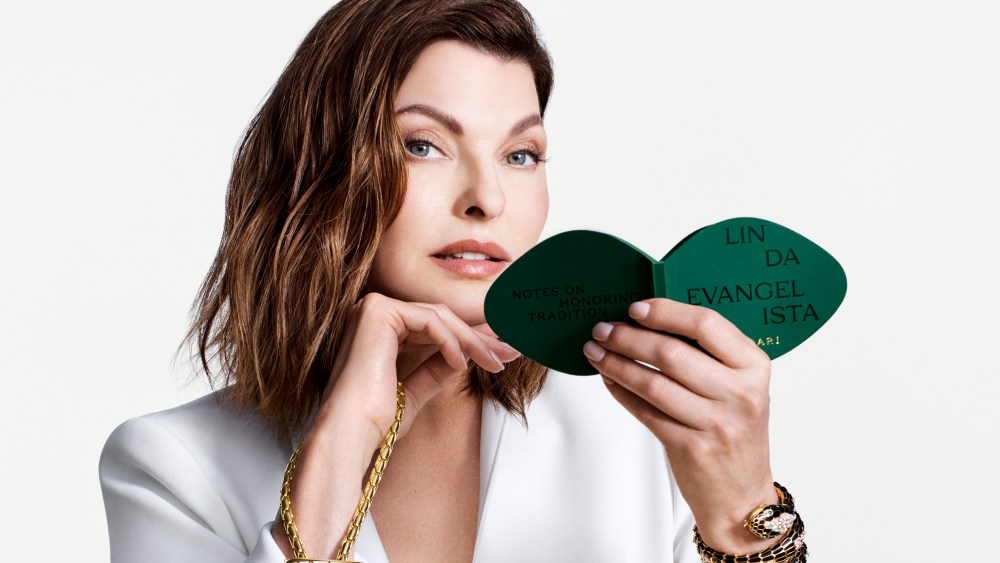
It was only one of the passages that set the tone for a quick yet candid chat that took place between camera clicks, a few steps away from the all-white set that saw Evangelista donning a pristine suit while posing with the precious snake head-shaped bag.
“This set is so chill. I have a beautiful team, and we’re coming off of a beautiful dinner we had last night. Everything is so easy,” she said, adding that she felt honored to be included in such a project.
“I’ve always loved the house of Bulgari. My first piece of jewelry I bought in Milan in the late ‘80s was a Tubogas bracelet and I still wear it. I actually left it in the hotel safe,” she recalled with a smile, while flaunting a newer Serpenti watch that temporarily substituted on her wrist for her treasured piece.
Asked about the difference from this set and those of her beginnings and her take on the evolution of the modeling career, she was quick to say that “everything is different.”
“It’s not better, just different. But you have to evolve with the times,” said Evangelista. “For each look, they just needed one frame. So most photographers would do a Polaroid of you and when they thought that’s how they wanted the photo to look, then they would get their camera, which had film inside, and do three rolls or 12 rolls, but you wouldn’t get to see the picture. They’d have to go and develop. And then they didn’t retouch it.
“So when they set it up you made sure it was perfect — people were holding reflectors and the clothes were perfect,” she continued. “Now sometimes I get sad because I’m not part of the creative process. Like if the sleeve is wrong, they’re like: ‘Oh, we’ll fix it later’. It’s always, ‘we’ll fix it later, we’ll do it in post-production’ and post-production when I started was printing… I love to be on the creative part and I sort of miss that because it gets taken care of by other things. And AI is just around [the corner], so you might not need me anymore in a few weeks,” she said.

She also pointed out the extra amount of content and BTS videos that come with each shoot and are intended to feed social media, and highlighted how the work “used to be simpler.”
“I don’t know if it’s easier [to be a model now]. I think it’s just very different, but they can handle it because it’s of their generation, that’s how they think. They think digital and social media. I’m not there yet. I don’t hate it, though. I think a lot of good comes from it… but it’s another world,” she said.
Even though the new generation of models has ways of reaching out and engaging with a wider audience, the fascination with the ‘90s supermodel era seems unceasing. Surprised to hear that younger generations are discovering the OG models on TikTok and archival footage, Evangelista tried to explain the phenomenon’s success and enduring charm precisely with the more limited exposure of yore.
“I think [it worked] because the work you saw from us was that one picture. And you waited for that magazine to flip the pages to see that one picture or if you had cable television, you might get like CNN and see some fashion shows, but there wasn’t that much access,” she recalled. “Now there’s so much access that it can borderline on noise and it doesn’t stick with you… I don’t know if that [phenomenon] can happen today because of all of the outlets, the noise and speed.”

Yet she still finds plenty to be excited about in the industry. “I love watching the new come in: the new photographers, makeup artists, working with new hairdressers,” she said. “I was so nervous and so excited [to work with James Green here]. I didn’t know how he was going to feel about me. So just newness. Fashion is about change and I kind of like the change.”
Far from the flashing cameras, easy hikes are the model’s way to wind down, instead. Yet they come second only to cooking in helping her relax.
“I have some OCD, so I love my knives,” she quipped. “I have beautiful knives that I take really good care of and I love chopping. I love the prep before the cooking and cutting everything the exact same size. I would dream to be a chef, actually a sous-chef,” she revealed.
Such a connection with food infiltrated the Bulgari project, too. To wit, Katrantzou asked each talent to write a personal miniature book designed to fit the silhouette of each Bulgari Icon minaudière. Each one was intended to reflect the life experience of each talent, as the project’s mission is to have women carry — and share — culture along with their precious bags.

In her pamphlet, Evangelista went back to her childhood, retracing her Italian roots, recounting family anecdotes and especially the centrality of the cooking experience and its rituals while growing up in her hometown in Ontario, Canada. Precise instructions for making her family’s traditional “Sunday sugo” tomato sauce are included in her writeup.
“I have friends that have inherited incredible things from their family, like jewels and paintings and cars. I have my family tomato sauce recipe. I have tradition that was handed down to me, and it’s my most precious valuable,” she said. “My grandparents brought this from Italy and [even if] they were better off in Canada and lived a better lifestyle, they still kept all those traditions of when they had nothing… It was every Sunday that we had ‘sugo,’ and now I do it for my son, for friends in New York – that is absolutely what we eat on Sundays.” Her personal touch? “Serve with freshly grated Parmigiano Reggiano and ground pepper. I like mine topped with fresh basil and dried chili flakes,” she writes in the book.