On the Line is a weekly roundup of sourcing and labor quick hits in the apparel and footwear industry, from worker protests to boardroom maneuvering, tracking the developments shaping conditions on the factory floor and beyond.
Bangladesh improves labor standing
Bangladesh didn’t make the International Trade Union Confederation’s list of the 10 worst countries for workers’ rights for the first time in nearly a decade, the result of a series of labor reforms that its interim government initiated following the fall of Sheikh Hasina’s authoritarian regime in 2024.
Among them, the trade union federation said, was a lower barrier to union formation, which previously required the consent of 20 percent of the workforce but can now take place with the support of as few as 20 workers, depending on company size.
The ITUC also cited reforms that included the introduction of 120 days of paid maternity leave, the explicit inclusion of domestic and agricultural workers in provisions on union rights, welfare, and social security, and the incorporation of shipbreaking into labor regulations.
At the same time, however, freedom of association in the South Asian nation remains restricted due to other regulatory roadblocks and employer opposition, it said.
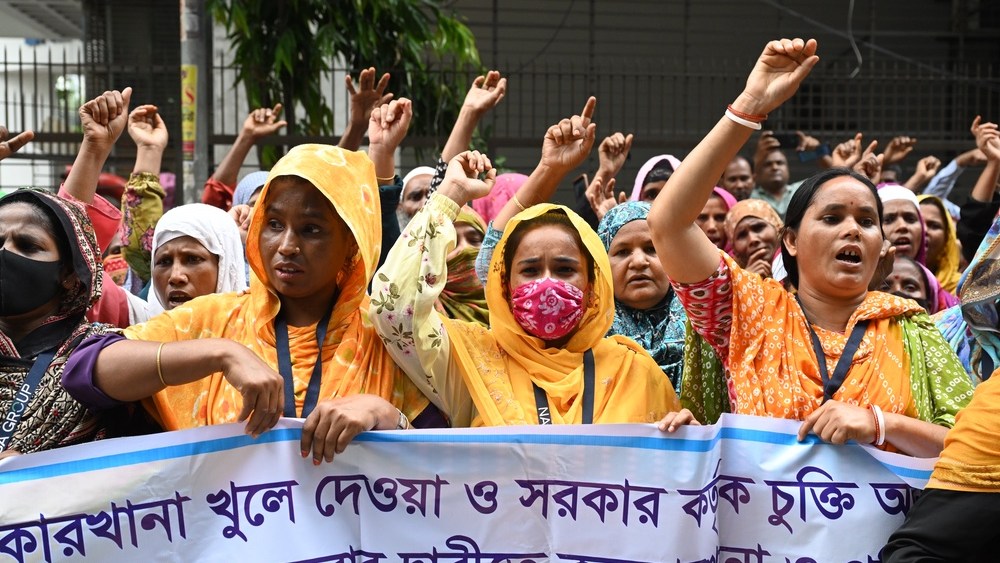
In April 2025, for instance, factory workers protesting unpaid wages and bonuses faced what the ITUC described as violent police suppression that included the use of tear gas to disperse demonstrators.
Bangladesh, therefore, retains a 5-point rating, meaning no guarantee of human rights.
REI’s San Diego store unionizes
REI’s San Diego store, the outdoor retailer’s third-largest in the country by revenue, has voted to join the United Food and Commercial Workers Union Local 135 to lobby for fair pay, predictable and consistent scheduling and improved working conditions.
“It’s been a long road, but we all want to make REI the best version of itself that it can be, and that is what brought us to this moment,” said Jae Michael, one of the store’s employees. “We are the ones stewarding the values of this co-op every single day, especially when we cannot rely on executive leadership to do the same. With our union, we’ll have a say in the decisions that affect our jobs and our lives.”
Last month, REI Union workers launched a 10-day boycott of the company’s Anniversary Sale to protest what they call the outdoor retailer’s “bad faith bargaining” after negotiations in Chicago reached an impasse in April.
San Diego employees appear to share the same concerns as their unionized colleagues in New York City, Boston, Chicago and elsewhere.
“We’re unionizing because REI has continued to take more and more away from its members by cutting member benefits, rights, products, and services, all while increasing CEO pay,” said Juanpablo Contreras, another worker at the store. “We aren’t asking for much—fair pay, health and safety protections, and a return to REI’s values, not just for workers, but members too.”
Cambodian workers injured in road accident
More than two dozen workers were injured in Cambodia on Thursday after a truck transporting them to their factory in southeastern Svay Rieng province overturned, a government official said.
Sun Mesa, a spokesperson for the Ministry of Labor and Vocational Training, blamed brake failure for the rollover.
The accident follows two separate traffic accidents in the Southeast Asian country last month that killed at least 14 garment factory workers and injured 79 others, most of them women. The first took place in Kampong Chhnang province, 37 miles north of Phnom Penh, after a heavy cargo truck crashed into an open-top truck also transporting workers to their factory. The second collision occurred in Svay Rieng when a bus carrying workers swerved off the road and flipped over.
While flatbed trucks are a common mode of transporting workers, they often lack seats, forcing passengers to stand and increasing their risk of injury or death in a crash.
Cambodia also has one of the highest road fatality rates in Southeast Asia, according to the Asian Transport Observatory, with some 3,000 deaths annually and roughly 2.3 percent of all deaths.
Child textile workers rescued in India
Nearly 40 child laborers, aged 12 to 14, were rescued from multiple textile units in Surat, in India’s western Gujarat state, where they were allegedly cutting and folding fabric, police said last week.
A Surat district task force made up of officials from multiple departments, including the Child Labour Department, Factory Department, Child Welfare Department, police and Surat Municipal Corporation, carried out joint raids at several textile facilities after receiving a tip-off.
Following a Child Welfare Committee order, authorities sent the boys to V R Popawala’s Children Home in Katargam and the girls to a Girls’ Home in the Ramanagar area.
“We were informed about child laborers who were kept in a long room where they work from morning till evening in the textile units,” Surat Assistant Labour Commissioner Haresh Gamit told the Indian Express. “We found that the textile unit owners rented the floors to run the units. The owners hire child laborers through ‘agents.’ These child laborers stay in the same space, and they work in the same place from morning to evening.”
The 37 children had arrived in Surat from the state of Rajasthan, more than 530 miles north, nearly five months ago, Gamit said.
“We will also take action against the unit owners and will register an offence against them with the local police,” he added. “We are gathering details on the unit owners and agents.”