
On the Line is a weekly roundup of sourcing and labor quick hits in the apparel and footwear industry, from worker protests to boardroom maneuvering, tracking the developments shaping conditions on the factory floor and beyond.
Wage talks redux
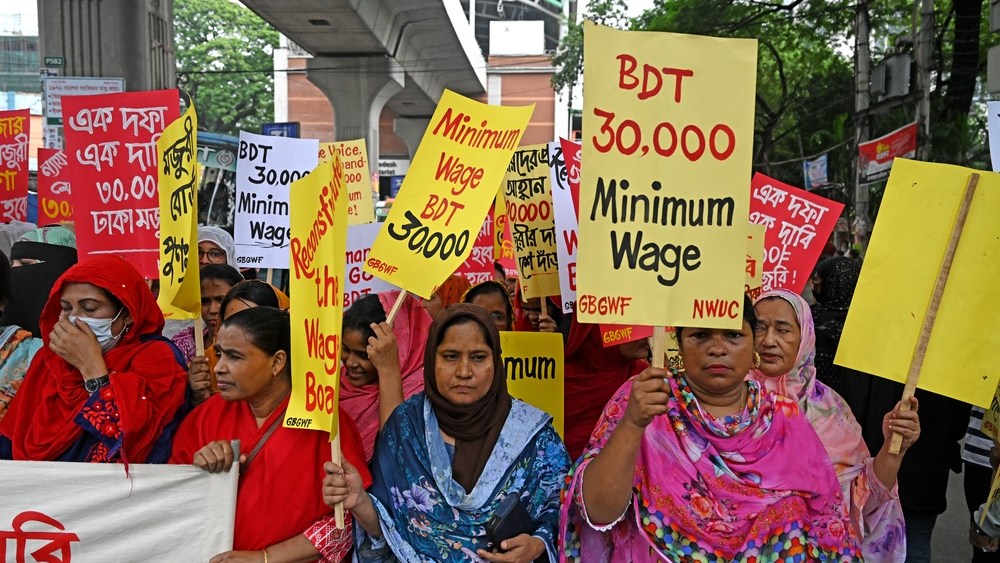
The Bangladeshi government will soon form a wage board to determine a new minimum wage for garment workers, labor and employment secretary Md. Abdur Rahman Tarafder said last week, countering a push by manufacturers to delay the next mandatory review until 2028.
Noting that nominations for worker and employer representatives are underway, Tarafder expressed hope that a gazette notification could be published by the end of October, after which the board would begin negotiations. He also said the board would consider Bangladesh’s overall economic situation, wage rates in neighboring countries and conditions in factories when setting the new floor pay.
The country’s current monthly minimum wage of 12,500 Bangladeshi taka ($101) was set in November 2023 following a wave of mass, frequently violent protests, during which workers and labor groups called for a basic wage of 23,000 taka ($186) amid rising inflation.
Similar disruptions have spread steadily across Bangladesh’s industrial zones since August, driven by sudden factory shutdowns, widespread layoffs and employers’ failure to pay wages and other dues. Last week, at least 50 people, including 19 police personnel, were injured after police used tear gas, water cannons and batons to disperse garment workers demanding unpaid wages and higher pay in Dhaka’s Uttara area. Earlier in the month, workers from several garment factories took to the streets in Uttara for four consecutive days, calling for a minimum wage of 30,000 taka ($243) as living costs continue to spiral.
Turkish shutdown
TYH Tekstil, a major apparel manufacturer headquartered in Istanbul, announced this week that it has closed seven of its 13 factories in Turkey and laid off 5,000 workers.
Selçuk Mehmet Kaya, the company’s chairman, cited escalating production costs, high inflation and exchange rate pressures affecting Turkey’s ready-to-wear and textile sectors as reasons for the contraction, saying that “unfortunately, we are among those most severely affected.” He added that TYH Tekstil, which has entered a court-supervised debt restructuring process aimed staving off bankruptcy, will focus on technical textiles and high-value fabrics at its remaining facilities.
The shutdowns follow the suspension of operations in September and the October closure of Turkish denim giant Orta Anadolu after 73 years in business. Reflecting systemic strains in Turkey’s textile industry, it too pointed to an unsustainable operational model driven by difficult economic conditions and rising supply chain costs.
“In recent years, the global textile sector has faced severe headwinds, including weakening global demand, rising operational and financing costs, supply chain fluctuations, and shifting trade dynamics,” the company wrote on its website last month. “Despite our comprehensive efforts—such as cost reduction initiatives, operational efficiency measures, and restructuring evaluations—unfortunately, it has been concluded that the current operational model is no longer sustainable under these economic conditions.”
Cambodia closure
The unexpected closure of a glove factory in Cambodia’s Kandal province has left 200 workers facing financial distress and initial uncertainty over legally required compensation, according to local media.
Cambodianess, which is operated by Cambodian Media Broadcasting Corporation, reported that Sahakreas Create Bridge Company agreed to pay workers outstanding wages, severance, seniority indemnity and other statutory benefits only following intervention by Cambodia’s Ministry of Labour and Vocational Training. Eight workers, however, declined the initial offer and continued to negotiate, alleging they were owed additional entitlements including travel allowances, public holiday pay and compensation for insufficient notice, though the ministry said they were seeking amounts beyond legal requirements.
Moeun Tola, executive director of the Center for Alliance of Labor and Human Rights, the labor group also known as CENTRAL, told the outlet that further factory closures could deepen job losses and make it harder for displaced workers to find new employment under already challenging conditions. In July, the Thai-owned Hi-Tech Apparel factory in the Poipet O’Neang Special Economic Zone suspended operations and laid off over 2,500 workers due to declining brand orders and disruptions from the Cambodia-Thailand border closure. Chinese-owned ML Intimate Apparel closed in April, leaving nearly 700 workers without employment or final wages.
Workers who lose their jobs without warning bear the brunt of factory closures, Tola said. He added that employers are less likely to comply with labor laws during shutdowns if workers don’t publicly challenge their decisions, especially on social media.
Union deal
The John Lewis Partnership, known for its high-end department stores and supermarkets in the United Kingdom, has signed a collective agreement with the Union of Shop, Distributive and Allied Workers, marking the company’s first trade union recognition deal in nearly 100 years.
The agreement, which takes effect at the end of the month, covers workers across John Lewis & Partners, Waitrose and John Lewis Money. It recognizes USDAW for statutory consultation, including on health and safety, equality and training. Pay and other employment terms and conditions will continue to be handled directly between the employee-owned partnership and its staff.
“This agreement will sit alongside our commitment to democratic principles, and will complement our existing democratic structures,” Jason Tarry, chairman of the John Lewis Partnership, said in a statement. “Our partnership council and forums remain the cornerstone of ensuring all voices are heard in our employee-owned model, giving partners real authority to hold leadership to account and shape the decisions that affect us, both now and in the future.”
The move comes ahead of legislative changes under the Employment Rights Act 2025 that will require employers to facilitate trade union access to workplaces in the United Kingdom.
“Trade unions have a positive impact in the workplace, providing staff with support, advice and representation, while giving them a collective voice, and we urge other retailers to follow the lead of John Lewis Partnership by engaging with us,” said USDAW general secretary Joanne Thomas.


