On the Line is a weekly roundup of sourcing and labor quick hits in the apparel and footwear industry, from worker protests to boardroom maneuvering, tracking the developments shaping conditions on the factory floor and beyond.
Possible closures
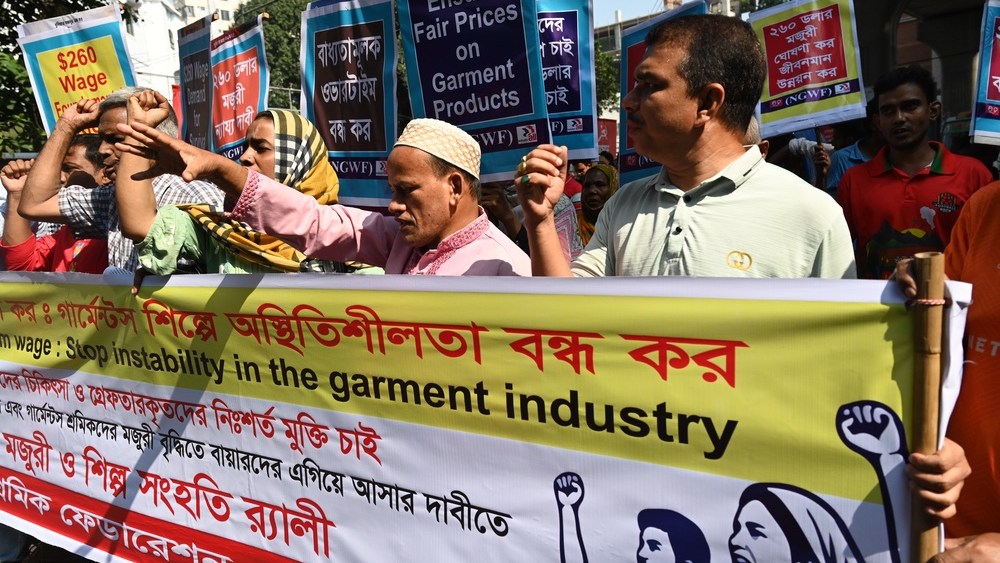
Factory owners in the Ashulia, Jamgora and Hemayetpur areas of Dhaka, Bangladesh’s capital, are weighing the indefinite closure of 210 factories amid continuing labor unrest over demands for a higher minimum wage. Employers plan to make a final decision at an emergency meeting on Saturday, local media reported.
The closures would add to the nine facilities in Ashulia and Savar that were shuttered indefinitely on Wednesday and Thursday after workers refused to report for work, according to The Business Standard. Those shutdowns will affect 200,000 employees, the publication reported.
The factories, as identified by the Department of Inspection for Factories and Establishments, are MM Knitwear, Arunima Sportswear, Newage Apparels, Newage Garments, Kailock Newage BD, Titas Sweaters, Mamun Knitwear, DMC Apparels and DMC Washing.
Under Section 13(1) of the 2006 Bangladesh Labour Act, factory owners can suspend operations indefinitely in cases of labor unrest or circumstances beyond their control. During these closures, workers are not entitled to wages under a principle commonly described as “no work, no pay.”
A senior Bangladesh Knitwear Manufacturers and Exporters Association leader told the Dhaka Tribune that beyond the work stoppages, factory owners had also struggled with vandalism.
“Running factories under these circumstances has become increasingly difficult,” the person said. “Production has remained suspended at some factories for 11 days, leaving owners worried about how they will pay workers’ wages.”
As of Thursday, 200 factories had paused production as tensions continued to flare.
Public commitment
On Thursday, Italian outdoor company Oberalp voiced support for the workers’ demand for a minimum wage of 32,000 Bangladeshi taka ($257), becoming the first—and so far only—brand to do so.
Calling fair wages a “fundamental component of decent work,” Oberalp said the figure was an “important step toward improving the well-being of garment workers and their families” and that it supported regular revisions to statutory minimum wages in Bangladesh to “ensure they remain aligned with workers’ needs and economic realities.”
“We reaffirm our intention to maintain our long-term relationships with our partner factories in Bangladesh,” the company said. “We have no intention of reducing our sourcing activities in the country and will continue to honor our commitments after the increase of minimum wages, including maintaining current and planned orders.”
The Clean Clothes Campaign, the garment industry’s largest consortium of trade unions and civil society organizations, previously called on fashion brands to publicly support the 32,000-taka demand and urge their suppliers to do the same. It also pressed brands to commit publicly to maintaining production in Bangladesh after the minimum wage increases, fully cover the additional labor costs in their purchasing prices and ensure that their suppliers respect the right to freedom of association and refrain from retaliating against protesting workers through violence, criminal charges or blacklisting.
Inflation help
Next Friday, the Bangladeshi government will launch a special Open Market Sale program to offer affordable rice to garment workers squeezed by inflation. Sources at the Ministry of Food told Prothom Alo that the program will initially run for three months, with each worker eligible to buy 10 kilograms of rice per month at 30 taka (24 cents) per kilogram.
The ministry plans to roll out the program across Dhaka, Chattogram, Gazipur and Narayanganj districts, the publication reported.
On Wednesday, the Ministry of Food wrote to the Ministry of Finance seeking additional or special funding for the current 2026-27 financial year. In the letter, the ministry said it regularly sells rice and flour at subsidized prices to stabilize domestic food prices, improve food access for low-income groups and keep prices within their purchasing power.
The rice, the ministry added, will be sold from 75 open trucks every Friday, the weekly day off for garment workers. Each truck will carry five metric tons of rice, making 375 metric tons available each week.
Call for calm
Bangladesh’s labor unions urged restraint on Friday as protests continued to roil the country’s industrial enclaves, AFP reported. Union leader Meer Abul Kalam Azad warned that “any subversive activities” could “jeopardize the ongoing work of the wage board,” especially after the six-member panel agreed to raise the minimum wage and update the pay schedule for December, allowing workers to receive their first revised salaries in January.
Nazma Akter, president of the Sommilito Garments Sramik Federation, similarly called workers to “be responsible.”
“A minimum wage board has been formed, and the board is moving quickly,” Akter told AFP. “If they cannot secure the support of the workers, the wage board may not be able to move forward.”
On Thursday, workers from several factories blocked the Dhaka-Tangail highway in the Mouchak area of Kaliakair, Gazipur, bringing traffic to a standstill until police and Border Guard personnel dispersed the protesters using sound grenades.
Mahmud Hasan Khan, president of the Bangladesh Garment Manufacturers and Exporters Association, told the Dhaka Tribune that wage negotiations could not continue while unrest persisted at factories, adding, “If the situation does not improve, we will take decisions in the interest of the industry.”