
The renewed scrutiny surrounding potassium permanganate (PP) has brought a familiar question back to the denim industry: What will replace PP?
It is an understandable question. PP became a standard because it could create the localized bleaching, contrast and worn effects the market wanted with a combination of speed, consistency and cost efficiency that few processes could match. Its use continued even as concerns around worker exposure, chemical handling and potential restrictions became increasingly difficult to overlook.
But searching for the next PP may be the wrong starting point.
The question assumes that one product must take the place of another while the rest of the finishing process remains largely unchanged. That is often how the industry approaches transition: identify the problematic input, find an alternative and insert it into the same workflow. Yet a direct substitution can preserve many of the limitations of the process it is intended to improve.
A more useful question is whether the workflow itself still makes sense.
Denim finishing has been through this shift before. Stone washing was once closely tied to pumice stones. Vintage effects depended heavily on manual scraping. Bleaching was routinely associated with hypochlorite. These methods did not lose ground because they stopped producing the desired result. They lost ground as other technologies became more precise, repeatable and compatible with changing expectations around safety, resources and industrial control.
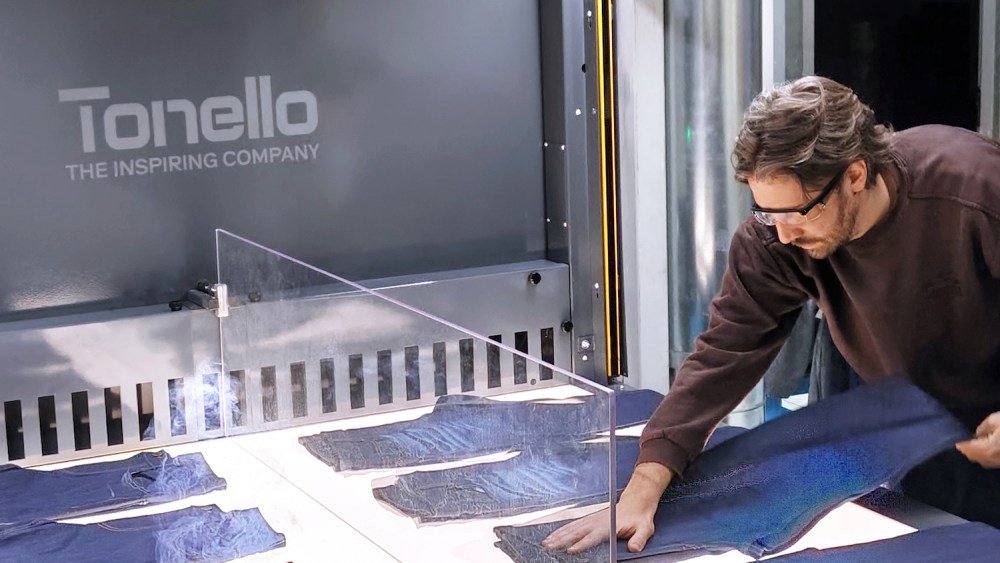
At Tonello, we have watched this evolution unfold over more than four decades. Laser technology reduced the need for manual abrasion. Ozone created a different pathway to bleaching and decolorization. NoStone challenged the idea that a stone-washed look necessarily required stones. None of these developments began by asking how to preserve an existing step. They began by reconsidering why that step was there in the first place.
That same thinking now shapes many finishing trials. The brief may still begin with an aesthetic reference, but it increasingly includes a second challenge: Can the look be achieved without PP, hypochlorite, pumice stones or hand scraping?
The answer is not always simple, and it rarely comes from a single technology.
Chemistry remains essential. Chemical suppliers are developing increasingly sophisticated products, while machinery, software and process control continue to improve. Some of the most credible advances are emerging where these areas overlap. The result depends not only on the chemical being used, but also on how it is applied, how the garment was dyed, how the fabric responds and how each stage of the process is controlled.
In many applications, for example, laser and ozone can work together to create localized contrast and bleaching effects traditionally associated with PP spray. This is not a universal replacement. Fiber composition, dyeing route, garment construction, shade and production conditions all influence what is technically and economically possible.
What has changed is the number of viable options available to laundries.
For years, PP remained central because it was familiar, effective and inexpensive. That balance is shifting. Brands are asking more detailed questions about chemical use and worker safety. Laundries need greater repeatability and process visibility. Technologies that were once considered niche are now established industrial tools, and the expertise required to combine them is becoming more widespread.
Regulation may accelerate the transition, but it is no longer the only reason to reconsider PP. Process control, workplace conditions, customer requirements and long-term competitiveness are already pushing the industry in the same direction.
Whether PP disappears entirely is not the most important point. What matters is that it no longer needs to be treated as the default starting point for achieving contrast.
The denim industry does not necessarily need another product that behaves exactly like PP. It needs better ways to design the effect from the beginning.
About the author
Alice Tonello is chief brand and strategy officer at Tonello, an Italian company specializing in garment finishing technologies. She has played a key role in the company’s evolution from a machinery manufacturer into an international reference point for denim and garment processing.
She also leads the Tonello Research Centre, where a multidisciplinary team works with brands, laundries and manufacturers to develop new finishing processes and explore emerging aesthetic and technological directions. Her work brings together fashion, technology and industrial application, with a particular focus on more responsible and innovative approaches to garment finishing.