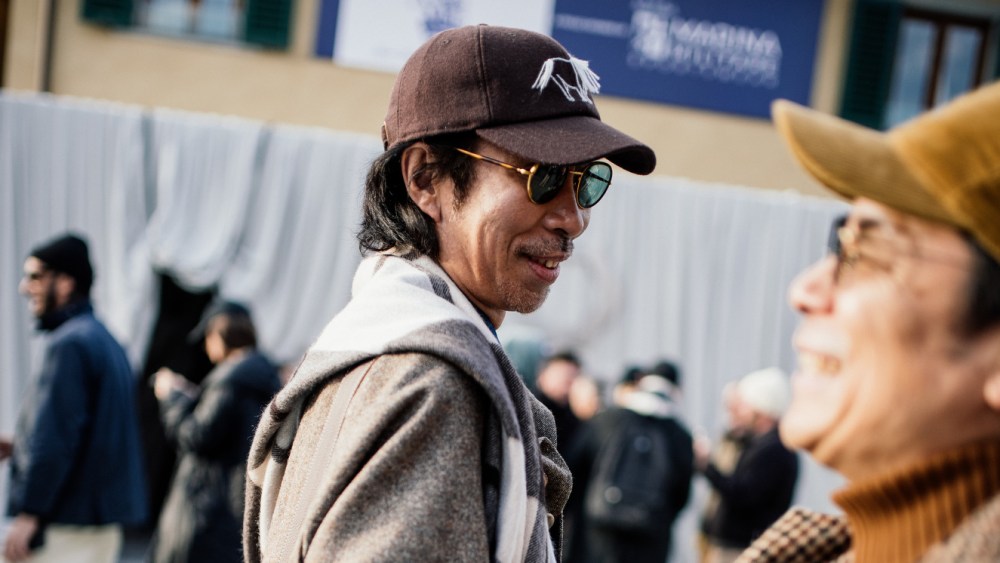
Leave it to the ever-optimistic Raffaello Napoleone, chief executive officer of Pitti Uomo and its parent company Pitti Immagine, to send a positive message to fashion professionals even amid a global downturn in luxury spending that has yet to reverse its course.
The menswear trade show’s organizer is confident that the upcoming edition — which runs Tuesday through Friday — will meet buyers’ and attendees’ demand for newness, without any compromise on the quality standards the fair has become synonymous with.
“This season’s theme is ‘motion,’ a direct reference to the industry’s need to react and work hard,” Napoleone said in an interview ahead of the fair’s kickoff. “We are very happy because we’ve reached our goal of about 750 qualitative exhibitors, but we remain committed to continue nurturing uncompromised selection and internationalization.
You May Also Like
“People are now traveling when it’s worth the effort. We’ve seen with other trade shows how rushing to sell as many square feet [of exhibition space] as possible is not paying off. Real competition is on content,” the Pitti Uomo CEO said.

To be sure, the Pitti Uomo team has been praised over the years for their scouting ability, mixing brands big and small, established and up-and-coming, or even launching at the fair.
“Our DNA is rooted in an Italian and European sensibility, but the offering is very international. That’s always been our trajectory,” Napoleone said. “Over the past months we’ve visited new markets that we had overlooked in the past, where we see interesting growth opportunities,” he added.
The roster of events planned for the fall 2026 edition of Pitti Uomo suggests a renewed focus on Japan, with two of the three guest designers — Shinya Kozuka and the 2025 LVMH Prize for Young Designers’ winner Soshi Otsuki — hailing from the island nation. The third guest designer is the Paris-based Hed Mayner.
“It’s a distinctive trait of Pitti Uomo to be able to scout interesting phenomena and trends that can bring about cultural relevance and business opportunities,” he noted, singling out another example, the Sebiro Sanpo event, the Japanese “suit walk” parade planned for Tuesday, its first iteration outside Asia.

Although the trade show’s offering will be organized around the usual five sections — including Fantastic Classic, Futuro Maschile, Dynamic Attitude, I Go Out and Superstyling — Pitti Uomo is spotlighting six guest nations, reprising its collaborations with key institutional fashion associations globally for regional spotlights. These include China Wave, Code Korea, Scandinavian Manifesto, J Quality, and Japan Leather Showroom for Japanese ready-to-wear and leather accessories brands, respectively, as well as the Promas and ICEX areas, dedicated to French and Spanish labels, respectively.
“Our commitment is always to bring newness via interesting projects and initiatives. I believe our offering really reflects originality and uniqueness,” Napoleone said. To wit, both Soshi Otsuki and Shinya Kozuka are making their international runway debuts at the Florentine fair.
The fair will also unveil a new space called HiBeauty, dedicated to fragrances, a reflection of the growing intersection in stores between that category and fashion.
“The motivation and appeal of the fair is fueled by the numerous different projects we provide each season. Together they conjure an event one doesn’t want to skip, because it would mean losing a good chunk of information on the current state of menswear,” Napoleone said. Reinforcing that message, he recalled how Sir Paul Smith asked organizers to visit the fair’s pavilions the season before he would join Pitti Uomo as its guest designer in June 2024.
“Any Pitti Uomo attendee returns home enriched, with information, networking and relationships. That’s tangible at the fair; in the span of 48 hours one gets to discover brands ranging from Brunello Cucinelli to up-and-coming, international ones,” he said.
His promise to deliver another standout season comes amid a dampened economy and ongoing geopolitical turmoil, which are denting the performance of fashion and luxury.
Preliminary figures provided by Confindustrisa Moda indicate that exports of Italian menswear fell 2.5 percent in the first nine months of 2025 to 6.9 billion euros, dented by a negative performance in markets outside Europe with a decline of 6.9 percent.
Exports to other European countries in the period ended Sept. 30 were up 2.6 percent. Overall, France, Germany and the U.S. were the three top Made in Italy importing countries in the January to September period, the research note said. Menswear exports to the U.S. increased 4 percent, whereas those to China and South Korea fell 16.7 percent and 18.9 percent, respectively.
The only bright spot in Asia was represented by Japan, up 4.6 percent compared to the same period in 2024, while the United Arab Emirates lifted the Middle East region with a 4.9 uptick in exports.

Although 2025 menswear sales are expected to see a contraction versus the previous year, the sequential improvements in the third and fourth quarters cast some hope on the sector.
“Menswear is enjoying a better response than womenswear, it’s proving more resilient to evolving market conditions,” Napoleone contended.