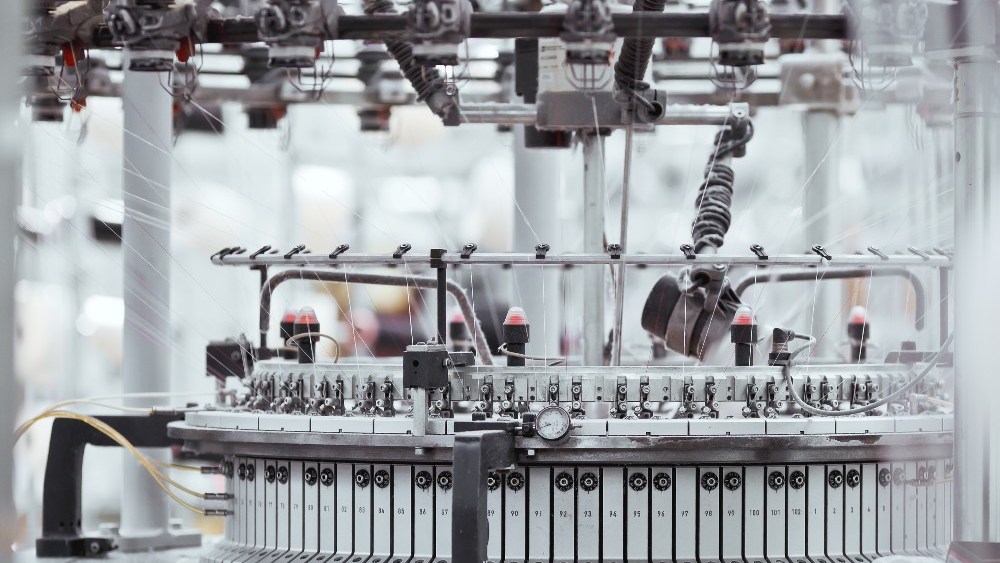
Textile mills experienced growth in new orders and production during the month of October.
The Institute for Supply Management’s Purchasing Manager’s Index (PMI), released Monday, showed that overall, American manufacturing activity remained in expansion territory last month. Registering at 55.5 percent in October—1 percentage point over September’s figure—the data shows the economy expanded for the 24th consecutive month in a row. A Manufacturing PMI above 47.5 percent indicates expansion.
“Of the five subindexes that make up the PMI, four (New Orders, Production, Supplier Deliveries and Inventories) grew faster than the previous month, while Employment growth slowed down by 0.3 percentage point,” wrote Susan Spence, MBA and chair of the ISM Manufacturing Business Survey Committee.
New orders were up for the 10th month in a row, hitting 55.5 percent in October (compared to 55.3 percent in September). The Production Index hit 59 percent, 2.3 percent higher than September—and the highest rate recorded since November 2021. The Prices Index continued to increase, reaching 75.2 percent (a 2.7 percentage point decrease from September), while order backlogs registered 54.6 percent, down 1.8 percent from the month prior.
Despite the mostly positive growth, general sentiment worsened for the third consecutive month, with 34 percent of comments in the positive range and 66 percent registering negative. Those with a pessimistic outlook cited pricing volatility (62 percent), longer lead times (41 percent), tariffs (25 percent) and the Iran war (21 percent), with most respondents mentioning multiple of these factors.
Spence said ISM was “encouraged with new orders, new export orders and production continuing to improve” during a conference call Monday, but admitted that “we’re sensitive to the loss of growth in employment and the backlog drop, as well as the continued pricing volatility. So, you get the increase in negativity.”
ISM research manager and PMI reports analyst Kristina Cahill added that “the current chasm between Manufacturing PMI data and sentiment could be as wide and lasting as ever,” according to ISM’s blog.
Notably, inputs—which are defined as supplier deliveries, inventories, prices and imports—were mixed, the group’s data showed, with the Supplier Deliveries Index up 0.1 percentage point, the Inventories Index growing 2.8 percent (again hitting expansion territory), and the Prices Index down 2.7 percentage points. The Imports Index went up 1.9 percentage points to 52.9 percent from September.
Textile mills were among the 12 manufacturing industries that reported growth in October, putting them in the company of sectors like electrical equipment, appliances, machinery, computers, metals, transportation equipment, furniture, chemicals and food, tobacco and beverages, among others.
For new orders, textile mills actually led a pack of 11 other industries in terms of reported growth in new orders, and the sector took the No. 4 out of 11 spot when it came to production growth. The textile sector was one of just two industries—the other being paper products—that reported that supplier deliveries were faster in October.
However, it was one of seven industries that reported higher inventories for the month out of 18 assessed, and it was among 16 industries that reported raising prices. Despite having higher inventory, textile mills were No. 1 among 11 industries that reported having order backlogs.
While responses from textile mill weren’t included in the ISM’s release, other insights illuminated some of the universal hurdles faced by U.S. producers across the board.
“Economic policies coming out of Washington continue to weigh on business conditions. Customers are unwilling to make commitments to anything other than the shortest term due to the vast uncertainty,” one fabricated metal products manufacturer said. “Canadian tariffs continue to damage small U.S. businesses selling into that important market.”
With a deeply integrated North American supply chain for textiles and sewn products that spans the U.S. and Canada, U.S. textile producers have expressed increasing worry in recent months about the impacts of steep new tariffs on the industry’s ability to continue to operate collaboratively.
“Though not a presidential election, the election-year dynamic has begun to take hold a bit. Canadian tariffs continue to have a negative impact on steel,” one metals producer added.
“Material shortages abound. Fuel remains high. Uncertainty remains constant,” they said.