LONDON – Big changes often start with tiny steps, and no one knows better than Priya Ahluwalia, who has worked with Epson on Fashion Play, a first-of-its-kind, doll-sized fashion collection made from textile waste.
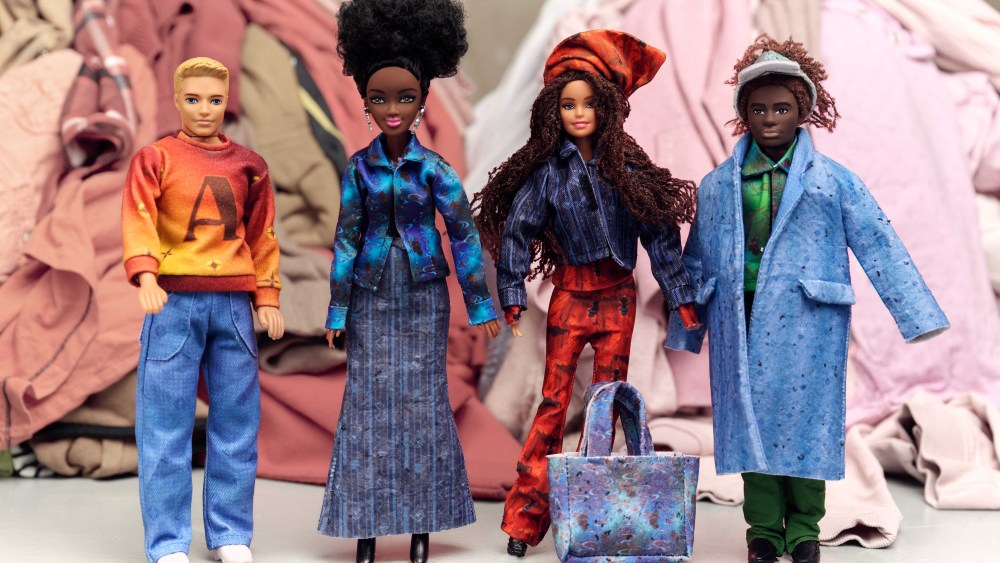
The miniature collection features two men’s and two women’s looks inspired by Ahluwalia’s fall 2025 designs, and using Epson’s new Dry Fibre technology.
You May Also Like
The collection dovetails with new research by Epson showing that 216 million pieces of children’s clothing end up in U.K. landfill every year. The company said it wants the industry and consumers “to rethink how kids’ clothes are made and bought.”
Epson also wants to showcase how its new, and still experimental, technology can give discarded textiles a new life by creating new fibers from old fabrics without using water or harsh chemicals.

Epson also used its Monna Lisa digital printer, which reduces water consumption by up to 97 percent, to color print the fabrics.
Maria Eagling, chief marketing officer at Epson, said the miniature collection is “a playful nod to our love of dressing up – which starts when we are children. But using methods and materials such as these could make a seismic change to the fashion industry and planet.”
Ahluwalia, who regularly works vintage and deadstock fabrics into her London Fashion Week collections, said that “traveling to India and Nigeria, I witnessed the true scale of textile waste as a result of the Western second-hand clothing industry. That experience has stayed with me, and I have since endeavored to work in a way that is better for people and the planet, especially in the global south.”
In an interview, Ahluwalia admitted that making the mini-collection was a challenge. She and her team shrunk the patterns from the original collection and then set to work hand-cutting the printed, recycled fabrics that Epson supplied.

“It was very fiddly – especially making the pockets on the coats – but it was fun,” said the designer, adding she welcomed the opportunity to work with Epson.
“I’m always really interested in working on projects that offer solutions, or where I’m testing new technology to make clothes in a better way. It’s actually very rare as an independent designer to be able to get access to [new technology] because when things are being trialed, it’s always on a huge scale,” she said.
She added that, going forward, the Epson fabrics will be an interesting proposition for show set design in particular. “It’s quite a durable material. With set design, I always rent, and I like using pre-existing things, but this gives us the opportunity to play around with bespoke printing in a set design.”

Ahluwalia is sticking to her green guns, but said she’s concerned about “the ebb and flow” of sustainable fabrics in fashion.
“I can definitely feel that people are not as interested in sustainable fabrics as they once were. It’s really difficult, because a lot of what is available now is recycled polyester, but I have noticed that consumers are not so into buying polyester. We’ve definitely reduced our use of it, and now we’re really focusing on natural fibers. And we’re still working with vintage and deadstock fabrics,” she said.
She added that working with Puma on clothing and footwear collections also gives her access to more sustainable materials. “Puma has the meterage. They can buy as many meters [of something] as they want. The bigger businesses are the ones that can move the needle,” on sustainability she said.