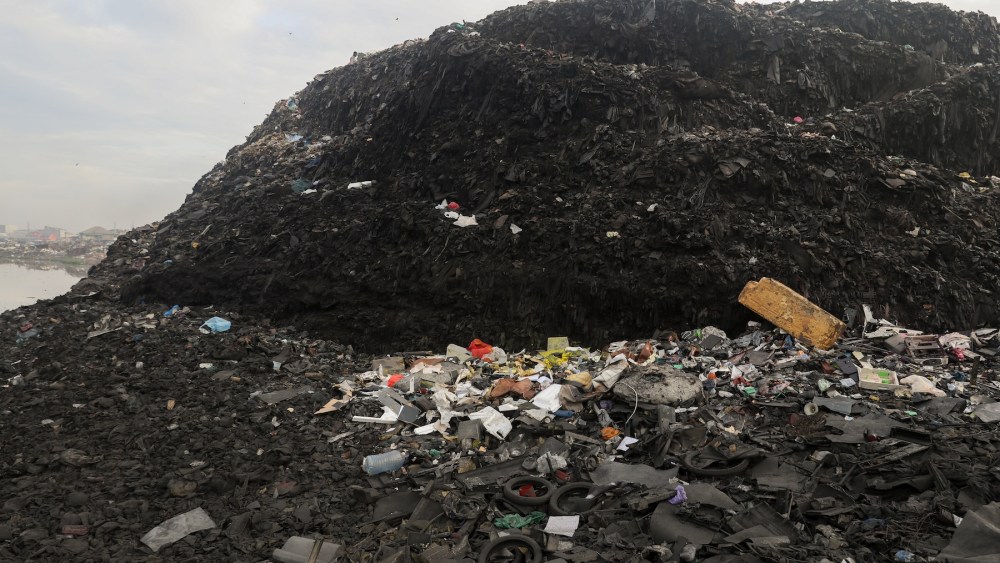
Discarded synthetic clothing released an estimated 878,000 metric tons of microplastics into the environment in 2024—nearly four times the modeled total in 2000, according to a report from Earth Action.
The estimate includes garments disposed of over decades that continue to fragment in landfills, dumpsites and the open environment. The report puts the 2024 leakage range at 588,000 to 1.11 million metric tons, reflecting variation in the model’s inputs.
“The microplastic footprint of clothing does not end when a garment leaves our wardrobe,” Julien Boucher, Earth Action’s co-founder and head of research, said in a statement accompanying the report. “Discarded synthetic clothing is a ticking time bomb. What is already in waste sites will keep breaking down for generations, and every year we add more, increasingly in countries least equipped to contain it.”
Cotton Incorporated commissioned and funded “The Microplastic Ticking Time Bomb.” Its chief sustainability officer, Jesse Daystar, co-authored the report, while Cotton Incorporated’s experts reviewed it.
“A synthetic shirt can keep shedding microplastics long after its last wash,” Daystar said in a statement accompanying the report.
Boucher told Sourcing Journal in written responses that Earth Action, a Switzerland-based research consultancy, set the scope, selected the data, led the modeling and analysis and drew the conclusions. He said Cotton Incorporated had no right to approve or change the conclusions. The two organizations agreed on a publication date, and no other organization provided financial or in-kind support, he said.

The assessment combines fiber production, clothing trade, waste management and climate data with published research on plastic fragmentation. It follows the synthetic portion of apparel, including blended garments, after disposal.
Discarded synthetic clothing produced an estimated 2.4 million metric tons of microplastics in 2024. Much of that plastic stayed inside waste sites, where it could leak out later.
Garments dumped in the open accounted for about 5 percent of the synthetic apparel deposited to date but 90 percent of estimated leakage in 2024.
Synthetic clothing left in the open could shed half its mass as microplastics in about four years, the researchers estimate. For buried clothing, they put that period at 60 to 112 years. The plastic remains in smaller pieces.
Landfill covers shield waste from sunlight. Collecting and treating the water that drains through it can keep microplastics from escaping. The model assumes those protections keep working for centuries. It leaves out deterioration of liners, covers and drains, which the authors say could allow more plastic to escape.
The researchers used municipal waste data from the World Bank’s What a Waste 3.0 to estimate how countries dispose of clothing. They applied each country’s waste-treatment shares to every year studied, leaving changes in collection and disposal out of the historical trend. In countries that have improved collection and treatment, the model could underestimate how much clothing was dumped or poorly contained in earlier decades, Boucher said.
“The increase since 2000 could be somewhat less steep, but the central finding holds: today’s leakage is driven by decades of accumulated deposits,” he said. The low and high estimates came from changing the model’s inputs. The authors did not calculate statistical confidence intervals or evaluate harm to people or ecosystems.
Independent peer review of the methodology through the Plastic Footprint Network is still pending, Boucher said. He expects the network’s textile fragmentation module and the underlying data tables around the end of 2026, depending on the review. Earth Action is still considering how to make the model available.
“Field data on how textiles fragment in disposal settings remain scarce, and waste statistics are weakest in the regions that receive the most used clothing,” Sarah Perreard, Earth Action’s co-founder and stakeholder engagement lead, wrote in the report’s foreword.
Earth Action compares its estimate of 707,000 metric tons of microplastic leakage in 2019 from clothing discarded over decades with a previous study’s estimate of about 110,000 metric tons from manufacturing and washing that year. For what it’s worth, the earlier estimate for manufacturing and washing covers releases to water. Earth Action’s model covers land, air and water. Boucher said the comparison leaves out fibers shed into the air while clothes are worn because no global estimate exists for those releases.
Earth Action estimates that Europe and the United States sent about 1.35 million metric tons of used synthetic clothing to regions it classifies as lower income in 2024. Just 14,400 metric tons moved the other way. Worldwide, the model estimates that 14 percent of synthetic clothing waste was disposed of outside the country where the garments were originally used.
Those flows include clothing traded for reuse. The model assumes imported garments are discarded in the year they arrive because the researchers lacked data on how long the clothes stay in use. Allowing for a second period of wear would shift some leakage in importing regions to later years, Boucher said.
Marie France de Crécy, head of L’Upcyclerie at Caritas Geneva, said in a comment included in the report that “the volumes of donated clothing far exceed both what we can sort and what the local area needs.”
Earth Action estimates that 45 percent of the 2024 leakage came from clothing discarded in Sub-Saharan Africa. It put East and Southeast Asia’s share at 18 percent and South Asia’s at 15 percent.
“Responsibility for their afterlife, therefore, cannot end at the point of sale,” Katia Osei, head of environmental justice at The Or Foundation, said in the report.
Earth Action estimates that waste deposits still contain 284 million metric tons of synthetic apparel that has yet to fragment, alongside 27.4 million metric tons of microplastic already formed but retained within them.
The researchers estimated outdoor fragmentation rates from short laboratory tests. For buried clothing, they relied on studies of other plastics. They also assumed openly dumped garments receive full sunlight. Boucher said the 2024 estimate was most sensitive to the share of synthetic textiles used in apparel, how quickly garments break apart in sunlight and how much synthetic clothing people consume in lower-income countries.
Shaded piles of discarded clothes would release less microplastic each year and keep leaking for longer, Boucher said. He gave no figures for how much shade or longer use of imported clothes would change the 2024 estimates worldwide or by region.
Better waste management cut leakage sooner in Earth Action’s model. When countries with the weakest waste systems shifted to the disposal practices of high-income countries over 30 years, annual leakage in 2100 was 80 percent below the baseline. A separate run put the reduction at 88 percent, assuming almost no synthetic clothing reached waste sites by then.
“The most immediate lever for brands is keeping garments in use for longer,” Boucher said. He pointed to durability, repair, resale, rental and take-back programs.
The report leaves open who should pay to manage the waste. Boucher suggested putting some of the money raised through textile extended producer responsibility schemes toward collection and treatment in countries that receive used clothing.
“Deposited apparel keeps releasing microplastics for decades, so solutions need to cover existing deposits as well as future waste,” he said.