
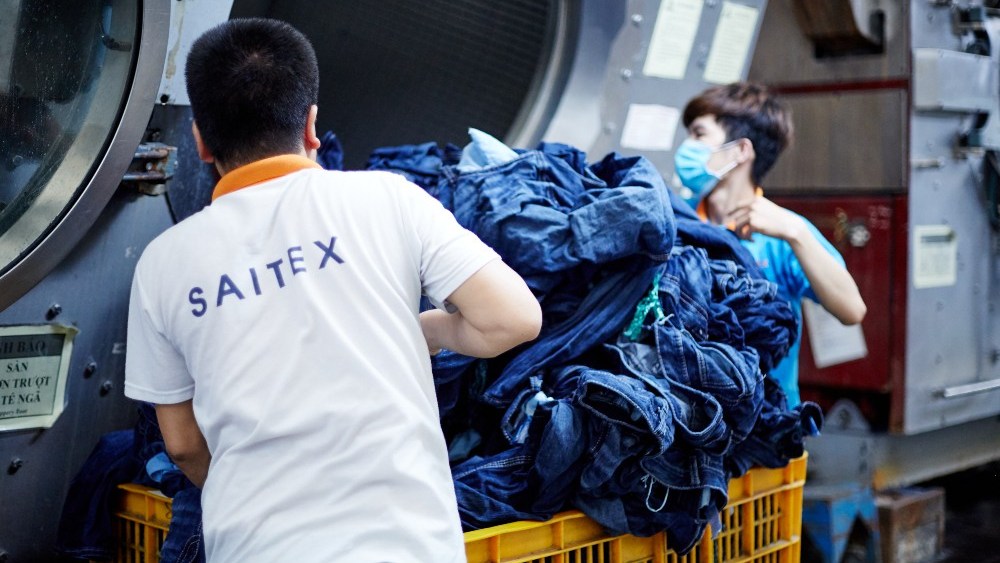
Vietnamese denim manufacturer Saitex saw another year of growth in production and sustainability.
Saitex released its 2025 Impact Report, highlighting gains while also noting where the company fell short on some of its sustainability goals. Saitex Fabric Mill increased production by 22 percent last year, while reducing electricity consumption per meter by the same amount. The denim manufacturer also cut its greenhouse gas emissions per meter by 20 percent, water consumption per meter by 9 percent and waste generation per meter by 25 percent.
The report noted that sludge remained Saitex’s primary source of waste in 2025, and that the company repurposed 40 percent of that waste to produce bricks for garden walkways and concrete blocks for retaining walls. Saitex also worked with sister company Stelapop to transform textile waste into high-performance wood and stone alternatives. In 2025, 8086 kilograms of denim waste from cutting-table offcuts, testing and second-choice samples was converted into 600 boards. Those boards were used to create furniture for Barneys New York in the Ginza district of Tokyo and Keio University in Japan.
Saitex also reported that around 85 percent of its denim fabric production aligns with the chemistry requirements for Cradle to Cradle Certified Material Health Gold, which means 100 percent of a product’s materials and chemical ingredients are proven safe for humans and the environment. The company’s denim production also meets criteria for Bluesign certification, which ensures safe chemicals, low environmental impact and worker safety. Saitex said it also continuously engages with other certifying bodies, such as GOTS, GRS, Renagri, Oeko-Tex and C2CPII.
The report did note that last year, production volumes certified at the Cradle to Cradle Certified Gold Material Health level decreased by 60 percent, while Bluesign-certified production dropped by 30 percent due to the lower purchasing demand. But the company’s use of Better Cotton (BCI) used in its mill increased from 9 percent to 21 percent in response to customer purchasing decisions.
Customer demand also impacted other production factors, such as water and steam consumption, as a higher demand for garment-dyed products, vintage washes and heaver-weight fabrics increased the need for water-based production processes.
The report also outlines how Saitex’s 90/10 formula for onshoring has allowed it to sidestep some of the Trump administration’s new tariffs by bringing 10 percent of production to the United States in its Los Angeles facility while the remaining 90 percent is in Vietnam.
“If 100 manufacturers adopted Saitex’s 90/10 model, the result would be 250.000 new American manufacturing jobs, over $12 billion in annual domestic wages and a $21.6 billion contribution to U.S. GDP,” the report estimated.
Saitex integrated its mill and apparel manufacturing operations into the Made2Flow platform, which enhances data granularity across the company’s vertically integrated manufacturing system. This move allowed the company to provide better product-level life cycle assessment data enabling digital product passport creation across its product portfolio.
Saitex also reported that its regenerative farming initiative on site in Vietnam increased its fruit, vegetable and herb output by 295.8 percent, and in 2024, the company donated 100 percent of the farm’s produce to staff, prioritizing pregnant and breastfeeding mothers as well as cleaning personnel.
The report detailed some misses for 2025, as well, such as delays to renewable energy and infrastructure projects such as planned solar installations and the rollout of closed-loop water systems. The company said the timelines shifted on those projects due to a number of factors, including construction requirements, permitting processes, infrastructure limitations and the continued lack of economically viable battery storage and direct renewable energy access in Vietnam.
Looking forward, Saitex said it will continue investing in renewable energy, circular manufacturing and advanced chemistry, while also focusing on ongoing life cycle assessments and digital product platform creation. The denim producer also set the goal of sourcing 100 percent renewable energy for apparel manufacturing by 2028.
Saitex CEO Sanjeev Bahl said the report is about more than just touting wins—he hopes it can be a guide for other companies looking to incorporate similar sustainability and social responsibility programs into their operations.
“We don’t believe better ways of working should be guarded. We believe they should be shared, tested and improved,” he said. “Our Impact Report is about passing on what we’ve learned, because good ideas are meant to travel.”