When Daniel J. Wellehan Sr. established Sebago in 1946 in Westbrook, Maine, alongside friends and business partners William Beaudoin and Joseph Cordeau, their original ambition was to deliver handmade, versatile and durable footwear.
Little did they know that the seminal Beefroll penny loafer they created would become a global icon, stand the test of time for 80 years, and help turn the brand into a cornerstone of the preppy and Americana aesthetic. In 1970, Sebago introduced the Docksides boat shoe, another hit that would appear on legendary sailor Gary Jobson in the 1983 America’s Cup.
Sebago’s current owner, BasicNet, has committed to preserve that 80-year legacy and ferry it into the future, celebrating the anniversary with several activations this year.
You May Also Like
“Whenever a brand reaches a milestone anniversary, we feel a real sense of responsibility. It means we are not simply managing the brand — we are acting as custodians, and we hope to add meaningful chapters to its history while protecting its heritage,” said Lorenzo Boglione, co-chief executive officer at BasicNet, a title he shares with his brother Alessandro.
“We draw heavily from the archives, because today more than ever it feels relevant to look back at what has been done before. At the same time, we are trying to write the next 80 years of the brand’s story,” he said.
BasicNet’s strategy for Sebago is a case study in revamping heritage brands with a cool undercurrent through a lifestyle proposition. The appetite for the great outdoors and enduring appeal of Americana over the past decade, especially in menswear, have certainly helped it cut through the noise.

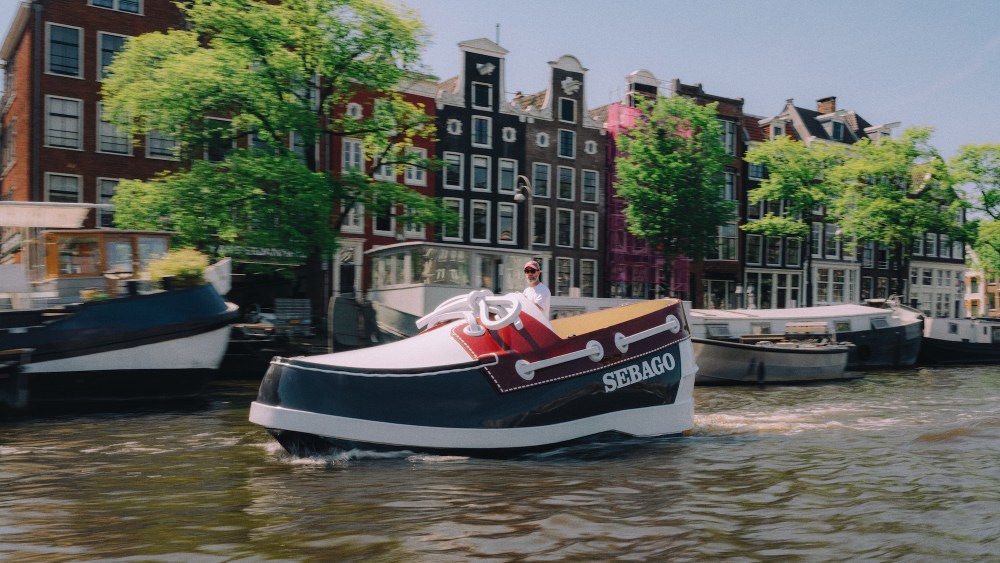
Florence marks the third stop in Sebago’s boat tour along major European waterways, after it touched down in Milan during design week in April and Amsterdam at the end of May.
Built in the shape of the signature Docksides boat shoe, the vessel will sail along the river Arno this week, timed with menswear trade show Pitti Uomo, when the brand will also host a party at the local Circolo Canottieri rowing club.
It sure is a marketing stunt, but an authentic one, Boglione contended.
“When we acquired the brand, there were a number of semi-abandoned assets sitting in warehouses around the world,” he said. “While the transaction was being finalized, our first priority was to secure and register the brand properly worldwide. After that, we turned our attention to those assets, including shoe lasts held by suppliers and, notably, the boat stored in a warehouse outside London, which had served as the European headquarters for the brand pre-Brexit.
“The boat had originally been conceived by the historic Sebago team, and it makes perfect sense. Sebago became iconic through the boat shoe. For years, the boat just sat there as an object of curiosity. But the more we looked at it, the more we understood its beauty, its logic, its instant wow factor and its unexpectedness. Sending the boat around as a design object — a floating billboard — became a natural idea,” he said.
The boat has been fully restored for the occasion and converted to electric propulsion to navigate canals and rivers in four cities that resonate with the brand, for its footprints there or historical link.
“Florence matters because we have just opened a store there and because of the global resonance of Pitti Uomo,” Boglione said.

The boat is just one of the activations planned around the anniversary.
Taking it back to where it all began, the shoe company has launched a Made in USA capsule shoe collection featuring the Docksides. The collection, which was entirely manufactured in the U.S., is offered for men in two colorways and crafted from premium full-grain leather.
“It is really for us an exercise in reconnecting with the brand’s roots and origins. America is growing business-wise, especially on the digital side,” Boglione said. “Commercially though, the line is not really viable. The manufacturing capacity simply is not there, we could not produce 5,000 pairs of shoes in the U.S.,” he explained, without disclosing the number of shoes in the capsule.
Alongside the footwear, the capsule is completed by a selection of leather accessories — coasters, a planner cover, a key holder and a valet tray — all made from leather and produced in the U.S. using traditional artisanal processes.
The Made in USA line is available as a limited edition on the brand’s e-commerce site and in a selection of mono-brand stores in Italy, France and Spain. The accessories will also be available exclusively at the London store.

Beyond storytelling, the move reflects Sebago’s ambitions for the American market. In addition to continued investments in scaling up its digital footprint in the country, the brand is planning a pop-up at outdoor apparel-geared retailer Westerlind in New York as a test for footwear and especially apparel, a category BasicNet has been expanding.
“It’s as a physical test — a way to plant some seeds and see the response. We are also working on collaborations specifically for the U.S. market,” Boglione explained.
Sebago returned to Pitti Uomo in January 2025 after a few years’ hiatus to unveil its 2.0 strategy, hinged on rounding out the brand’s offering with a stronger push on ready-to-wear, a category it had toyed with since the ‘80s with small and sporadic capsule collections.
The recent apparel collections, centered around Americana and the preppy look, seem to be accruing fans, expanding the brand’s appeal beyond the boat shoe and the penny loafer, although footwear remains Sebago’s bread and butter.
“Footwear is growing extraordinarily well and although apparel [sales] are doubling year-on-year, shoes are growing even faster,” Boglione said. “At the same time, apparel helps us educate the consumer around the shoes, and we are convinced clothing is a central part of the brand story,” he said.
As it makes baby steps in the U.S., Sebago continues to cement its presence in Europe, its main market, where retail is catching a strong tailwind.
Over the past 12 months the brand has set up shop in several locations in France, a growing market, including a second unit in Paris, new doors in Nice, Lyon, Biarritz, Arcachon, Toulouse and Dinard, with Bordeaux, Saint-Malo, Rouen and Saint-Tropez set to open by the end of 2026.
In Spain, it relocated its Barcelona flagship, opened a second banner in Madrid, and added new flagships in Sevilla, Malaga, Oviedo and San Sebastián, while Italy welcomed a store in Florence, with Bologna and Viareggio in the pipeline.
The brand operates 30 flagships across Europe, with retail accounting for 30 percent of total sales, including e-commerce. The remainder is wholesale-driven and includes accounts in Asia and the Middle East. BasicNet does not disclose a revenue breakdown for brands in its portfolio, which include Kappa, Robe di Kappa, K-Way, Superga, Sundek and Briko.
Marking the anniversary, Sebago has also launched the third volume of its editorial project dubbed Sebago YearBook centered on the stories and places that have shaped the brand’s identity.
Sebago was purchased by BasicNet from Wolverine Worldwide for $14.25 million in 2017.