
The seismic influence of Japanese fashion on the Western scene back in the 1980s remains unparalleled — many observers credit it with forcing an evolution of Europe’s definition of beauty in clothing.
The soulful menswear à la Yohji Yamamoto, avant-garde deconstructivism in Rei Kawakubo’s creations for Comme des Garçons and the innovative practicality of the colorful Issey Miyake designs have cemented a precise notion of what the island country’s fashion is about.
At the upcoming edition of menswear trade show Pitti Uomo, a new wave of Japanese designers is expected to advance that conversation with Millennial-minded novelty.
You May Also Like
Joining the fair as its “Special Event” project, designer Shinya Kozuka is making his European runway debut in Florence, after unveiling his collections in Tokyo as part of the local fashion week since 2021 and with individual presentations.
The London’s Central Saint Martins’ graduate was born in Osaka and is currently based in the Japanese capital, where he established his namesake brand in 2015.
Praised for the thoughtful approach to form and proportions, Kozuka’s creative process is informed by the overarching concept of “Picturesque Scenery,” in that the designer has a knack for sketching vignettes inspired by everyday occurrences that serve as the narrative bedrock of his collections, each called “Issue.”
The inspiration is often nonlinear and the highly conceptualized storytelling contrasted with the architectural, apparent simplicity of his clothing that is rooted in workwear and tailoring sensibilities. His work is oftentimes reduced to archetypal forms and silhouettes, offering a naive quality of the painterly motifs he hand-sketches on the pieces.

During a lengthy interview ahead of his show, Kozuka said that the one-off Florence show is intended to convey the brand’s “best of” and provide an opportunity for a global audience to discover his world.
“It’s the first time for me to show my collection abroad, so I was just thinking to highlight the fundamentals of the brand, the stronger components and avoid diluting them with too many elements. It’s about showing my characteristics and my character,” he said.
Business-wise, his company’s partner, Shimpei Kajiura, described the Pitti Uomo invitation as a “cardinal point.”
“Our customers hail from around the world and half of our sales are generated outside Japan,” Kajiura said. “But non-Japanese customers who really like our pieces may not be as familiar with our overall world, so the runway show is the best way to express it,” he said.
While details were not provided, Kajiura said that in addition to Japan, Shinyakozuka’s biggest markets include China, the U.S. and Australia. South Korea, Hong Kong and Taiwan are also fairly big, whereas Europe has been lagging behind. The brand operates two stores in Tokyo and has a network of about 100 stockists, including 60 in Japan.
The inspiration for the fall 2026 collection — titled “Issue 9” — started from the lone, single gloves Kozuka would often see abandoned on the sidewalks while walking home late at night in Tokyo, with a beer in his hand.
Viewed as familiar and comforting objects that people easily lose, they triggered the designer’s imagination and overlapped with other references, especially Henri Matisse’s murals inside the “Chapel of the Rosary” in Vence, France, which he visited in the lead-up to the collection’s unveiling in Florence.
In Kozuka’s non-linear thinking, both elements reminded him of everyone’s journey back home — or, symbolically, a return to one’s roots. The lone gloves, like Matisse’s paintings, are seen as guiding lights in the process.
“In my imagination, the glove — once just an inorganic sign one might spot on a walk, like a traffic signal or a street sign — became something organic. Layer by layer, this idea stacked itself together, naturally forming one conclusion: The lone glove is both a home and a lighthouse. It might not make literal sense, but it evokes empathy,” Kozuka said.
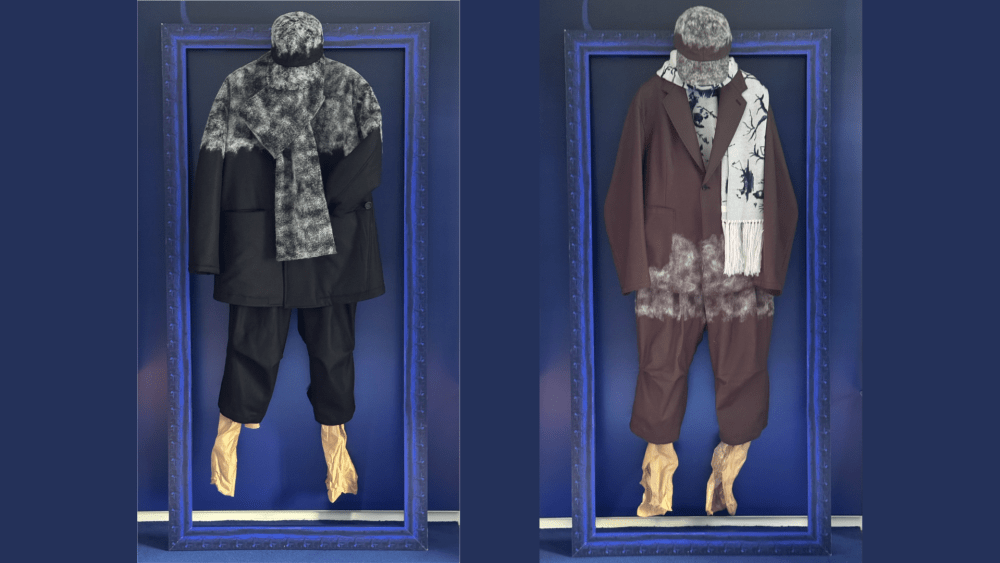
The designer declined to fully elaborate on how exactly all of that translates into runway pieces, to avoid spoiling the surprise, but he said that the concise menswear collection hinges on the baggy bottom and relaxed top combo achieved through 3D patternmaking.
These are the Japanese designer’s forte, conceptualizing his design approach as “fashioning the space between the body and the garments, or the ‘negative space’,” he said.
For fall 2026, soft tailoring layered under melton topcoats mingle with chunky knitwear and accessories, in addition to jacquard denim and printed tops featuring Kozuka’s illustrations and vignettes.
The Japanese winter landscape bathed in snow-covered silence informs the lineup’s color palette, Kozuka said, dominated by muted tones such as black, sepia, white and navy blue, in addition to some unexpected “icy nuances,” he said.

The collection features a range of collaborations including Reebok and Dickies, as well as with Japanese brands such as hatmaker Kijima Takayuki; performancewear label Nanga; accessories brand Tsuchiya Kaban, and apparel firm Anonymous Ism.
The runway show, scheduled for Wednesday at 5 p.m. CET, is to be held at the Magazzino 07 venue, a windowed warehouse inside the Fortezza da Basso fairgrounds.
To some extent, the winter light filtering through the space at sunset is expected to evoke the lighthouse and walking home narratives, coupled with a snow-covered catwalk, but the main reason for the venue choice was its proximity to the fair which the designer expects will ensure a strong turnout.
“We are thinking about doing runway shows in Paris in the future. So, this opportunity is really nice as a first step,” Kozuka said.
It’s also a full-circle moment per se. “I’m happy, because when I was young, I loved Raf Simons’ [work] and I remember seeing his show at Pitti Uomo when I was 20 [in 2016]. I didn’t expect to be able one day to join a trade fair like this and to be showing at a similar space,” the designer said.