
Rwanda and South Africa will be removed from the African Growth and Opportunity Act (AGOA) trade preference program, the Trump administration announced this week.
United States Trade Representative (USTR) Ambassador Jamieson Greer on Monday issued a statement saying that President Donald Trump had notified Congress as well as the governments of the countries in question that he intends to terminate their access to AGOA beginning on Jan. 1, 2027.
“The Office of the United States Trade Representative led the annual interagency review of sub-Saharan African countries’ eligibility for the AGOA trade preference program. Based on the review, President Trump found that the governments of Rwanda and South Africa are engaging in practices that are inconsistent with AGOA’s eligibility criteria,” Greer said.
“These concerning and pervasive practices include, but are not limited to, barriers that undermine American trade and investment and practices that pose a threat to U.S. national security and foreign policy interests in the region,” he added. “The Trump Administration is working to ensure our African partners take the necessary steps to meet the eligibility criteria.”
According to the USTR, the administration is “deeply concerned” about a number of issues in Rwanda at this juncture, including alleged barriers to trade and investment, human rights and worker rights challenges, political pluralism and adherence to the rule of law. According to the federal government’s trade arm, the country has also perpetuated practices that threaten American national security and foreign policy.
While Greer didn’t elaborate, Rwanda’s exclusion from AGOA mirrors a suspension put in place during Trump’s first term in office. In 2018, Rwanda lost its AGOA eligibility due to its own restrictions on imports of used apparel from the U.S.
More recently, Washington has taken issue with the Kigali government’s continued backing of the M23 rebel group in the Democratic Republic of Congo. Last week, the U.S. Treasury Department imposed sanctions on Rwanda’s Ministry of Defense, saying that Rwanda has supported the “deployment of thousands of troops and provision of military equipment, logistics, and training”—accusations the Kigali government denies.
Meanwhile, in South Africa, Greer’s office said that the administration takes issue with certain barriers to U.S. trade and investment, alleging corruption and threats to America’s national security and foreign policy interests.
The president’s decision comes after a prolonged period of tension with the South African government.
Last week, the country was cut out of a meeting of the Group of 20 nations in Atlanta, Ga., and in September, the Trump administration announced travel bans on South African officials it claims have discriminated against Caucasians, a minority group in the country. It’s an issue that’s been championed by Trump acolyte Elon Musk, who claims that white South Africans are routinely persecuted—a claim the country’s government denies.
South Africa, which represents the continent’s largest economy, has been eligible for AGOA benefits including free trade with the U.S. on a wide variety of exports since the preference program was signed into law by President Bill Clinton in 2000. In 2025, it exported around $1.7 billion worth of products to the U.S. market under AGOA, including apparel, cars, agricultural goods and other manufactured items.
South Africa has also faced scrutiny from Washington over its relationships with U.S. adversaries and competitors. Last year, some Republican lawmakers rallied behind a piece of legislation that would oust South Africa from AGOA over its strategic partnerships. It is a founding member of the BRICS Alliance, which includes Brazil, Russia, India and China, all of which have faced mounting tension with the U.S. South Africa has also pushed back on pressure from the U.S. to distance itself from Iran in recent months.
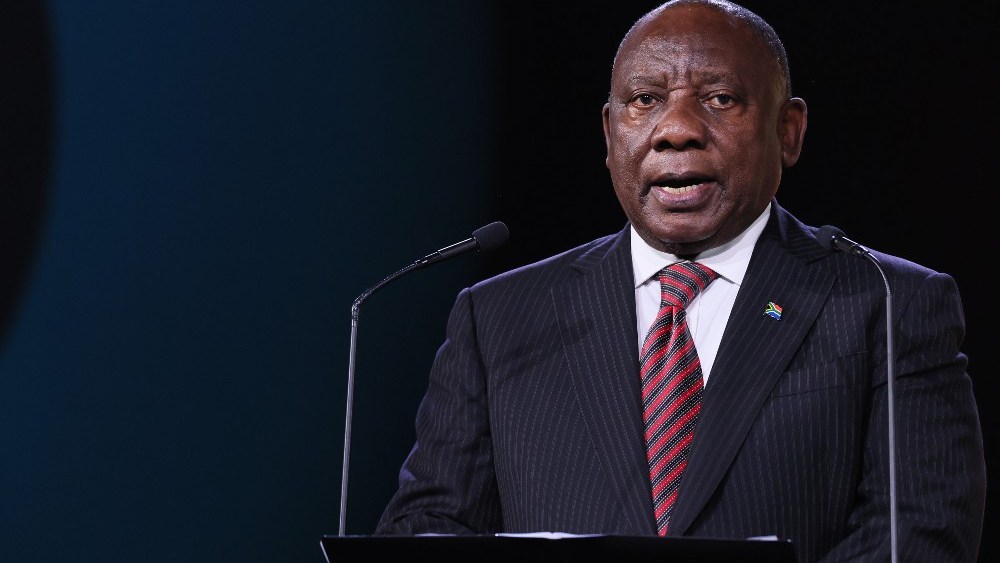
Sensing the potential of an AGOA ouster, South African President Cyril Ramaphosa has advised in recent weeks that the country’s businesses prepare themselves for the loss of duty-free benefits. While Congress voted to extend the nation’s eligibility through 2028 when it extended the trade preference program as a part of the Continuing Appropriations and Extensions Act for 2027, Trump has the final say in eligibility.
“We are not the first and only country to be taken out of AGOA. And I believe we will not be the last,” he said.
Following the news on Monday, the South African government released a statement saying that “AGOA remains important to South Africa, but it does not constitute the totality of the economic relationship between South Africa and the United States.”
Last year, about 89 percent of South African exports to the U.S. entered under most favored nation terms, while 10 percent entered under AGOA (down from 28 percent in 2024, showing that utilization was already slowing).
“This decision does not define the broader relationship between South Africa and the United States, however a solution depends on the willingness of both Parties to find solutions,” South African Trade Minister Parks Tau said. “At the same time, government will support affected sectors, protect South Africa’s national interests and continue pursuing trade, investment and shared economic opportunities with the United States.”


